


Global Ship Lease: First-Half Revenue, Strong Margins and 15 New Ships on Order
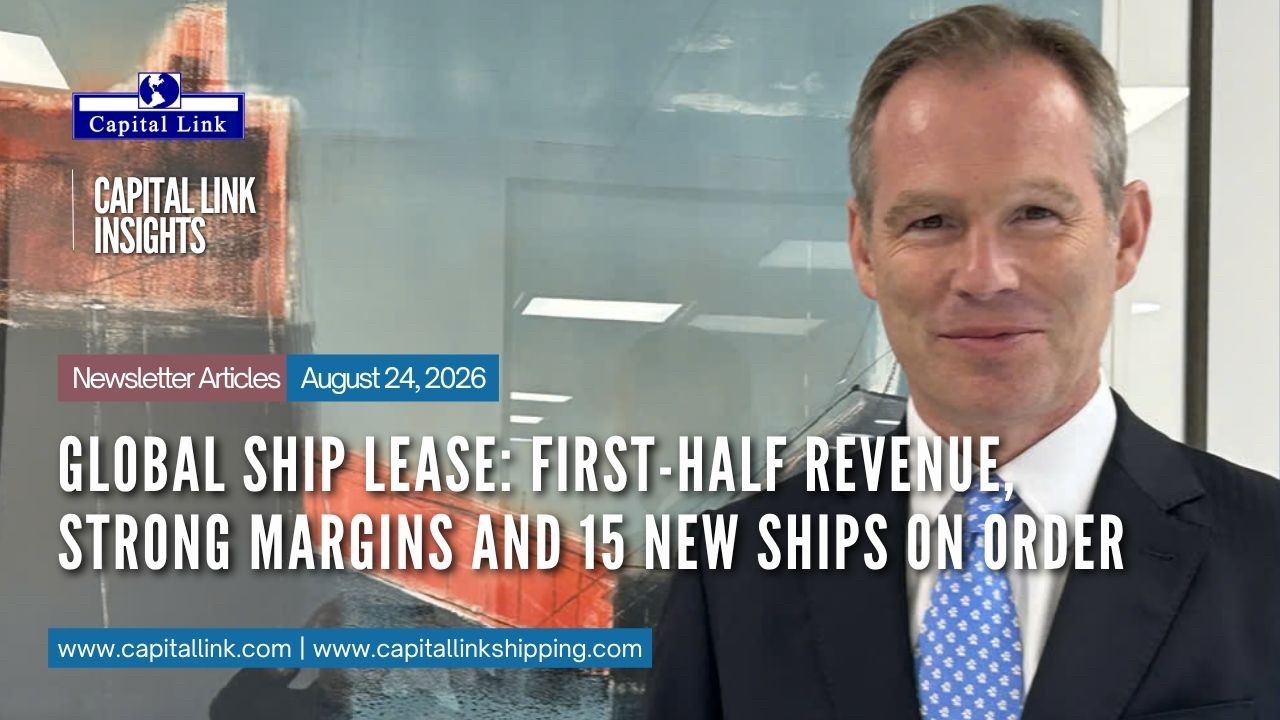

In this episode of Capital Link’s Trending News Podcast, Tom Lister, CEO of Global Ship Lease (NYSE:GSL), joins Capital Link President Nicolas Bornozis, to discuss the company's first-half 2026 results, fleet renewal strategy, and container sector outlook.
Mr. Lister highlighted GSL's strong financial performance, with net income of over $180 million and a dividend yield of around 6%. He detailed the company's 15-ship new building program, emphasizing the strategic focus on mid-size, wide-beam, ultra-high reefer container ships due to their operational flexibility and the aging global fleet in this segment.
Mr. Lister explained that the new builds are de-risked with multi-year charters covering over 75% of their cost, and he discussed the rationale behind the timing of the order. The conversation also covered current market conditions, including geopolitical disruptions and the strong demand for container shipping capacity, with fleet utilization at nearly 100%.
The full discussion can be found here: youtube.com/watch?v=Al5oLlP7tUw
GSL’s Fleet, Financials and Contracted Visibility
The company owns 71 mid-size and smaller containerships, 41 of them wide-beam post-Panamax, chartered to liner operators including MSC, Maersk and CMA CGM. GSL supplies the vessel and the crew and the customer directs the ship and pays for the fuel. Mr. Lister framed the fleet's appeal as optionality. Ships between roughly 2,000 and 10,000 TEU range can call at far more global ports than the handful of hubs that accommodate the largest vessels, an advantage that grows as supply chains fragment under conflict and trade tension. Disruption of that kind tends to stoke demand for capacity, which supports earnings for the owners supplying it.
First-half revenue came to $396.8m with net income of $180.7m, leading Mr. Lister to observe that the Company generates net income at a rate of close to a million dollars a day. Adjusted EBITDA was $264.6m, an EBITDA margin above 65%, on earnings of $5.02 per share. The second quarter contributed $198.7m of revenue, $89.3m of net income and $131.4m of adjusted EBITDA, with earnings of $2.48 per share.
Contract cover stands at $3.2bn over a TEU-weighted average of 3.3 years, with $1.45bn of contracted revenue added in the first half alone. Market capitalization is $1.5bn and the annualized dividend, $2.50 per common share, yields 6% on the share price.
The credit position has moved in step. Moody's rates the company Ba2 with a positive outlook, S&P and KBRA both hold BB+, and $350m of USPP notes maturing in 2027 carry an investment grade BBB from KBRA.
Chokepoints, Demand Growth and Zero Idle Capacity
Asked whether the Strait of Hormuz and the Red Sea are open or closed, Mr. Lister was candid: anything he told the audience would probably be out of date within a day. A handful of liner operators are tentatively reintroducing Red Sea and Suez services, though he noted the ships that normally run that corridor are the larger ones moving between Asia, the Middle East and Europe, so the outcome matters less for mid-size and smaller tonnage. On Hormuz he declined to guess, pointing to seafarer safety as the governing consideration. Global Ship Lease has no vessels deployed in that trade.
On demand, the figure he reached for was volume growth as containerized volumes grew 5% in the first half against the same period of 2025. Real demand, in other words, and not merely demand manufactured by supply chain disruption.
On the question of permanence, his answer was that the uncertainty is itself the argument. As long as the world stays unpredictable, liner operators will want ships that can be deployed anywhere, which is what mid-size and smaller vessels offer.
When it comes to the market cycle itself, considering idle capacity at 0.7% and scrapping close to frozen, Mr. Lister's reading was that the fleet is at full utilization with no slack in the system. Where the market goes next matters less to him than the fact that it starts from full capacity. If rates hold, the existing fleet keeps earning. If asset values correct, that becomes a buying opportunity.
The Reconciliation between EBITDA and Utilization
Utilization improved to 97.4% even as EBITDA came in modestly lower year on year. The apparent disconnect comes down to fleet size rather than weaker operating performance. GSL had monetized four non-core vessels, which were delivered to buyers during the first half of 2025. While the asset sales generated value for the company, they also removed the EBITDA contribution from those vessels from the year-on-year comparison. At the same time, utilization improved as the fleet experienced fewer off-hire days, particularly from drydocking. In other words, GSL had one fewer vessel contributing to EBITDA, but the remaining fleet operated at higher utilization. Mr. Lister noted that the year-on-year EBITDA decline was therefore largely anticipated by analysts, with the company’s results coming in broadly in line with consensus expectations.
Net debt to adjusted EBITDA has fallen to just 0.4x, from 8.4x in 2018, prompting the question of when being de-levered begins to look like being under-levered from a shareholder-return perspective. Mr. Lister’s response centered on the value of maintaining financial flexibility in a highly cyclical and volatile industry. He argued that the combination of cash on the balance sheet and low leverage provides GSL with the ability to both manage downside risk and capitalize on opportunities when they arise. Importantly, being lightly levered today does not mean GSL intends to remain so indefinitely. The company can selectively add leverage when the risk-return profile warrants it, with its newbuilding program providing a clear example: younger assets backed by strong forward cash-flow visibility are well suited to debt financing, allowing GSL to enhance returns while maintaining its disciplined approach to leverage.
On the ratings, he credited a combination of balance sheet discipline, the financial health of the counterparties, and the agencies' reaction to the newbuilding program itself.
Fifteen Ships, and the Strategy Behind the Specification
The order comprises 15 mid-size, ultra-high-reefer, wide-beam, latest-generation containerships, at an aggregate contract price of $1.33 billion, with deliveries scheduled between the fourth quarter of 2028 and the first quarter of 2030. Mr. Lister translated the specification term by term. Mid-size means operational flexibility: the vessels can be deployed as headhaul tonnage or feeders at the operator’s discretion, making them well suited to increasingly fragmented supply chains. Ultra-high reefer means greater capacity for controlled-atmosphere cargoes, among the more valuable boxes carried by liner operators, with this segment growing faster in volume terms than dry cargo. Wide-beam means lower slot costs, as the ability to carry more boxes per vessel reduces the cost per slot. Latest generation means greater fuel efficiency.
More than $1 billion of the $1.33 billion contract price is covered by the adjusted EBITDA expected from the firm charters already attached to the vessels, based on a TEU-weighted average firm charter term of 7.1 years. In other words, more than three-quarters of the aggregate contract price is covered by contracted earnings, before the vessels have generated any additional revenue beyond their initial charter periods. The charters are also with top-tier counterparties.
Five of the newbuildings carry charter extension options priced more than 25% above the initial rates. Mr. Lister emphasized that the demand for those options came from the charterers, not GSL. The charterers were willing to pay the premium to secure them. GSL was not seeking to grant the options, the charterers were seeking to take them and accepted the premium to get them. He reads that as an indication that the end users themselves see long-term value in these ships and expect them to remain strong earners beyond their initial charter periods.
Funding the Newbuildings
Funding will combine balance sheet cash with debt, with Mr. Lister noting the financing is under way, and the payment profile helps. Newbuilding instalments track construction milestones, starting with a deposit at contract signing, then steel cutting, keel laying, launch and delivery. Importantly, 50% to 60% of the purchase price is due at delivery, putting the bulk of the capital outlay at the point when the vessels become cash-generating assets.
Forward visibility on contracted revenue is expected to support attractive financing and enhance returns on equity.
Fleet renewal runs the other way too. GSL sold four older non-core ships forward during the first half for $65.5m in aggregate, with an expected gain on book of approximately $33 million. Three are 2,200 TEU vessels and one is 5,900 TEU, all built between 2000 and 2002. Importantly, GSL continues to earn income from the vessels until their delivery to the buyers, scheduled between the end of 2026 and the end of 2027.
The Case for Ordering Now
The industry had been waiting for the International Maritime Organization to provide clarity on decarbonization rules, with a clearer framework expected by the fourth quarter of 2025. That clarity did not materialize, for a multitude of reasons, and it is now unclear when, or even if, it will arrive. The option value of waiting has therefore diminished. What once justified delaying an order no longer carries the same weight.
Pricing was another important factor. Time charter rates and secondhand values have both spiked, all the while newbuilding prices have stayed comparatively flat and subject mainly to inflation. With yard orderbooks full for the next 3-4 years, inflation is the main factor expected to drive newbuilding prices from here. If price movement is principally inflationary, waiting for a better entry point carries a cost instead of a benefit.
Finally, strong ties with the liner companies let GSL construct a deal that combined a commitment on newbuilding slots with charters already in place, taking three quarters of the contract price risk off the table at the point of order.
Mid-Size and Smaller Classes: The Underbuilt Segment
Mid-size and smaller classes have been underbuilt for years, and at the same time investment capital went into ultra-large vessels. The median age of the oldest quartile by TEU capacity in each sub-10,000 TEU segment runs from 21 to 28 years today, which becomes 24 to 31 years by the time GSL's newbuildings deliver. The structural case sits mostly in the age profile.
The orderbook has not corrected this. It stands at 39.1% of the fleet overall but 55.2% in the 10,000-TEU-plus segment, against 24.7% for sub-10,000 TEU and 26.0% for GSL's focus segments. On the company's numbers, if every vessel aged 25 years and above were scrapped, the implied net growth of the sub-10,000 TEU fleet through 2030 would be 0.7%.
Mr. Lister pondered on why the market took so long to react, given that non-mainlane trades are around 75% of global containerized volume and are served mainly by smaller vessels. His view is that liner shipping spent years optimizing for a stable trading environment, with large cargo flows from China into Europe and the United States favoring very large vessels that offer excellent unit economics.
That environment has now changed, and the orderbook has not caught up. Fleet composition cannot be redirected overnight, and shifting ordering activity toward smaller vessel classes takes time.
About GSL
Global Ship Lease is a leading independent owner of containerships with a diversified fleet of mid-sized and smaller containerships. Incorporated in the Marshall Islands, Global Ship Lease commenced operations in December 2007 with a business of owning and chartering out containerships under fixed-rate charters to top tier container liner companies. It was listed on the New York Stock Exchange in August 2008. Our operating fleet of 71 containerships as of June 30, 2026, had an average age weighted by TEU capacity of 18.4 years. 41 ships are wide-beam Post-Panamax. As of June 30, 2026, our fleet also included 15 newbuilding containerships under construction with scheduled deliveries between the fourth quarter of 2028 and the first quarter of 2030. As of June 30, 2026, the average remaining term of the Company’s charters, to the mid-point of redelivery, including options under the Company’s control and other than if a redelivery notice has been received, including our Newbuildings, was 3.3 years on a TEU-weighted basis. Contracted revenue, including our Newbuildings, on the same basis was $3.2 billion. Contracted revenue was $4.1 billion, including options under charterers’ control and with latest redelivery date, representing a weighted average remaining term of 4.4 years.


READ MORE
 Finance
Shandong Shipping and OSM Thome Form Singapore JV
 Finance
From RMB 1.87 Billion to RMB 4.55 Billion: What Changed at COSCO Shipping Energy in One Year?
 Finance
Net Profit Jumps 42% as NJTC Reshapes Its Liquid-Bulk Shipping Network
 Finance
Shipping’s Risk Equation Is Being Repriced as Finance, Insurance and Contracts Adapt
 Finance
Capital Is Available, but Ship Finance Is Repricing the Risk of Buying the Wrong Vessel
 Finance
Plenty of Capital, Yet Ships Still Struggle for Financing: The Structural Mismatch Reshaping Ship Finance
 Finance
COSCO SHIPPING Specialized Posts $202 Million H1 Profit as Second-Quarter Earnings Double
 Finance
Revenue Tops $200m as Seacon Shipping’s Attributable Profit Jumps 44.7%
 Finance
Hengli Heavy Industries Posts RMB 23.5bn Revenue and RMB 3.6bn Net Profit as H1 Orders Reach 207 Ships
 Finance