

Not Yet Broken Apart, but the Disaster Has Already Begun: Shadow Tanker Leaks Oil off Oman
The Caroline Bezengi is carrying more than 800,000 barrels of Russian crude and has been stranded on rocks for nearly two months. The oil slick has expanded to around 20 square kilometres and crude has reached the shoreline, while the vessel’s ownership, flag, insurance and salvage responsibilities remain unclear.
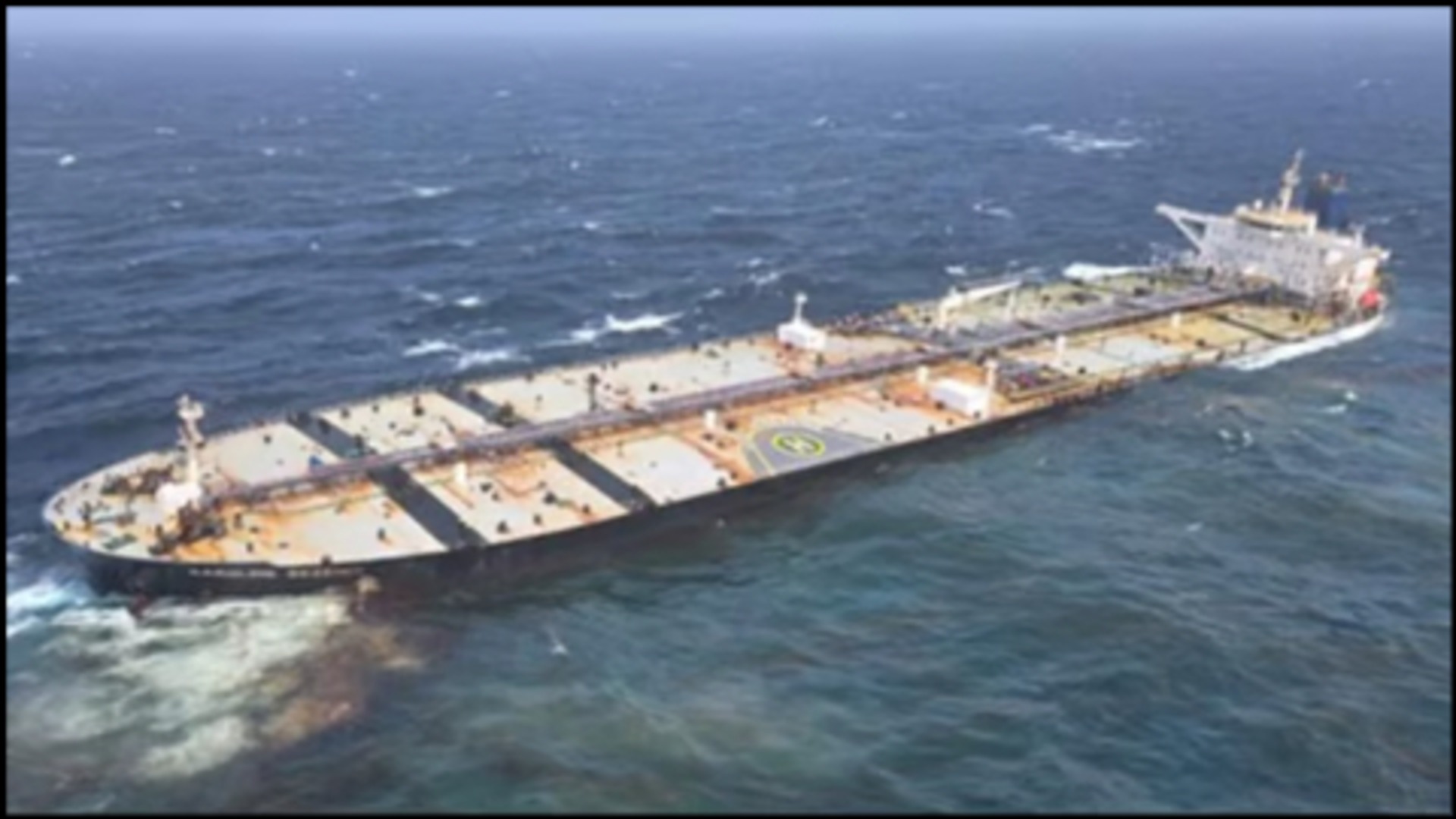

An environmental emergency off the southern coast of Oman is steadily developing into a full-scale ecological disaster.
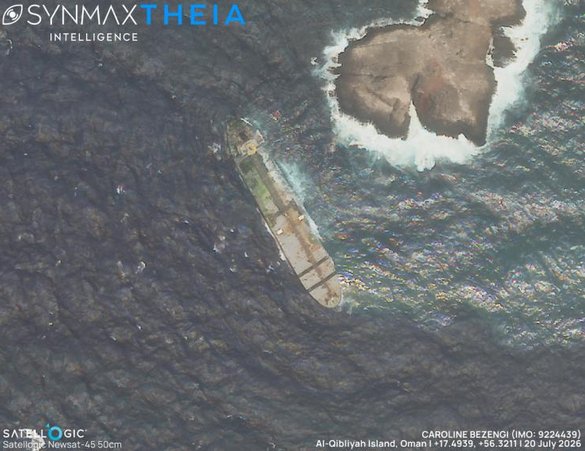
As of 3 August 2026, the tanker Caroline Bezengi remained grounded on rocks near the southwestern tip of Jazirat Al Qibliyyah, part of Oman’s Al Hallaniyat Islands. Recent satellite images show oil leaking from the vessel, with the slick expanding to around 20 square kilometres. Dark patches of oil have also reached the island’s shoreline.
The International Maritime Organization has said there is currently no evidence that the vessel has completely broken apart. However, satellite imagery and maritime experts have confirmed worsening oil leakage, a growing list, structural damage and the risk of further deterioration during the monsoon season.
The most dangerous scenario is now the failure of the vessel’s remaining structural integrity, which could release a large proportion of its cargo within a short period.
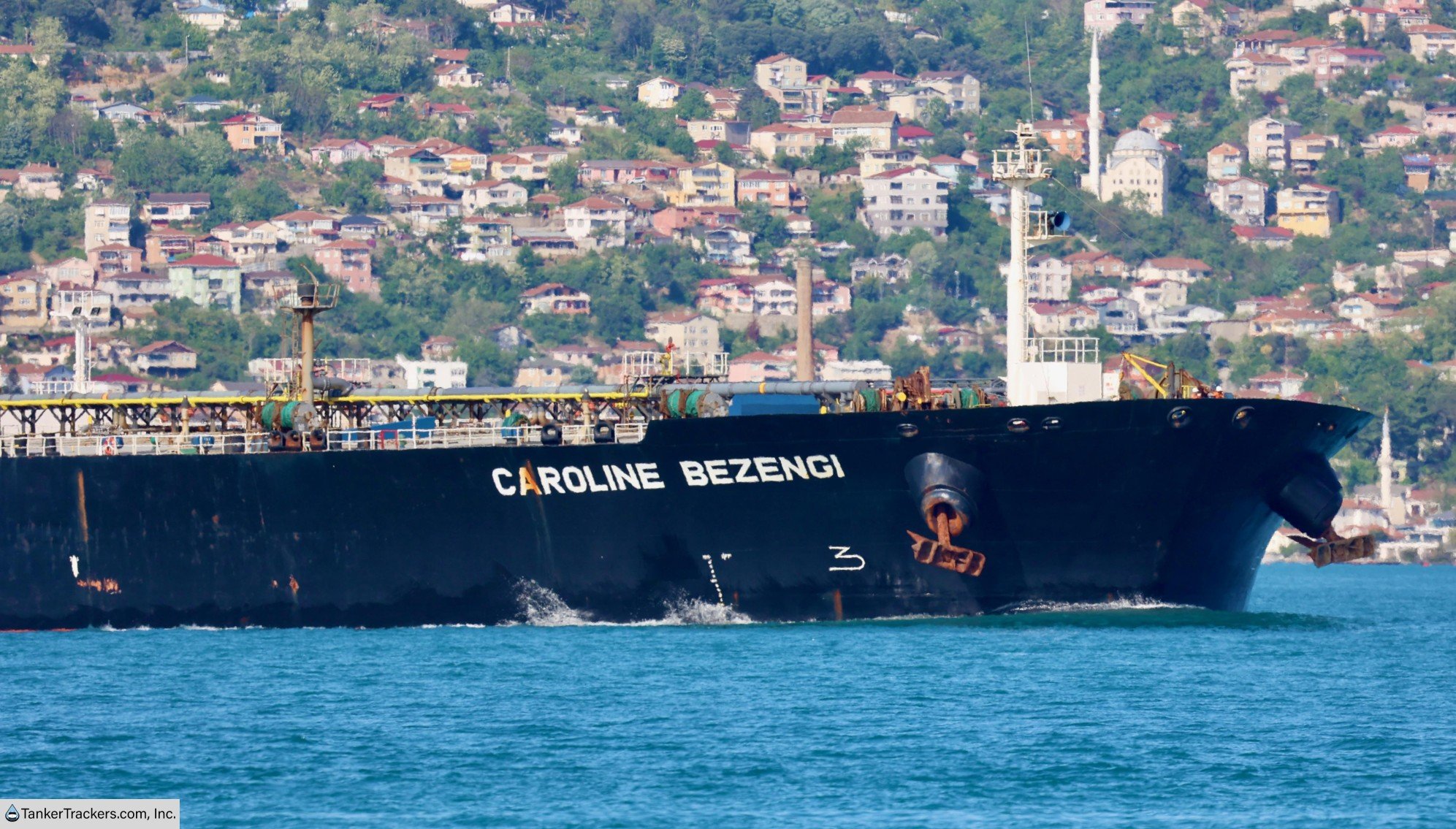
One technical point must first be clarified. Some English-language reports have described the ship as a “Supermax”. However, the Caroline Bezengi is approximately 274 metres long and has a deadweight capacity of about 159,000 tonnes. It is a Suezmax crude oil tanker, not a Supermax vessel. Built in 2001, the ship is now around 25 years old.
From Novorossiysk to the Rocks off Oman
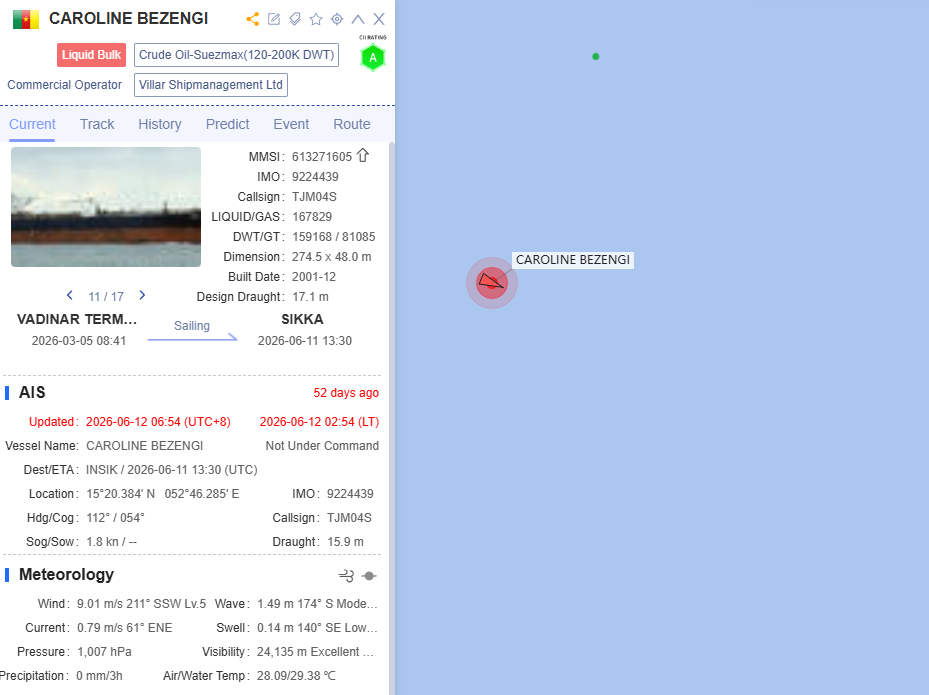
The Caroline Bezengi loaded Russian crude at the Black Sea port of Novorossiysk and was reportedly sailing towards India. Satellite images showed the ship at Novorossiysk in May 2026.
On 8 June, the vessel reported an incident near Mukalla, off southern Yemen. Two maritime security sources told Reuters that an initial assessment indicated an explosion had occurred on board.
The cause of the explosion has not been established. The Associated Press also said it could not independently verify reports suggesting the vessel had been attacked.
On 11 June, the ship stopped transmitting its position through the public Automatic Identification System. It subsequently appeared near the southwestern end of Jazirat Al Qibliyyah and became stranded several hundred metres from the rocky coastline.
Omani environmental officials visited the area and collected water samples on 1 July. Laboratory results released at the time reportedly found no petroleum contamination.
This suggests that, during the early stage of the casualty, most of the cargo may still have remained inside the tanks, or that any leakage was too limited to be detected through the initial sampling.
Satellite images later showed the situation deteriorating rapidly. Between 2 and 13 July, imagery from the European Union’s Sentinel satellites revealed silver-grey patterns consistent with an oil sheen.
Three independent specialists from SkyTruth, the Conflict and Environment Observatory and Data Desk assessed the images and concluded that the observed patterns were consistent with an offshore oil spill.
Images taken on 28 July showed a darker oil trail immediately beside the vessel, as well as lighter contamination north of the island. Wim Zwijnenburg, a remote-sensing specialist at PAX, said the darker plume suggested that at least one part of the hull had been breached and was releasing crude oil.
By 31 July, satellite imagery indicated that the slick had spread across approximately 20 square kilometres. Dark oil deposits were also visible along the island’s shoreline.
The volume released still appeared to be below the level expected from the complete rupture of a cargo tank. Nevertheless, the affected area had expanded significantly within one week.
Has the Vessel Started to Break Apart?
The phrase “breaking up” has created considerable uncertainty in reporting on the casualty.
Some maritime publications, citing an inspection conducted on 12 July, reported that the vessel’s condition had deteriorated significantly. They said the ship had settled deeper in the water, developed a greater list and may have suffered flooding in several cargo tanks.
The same reports suggested crude oil could have entered ballast tanks or double-hull spaces, potentially creating an accumulation of hydrocarbon vapours and an associated explosion risk.
However, the complete findings of that inspection have not been published as a formal report by the Omani authorities. Claims that nearly all cargo tanks have been breached are currently based mainly on industry reports and unnamed maritime sources.
They should not be treated as officially confirmed facts.
Reuters quoted an IMO spokesperson on 31 July as saying:
“The vessel has not broken up at this point. Discussions are ongoing regarding how to address the safety and environmental risks.”
A more accurate assessment is therefore as follows.
The confirmed facts are that the tanker is grounded, crude oil is leaking, the contaminated area is expanding and oil has reached the shoreline.
There is also strong evidence that the hull has suffered localised damage, the vessel is listing, water may have entered internal spaces and the overall structural condition is worsening.
What remains unconfirmed is whether the ship has fractured into separate sections, whether all or most cargo tanks have been breached, and what caused the original explosion.
This distinction matters.
The Caroline Bezengi may not yet have entered the worst-case phase of an uncontrolled, large-scale cargo release. However, the vessel is steadily losing its remaining safety margin under the combined effects of rocks, swell, tidal movement and monsoon weather.
What More Than 800,000 Barrels of Crude Means
Environmental specialists estimate that the tanker may be carrying more than 800,000 barrels of crude oil, equivalent to approximately 127,000 cubic metres.
This figure represents the estimated total cargo on board. It does not mean that the entire cargo has already leaked into the sea.
Current satellite imagery is more consistent with a continuing, relatively slow but progressively increasing discharge.
The main danger is a major structural failure.
If the outer hull, cargo tank boundaries or internal bulkheads fail over a wider area, the casualty could move rapidly from a localised spill to a major release.
A grounded vessel experiences a fundamentally different load distribution from a ship floating normally at sea. Rocks create concentrated support points under the hull, while the usual distribution of buoyancy between the bow, midship section and stern is disrupted.
Repeated movement caused by waves and tides can subject the hull girder to bending and twisting stresses.
If water has entered cargo tanks or ballast spaces, free-surface effects may further reduce stability. As the ship’s list increases, loads at the points of contact between the hull and the rocks may become even more concentrated.
For a 25-year-old tanker that is fully laden, grounded and already leaking, these factors substantially increase the probability of further structural damage.
A Spill in an Environmentally Sensitive Area
Jazirat Al Qibliyyah is part of the Al Hallaniyat Islands, an ecologically important group of islands off Oman’s Dhofar coast.
The surrounding waters include coral reefs, rocky shores, beaches and deep-water habitats. The area supports turtles, seabirds, fish and marine mammals and is covered by Omani marine protection and buffer-zone arrangements.
The Al Hallaniyat Islands and the waters off Dhofar are also an important habitat for the Arabian Sea humpback whale.
This population is small and endangered. Scientific research has linked the waters off Dhofar to breeding, nursing and feeding activity.
Once crude oil reaches the shoreline, the environmental risk is no longer limited to a floating surface slick.
Oil can enter rock crevices, tidal pools, beach sediments and shallow coral habitats. Seabirds exposed to oil may lose the waterproofing and thermal protection provided by their feathers.
Turtles and marine mammals may also be affected through inhalation of volatile compounds, ingestion of contaminated prey or direct physical contact with oil.
The Dhofar coast is currently experiencing the seasonal khareef monsoon, which normally reaches its peak during July and August.
Stronger winds, rough seas and surface currents may accelerate the movement of oil. They also reduce the safe operating window for salvage vessels, containment booms, divers and oil-transfer operations.
Why Has the Cargo Not Been Removed?
Industry reports indicate that the Omani authorities asked professional salvors to examine options for removing the cargo.
One proposal reportedly involved positioning a receiving tanker on the sheltered side of the island and laying an approximately 1,000-yard transfer hose to the Caroline Bezengi.
The concept may be technically feasible, but the operation would be highly complex.
Salvors would first need to determine whether the cargo tanks, pipelines, pumps and valves remain safe to use. They would also need to manage hydrocarbon vapours, static electricity and the risk of fire or explosion.
The receiving tanker would have to remain stable at a controlled distance, while the transfer hose would need to withstand swell, vessel movement and the loads created by pumping oil over a relatively long distance.
Removing cargo would also change the grounded tanker’s weight distribution and structural loading.
An incorrect discharge sequence could increase bending moments, shear forces or the vessel’s list, potentially triggering the structural failure that the operation is intended to prevent.
Salvors would therefore normally require detailed hull-strength calculations, ballast adjustments and continuous monitoring before proceeding tank by tank.
Legal and financial complications appear to be contributing to the delay.
Oman’s Ministry of Transport, Communications and Information Technology reportedly ordered the owner to remove the vessel and cargo within a specified period and warned that legal action could follow.
However, as of early August, it remained unclear whether the registered owner had formally responded.
Neither Reuters nor the Associated Press had obtained a public statement from the owner, while the Omani authorities had not released a comprehensive and regularly updated salvage report.
A Shadow Tanker with an Opaque Responsibility Chain
The Caroline Bezengi previously operated under names including SCF Altai, Aurora Borealis and Amoroza. It also had past links to Russian state-controlled shipping company Sovcomflot.
In recent years, the vessel underwent changes in name, ownership, management and flag, and became part of the network commonly described as Russia’s “shadow fleet”.
The term “shadow fleet” is not a single legal classification recognised under international law.
It is generally used to describe ships involved in sanctioned oil trades that operate through opaque corporate structures, frequent reflagging, changes of ownership, non-mainstream insurance arrangements and unusual AIS behaviour.
Commercial vessel databases have listed the Caroline Bezengi’s registered owner as Shanghai-based Rentoor Shipmanagement. Journalists and other parties have reportedly been unable to contact the company.
Some databases continue to identify the ship as Cameroon-flagged. Industry reports, however, suggest that its Cameroon registration may have expired, raising questions over the validity of its current flag status.
What can be directly confirmed is that the Caroline Bezengi has been sanctioned by the European Union, the United Kingdom, Canada and Switzerland.
The United Kingdom designated the ship in February 2026, citing its role in transporting Russian-origin oil. The European Union added it to its restrictive measures in October 2025 as part of sanctions targeting high-risk shipping and the transport of Russian petroleum.
Some maritime reports have also described the vessel as being sanctioned by the United States Treasury’s Office of Foreign Assets Control.
However, no public OFAC designation directly listing Caroline Bezengi or IMO number 9224439 had been identified at the time of writing.
The United States has sanctioned entities that previously appeared in the vessel’s ownership or management chain, including Lagosmarine.
Reports should therefore distinguish between a vessel that has been directly designated and a ship that has historical links to a sanctioned company.
These uncertainties have practical consequences for the emergency response.
Salvage companies require a clear contractual mandate and reliable payment guarantees. Receiving tankers, banks, insurers and equipment suppliers must also assess sanctions exposure.
An unclear flag status, an unreachable owner or opaque insurance arrangements can delay authorisation, contracting and financial security at precisely the time when rapid intervention is most important.
Who Will Pay for the Pollution?
Oman is a contracting state to the 1992 Civil Liability Convention and the 1992 International Oil Pollution Compensation Fund Convention.
Under this system, the registered owner of an oil tanker carrying persistent oil is generally subject to strict liability for pollution damage.
Tankers above the relevant tonnage thresholds are also required to maintain compulsory liability insurance. Pollution claimants may normally bring claims directly against the owner’s insurer.
If compensation from the owner and insurer is insufficient or unavailable, the 1992 Fund may provide supplementary compensation, subject to the applicable legal conditions.
Recoverable costs may include reasonable preventive measures, clean-up expenses and certain economic losses affecting fisheries or tourism. Actual compensation depends on evidence, causation, the applicability of the conventions and the relevant liability limits.
No authoritative public information has confirmed which insurer, if any, has issued valid oil-pollution liability cover for the Caroline Bezengi.
International conventions provide a legal compensation framework, but they do not automatically resolve immediate questions involving salvage funding, sanctions licences and emergency authority.
If the owner remains unreachable, the Omani government may have to commit public resources to cargo removal, shoreline protection and clean-up before attempting to recover the costs through the detention of the vessel, claims against the cargo or subsequent legal proceedings.
The crude oil on board still has considerable commercial value and could potentially help finance part of the salvage operation.
However, any sale or disposal of the cargo would itself be complicated by questions over ownership and international sanctions.
The Incident Has Already Passed the Warning Stage
The Caroline Bezengi has not been confirmed as having broken into separate sections. Nor is there evidence that all of its estimated 800,000 barrels of crude have entered the sea.
That does not mean the disaster remains hypothetical.
Oil leakage has been confirmed through multiple satellite images and assessments by independent experts. The contamination has already reached the shoreline of a protected island.
The tanker remains heavily laden and stranded on rocks during the monsoon season, while no public announcement has confirmed the start of a major cargo-transfer operation.
Four issues now require close attention.
The first is whether the ship’s list and structural condition continue to deteriorate.
The second is whether the oil can be transferred during a suitable weather window.
The third is whether the pollution spreads to other parts of the Al Hallaniyat Islands or reaches the mainland coast of Dhofar.
The fourth is whether the Omani authorities publish a more detailed plan for environmental monitoring, salvage and legal recovery.
The casualty exposes the most tangible external cost of the shadow fleet.
A tanker may continue trading through frequent flag changes, shell companies and opaque management arrangements. But once an accident occurs, the parties capable of authorising salvage, providing financial guarantees, accepting environmental liability and responding to the coastal state may suddenly become difficult to identify.
The Caroline Bezengi remains stranded on the rocks off Oman.
The hull may not yet have completely broken apart, but the time available to prevent a much larger spill is steadily running out.

READ MORE
 Safety
Collision-Damaged 181,000-dwt Capesize CAPE XL Safely Berthed in Qingdao — Three Months After Singapore Strait Collision
 Safety
CDB Leasing Moves to Auction Fire-Damaged LNG Carrier GasLog Salem as Lease Nears End
 Safety
Panama-Flagged Bulker Sinks in Bay of Bengal; 2 of 24 Crew Rescued, 20 Chinese Nationals Missing
 Safety
Rescued From One Drone Attack, Turkish Cook Dies in Second Black Sea Strike
 Safety
Five Grain‑Carrying Bulkers Hit in Succession; Novorossiysk‑Tuapse Shipping Route Under Siege
 Safety