

Red Sea “Toll Booth” Next? Houthis Weigh Transit Fees as RCL Cancels China Sailing
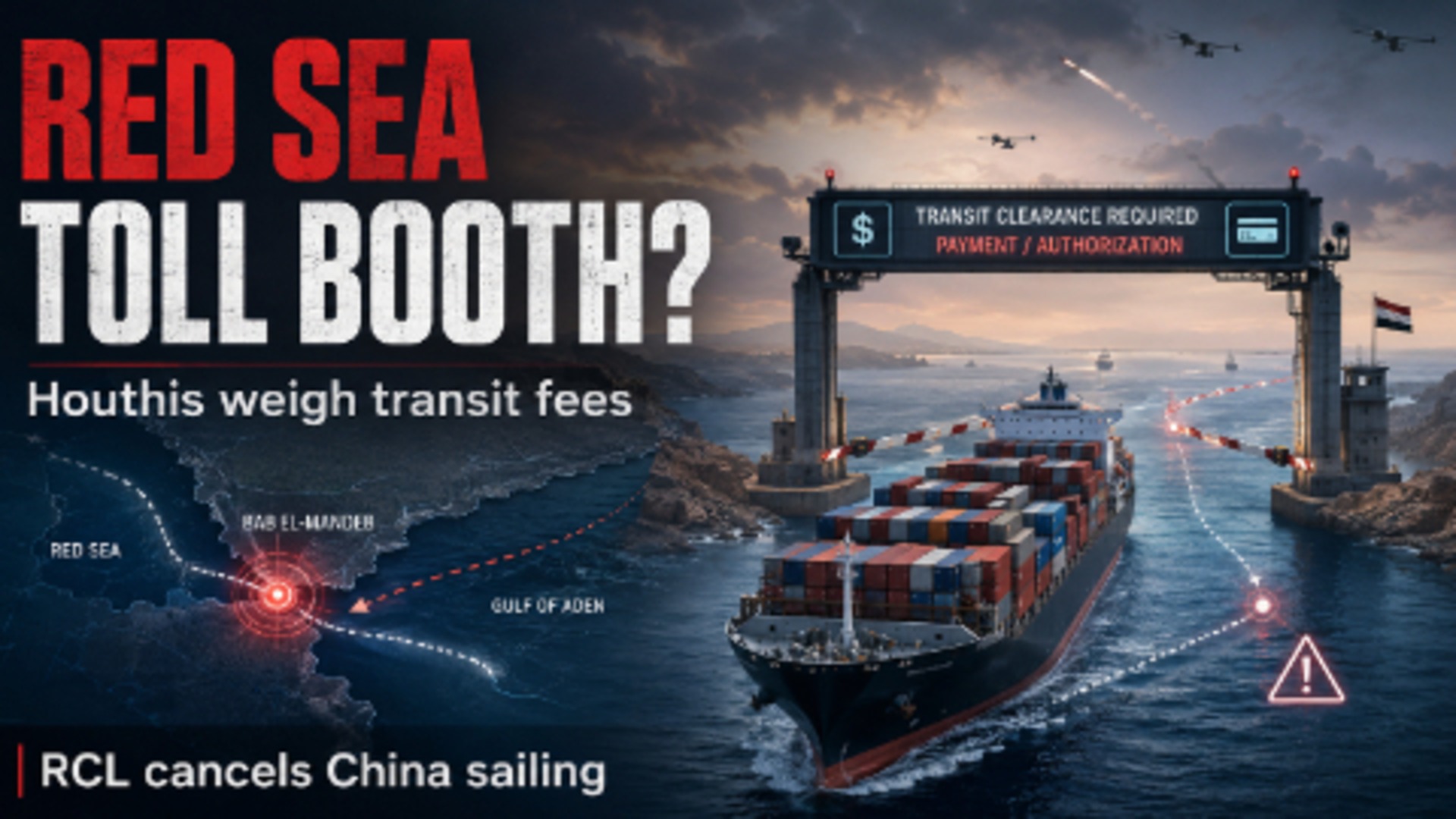

Two of the Middle East’s most important maritime chokepoints could be moving towards a new and highly controversial model: paying for passage.
Following Iran’s attempt to establish a vessel-permit and fee system in the Strait of Hormuz, Yemen’s Houthi movement is reportedly considering charging commercial ships transiting the Bab el-Mandeb Strait.
At the same time, Regional Container Lines, or RCL, has invoked force majeure and cancelled a China–Red Sea sailing operated by TS Chennai. The proposed Houthi fee has not yet been implemented, but the deteriorating security environment is already translating into cancelled voyages, cargo diversions and additional costs being passed on to shippers.
Bab el-Mandeb placed on the “toll” agenda
Reuters reported on 29 July, citing regional officials and people familiar with the matter, that the Houthis are studying a plan to charge most commercial vessels passing through Bab el-Mandeb.
No tariff, implementation date or detailed scope has been announced. The Houthi media office has also made no public comment, meaning the proposal remains under consideration rather than in force.
According to the report, Houthi officials discussed the issue during a visit to Iran in July. Iranian advisers were subsequently said to have travelled to Yemen to assist with plans for a dedicated body that would supervise vessel transit and collect fees.
The proposal appears to serve a broader strategic purpose. By attaching a financial condition to passage, the Houthis would be seeking to convert their military influence over Red Sea shipping into a form of access control and economic leverage.
Bab el-Mandeb links the Red Sea with the Gulf of Aden and serves as the southern gateway to the Suez Canal. Any effective fee system would therefore affect one of the principal maritime corridors connecting Asia and Europe.
There have also been suggestions that Chinese vessels could be exempted. That possibility, however, remains unconfirmed. It is still unclear whether a “Chinese vessel” would be defined by flag, beneficial ownership, management, charterer, cargo interest or destination.
This distinction matters. Modern shipping structures frequently involve a foreign-flagged vessel, a shipowner in one jurisdiction, a manager in another and cargo destined for a Chinese buyer. Any exemption regime would therefore be difficult to apply consistently.
The Houthi threat has already widened
The fee proposal follows a broader expansion of Houthi shipping restrictions.
On 20 July, the group announced what it described as a maritime blockade against Saudi Arabia and warned shipping companies against calling at Saudi ports. Vessels associated with Saudi cargoes and terminals were threatened with attack.
Several tankers carrying Saudi crude subsequently altered course in the Red Sea, while traffic through Bab el-Mandeb became increasingly volatile.
The strait has not been completely closed. Vessel-tracking data showed that 39 commodity-carrying ships passed through Bab el-Mandeb on 28 July, up sharply from just 11 on 26 July.
The wider pattern, however, is one of instability rather than recovery. Some vessels continue to sail through, others wait for security assurances, while many liner operators prefer to cancel services or divert around the Cape of Good Hope.
Tehran has already tested the “strait toll” model
The Houthi proposal is not emerging in isolation. Iran has already attempted to establish a similar structure in the Strait of Hormuz.
Earlier this year, Tehran advanced plans under which vessels seeking passage could be required to submit information, follow designated routes, obtain authorisation and pay a fee.
Iran also reportedly proposed charging ships as much as $2 million for passage, with part of the revenue potentially shared with Oman, which controls the opposite side of the strait.
The plan later developed into a more institutionalised structure. The United States said Iran had established a body referred to as the Persian Gulf Strait Authority, which required ships to register, follow routes designated by the Islamic Revolutionary Guard Corps and make payments.
Washington sanctioned the entity and warned shipowners, banks, insurers and intermediaries that paying such charges could create serious sanctions exposure.
The US later imposed further sanctions on associated maritime insurance and service companies that allegedly required ships to purchase compulsory cover or make digital-asset payments in exchange for passage.
The Hormuz case produced two very different concepts of maritime fees.
One is a voluntary contribution for navigational safety, environmental protection, search and rescue, or the maintenance of maritime infrastructure. Oman and other Gulf states have explored this type of cooperative arrangement.
The other links payment directly to access and protection under military pressure. That model is far more likely to be treated as coercive, challenged under international law and targeted by sanctions.
Could a Houthi toll system actually work?
The Houthis face even greater obstacles than Iran in establishing a formal and durable fee regime.
Iran is a recognised coastal state with a navy, ports, maritime authorities, surveillance systems and access to state institutions. Even so, its Hormuz fee proposal has faced strong international opposition and sanctions.
The Houthis control parts of Yemen’s Red Sea coastline, but they are not internationally recognised as Yemen’s legitimate government. They do not control the African side of Bab el-Mandeb, where Djibouti and Eritrea are located, and they lack a maritime administration recognised by the international shipping community.
Under the international legal framework governing straits used for international navigation, vessels enjoy transit-passage rights. Coastal authorities may regulate safety, pollution prevention and traffic separation, but an armed group imposing a compulsory fee simply for passage would struggle to establish legal legitimacy.
For this reason, a transparent and widely accepted fee system similar to the Suez Canal toll structure appears unlikely.
A less formal arrangement is more plausible.
Under such a model, vessel operators or agents could contact intermediaries, submit information about the ship and cargo, make a payment and receive an assurance that the vessel would not be targeted during a particular transit.
Such an arrangement would be opaque, selective and politically driven. It would also offer no reliable guarantee that different Houthi units could identify the vessel correctly or that other armed actors would respect the arrangement.
Past reports have alleged that the Houthis received payments from shipping interests in return for safe passage. The claims, including estimates that such revenues reached as much as $180 million per month at one stage, have not been independently verified.
The proposal may therefore be more useful to the Houthis as a bargaining tool than as a conventional source of maritime revenue.
International reaction could come before implementation
Any attempt to begin collecting fees would probably trigger an immediate response from the United States, Europe and Gulf countries.
The US approach in Hormuz offers a likely template: warn shipping companies against payment, sanction the collecting entity and target any banks, insurers, payment platforms, ships or intermediaries involved.
For mainstream shipowners, the compliance risk may outweigh the amount of the proposed fee itself.
A payment involving a sanctioned entity could expose a company to restrictions on dollar transactions, insurance complications, loss of cover and reputational damage. P&I clubs, war-risk insurers and banks would almost certainly require detailed disclosure of the recipient and purpose of any payment.
European and Gulf states would also be unlikely to accept the principle that an armed non-state group can charge for passage through a major international waterway.
Military enforcement is less straightforward. Naval forces cannot escort every merchant vessel, and governments may be reluctant to expand deployments. This means international opposition could initially rely more heavily on sanctions, legal pressure and financial isolation than on comprehensive naval protection.
The reported possibility of exemptions for Chinese ships could also complicate the response. Even where a vessel is perceived as Chinese-linked, complex ownership and chartering arrangements could create uncertainty, while an exemption would not remove insurance, operational or misidentification risks.
RCL cancels China–Red Sea voyage
The shipping market is not waiting for a formal toll announcement.
On 24 July, RCL declared force majeure and cancelled voyage 2604E of TS Chennai, withdrawing the vessel’s planned China–Red Sea service.
The company said cargo-handling, storage, diversion, transshipment, inland transport, port charges, detention, demurrage and other related costs arising from the disruption would be dealt with under the applicable bill-of-lading terms and passed to cargo interests.
The cancellation was announced before the reported Houthi fee proposal became public and should not be presented as a direct response to the proposed toll.
It is nevertheless highly relevant. It demonstrates that Red Sea risk is already affecting service reliability and contractual cost allocation.
Tankers and bulk carriers can often assess a Red Sea transit on a voyage-by-voyage basis, taking account of freight earnings, cargo value, insurance and charter-party terms.
Container shipping is less flexible. A single delayed or diverted vessel can disrupt an entire string of port calls, transshipment connections and subsequent sailings. For liner operators, cancelling a voyage or continuing to route around the Cape may be commercially preferable to entering a corridor where security rules, payment expectations and vessel eligibility are unclear.
The toll booth may never open, but shipping is already paying
A formal, transparent and internationally accepted Houthi toll system appears difficult to establish.
The Houthis lack recognised maritime authority, while any payment mechanism would face legal, banking, insurance and sanctions barriers.
That does not make the proposal irrelevant.
The group does not need to operate a conventional toll booth to impose costs on shipping. It only needs to create a credible belief that vessels refusing to comply could be targeted.
That belief is enough to raise war-risk premiums, extend voyages, disrupt schedules and push more cargo around the Cape of Good Hope.
From Hormuz to Bab el-Mandeb, the same strategic pattern is emerging: armed actors are seeking to turn military influence over maritime chokepoints into control over access, fees and political leverage.
The Red Sea toll booth may never formally open. The shipping industry, however, is already paying the bill.


READ MORE
 Safety
Collision-Damaged 181,000-dwt Capesize CAPE XL Safely Berthed in Qingdao — Three Months After Singapore Strait Collision
 Safety
CDB Leasing Moves to Auction Fire-Damaged LNG Carrier GasLog Salem as Lease Nears End
 Safety
Panama-Flagged Bulker Sinks in Bay of Bengal; 2 of 24 Crew Rescued, 20 Chinese Nationals Missing
 Safety
Rescued From One Drone Attack, Turkish Cook Dies in Second Black Sea Strike
 Safety
Five Grain‑Carrying Bulkers Hit in Succession; Novorossiysk‑Tuapse Shipping Route Under Siege
 Safety