


China’s First Rail Link Running Perpendicular to the Quay Opens at COSCO SHIPPING Ports’ Xiamen Ocean Gate Terminal
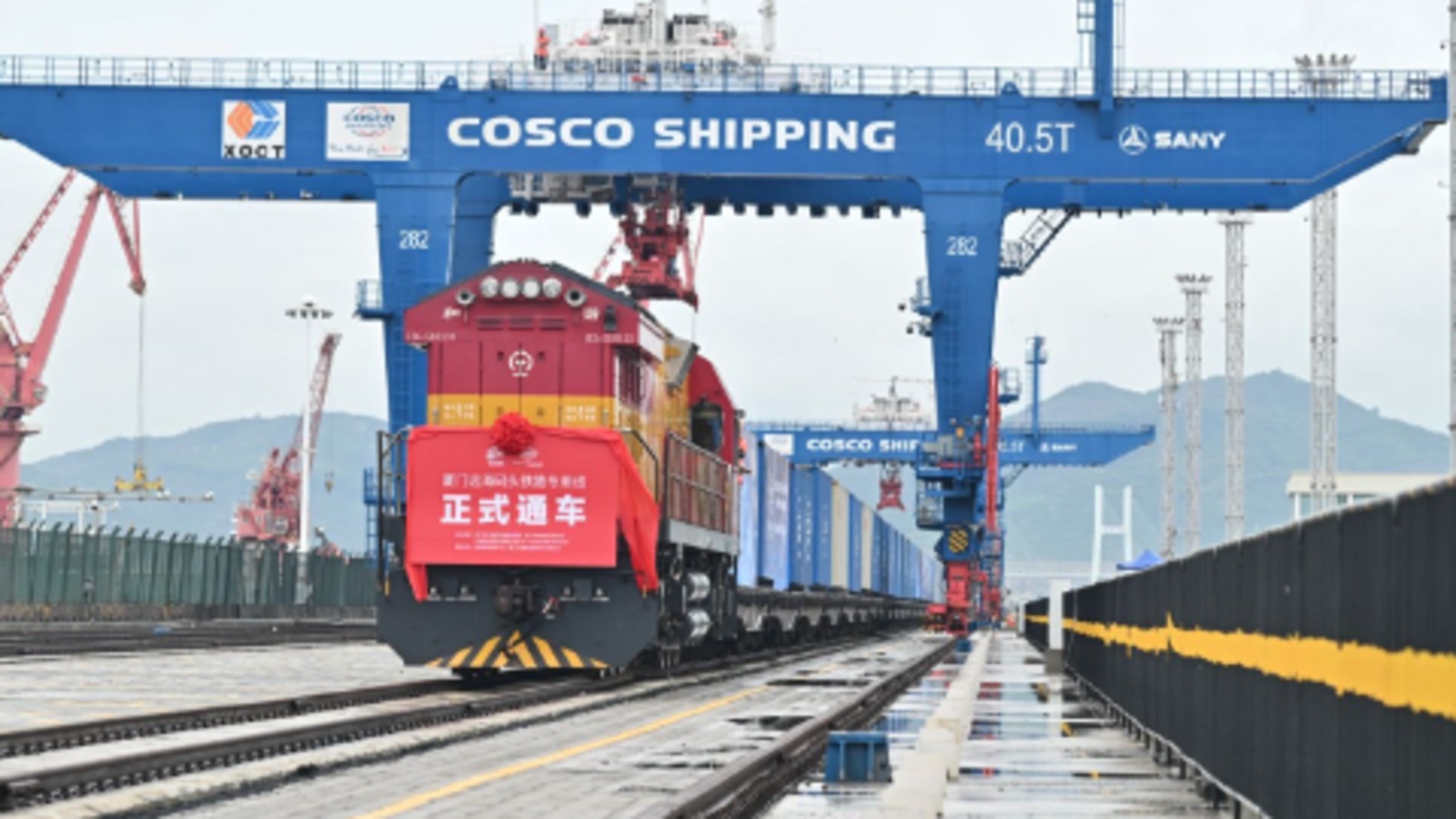

On July 29, 2026, a container train departed smoothly from Xiamen Ocean Gate Automated Container Terminal, operated by COSCO SHIPPING Ports, marking the official opening of China’s first dedicated sea-rail line running perpendicular to the shoreline and directly into a container terminal.
Officials from Fujian Province and Xiamen Municipality, representatives from government departments and port regulatory authorities, executives from COSCO SHIPPING Group, China Railway Nanchang Group and COSCO SHIPPING Ports, as well as business partners from across the industry, attended the commissioning ceremony and witnessed the departure of the first train.
The dedicated railway line at Xiamen Ocean Gate Terminal is 1,586 metres long and has a designed annual handling capacity of 250,000 TEU of containerised cargo and 250,000 tonnes of breakbulk and general cargo.
The railway runs directly through Xiamen Ocean Gate Terminal, China’s first fully automated container terminal. Departing from conventional port railway layouts, the line is positioned perpendicular to the shoreline and extends deep into the terminal’s core operational area, reaching within just 70 metres of the quay front.
Containers can therefore be transferred directly between trains and the terminal operating area, eliminating the traditional intermediate transfer process and completing the “last mile” of sea-rail intermodal transportation.
Backed by Fujian’s manufacturing base and consumer market, the dedicated railway line will connect with 21 ocean services linking Xiamen Ocean Gate Terminal with Europe, North America, Australia, the Middle East and Southeast Asia. It will also connect with inland railway corridors extending to Jiangxi, Hubei, Chengdu and other major hinterland markets.
The project is expected to further integrate Xiamen Port’s maritime network with China’s national railway system, creating a three-dimensional logistics network that reaches global markets by sea and extends across China and Eurasia by land.
Xiamen is an important strategic shipping, port and logistics hub for COSCO SHIPPING Group and COSCO SHIPPING Ports. The new railway line will be integrated with COSCO SHIPPING’s surrounding shipping services, road transport capacity, port and terminal operations, warehousing facilities and logistics resources.
By combining individual logistics nodes, transport corridors and wider service networks, the project will enable COSCO SHIPPING to provide customers with more efficient and cost-effective integrated logistics solutions.
Speaking at the ceremony, Lin Zhicheng, Vice Mayor and member of the Leading Party Members Group of the Xiamen Municipal People’s Government, said:
“The sea-rail intermodal project at Xiamen Ocean Gate Terminal enables seamless connections between trains and vessels, addresses long-standing collection and distribution bottlenecks, extends the port’s reach into inland markets and strengthens land-sea transport corridors.
“It will also support the development of smart ports and the Belt and Road Initiative. Xiamen will continue investing in port infrastructure and working with enterprises to develop a green, intelligent and modern international port.”
Lin Ji, Director, General Manager and Deputy Party Secretary of COSCO SHIPPING Group, said:
“As the tides rise along the Lujiang River, a new chapter of sea-rail connectivity begins.
“Through unified data interfaces and an intelligent dispatching system, the dedicated railway line at Xiamen Ocean Gate Terminal will improve cargo access between the port and inland regions including Jiangxi, Hunan and Hubei.
“It is a landmark project supporting Fujian’s opening-up and promoting the domestic and international dual-circulation development model. It is also China’s first example of a zero-distance, seamless connection between sea and rail transport.
“COSCO SHIPPING will continue investing in Fujian. Through a more comprehensive shipping network, more diversified supply-chain services and greener and smarter logistics technologies, we will develop a multidimensional transport network connecting the overland Silk Road to the north, the Maritime Silk Road to the south and the Taiwan Strait to the east.
“Together with Fujian Province, Xiamen Municipality, railway, port and shipping partners, and industrial customers, we will strengthen the southeastern land-sea transport corridor, safeguard the smooth operation of global supply chains, create new opportunities through greater opening-up, and contribute to the development of a new shipping order and maritime ecosystem.”
Wu Chengzhong, Deputy General Manager of China Railway Nanchang Group, said:
“Over the years, China Railway Nanchang Group has deepened port-rail cooperation between Fujian and Jiangxi, increased the frequency of sea-rail services connecting inland markets with Xiamen Port, promoted single-document intermodal transport and reduced logistics costs.
“The opening of the dedicated railway line creates new opportunities for strategic cooperation between the railway and port sectors.
“China Railway Nanchang Group will continue working with all stakeholders to improve land-sea logistics corridors and leverage the Silk Road Maritime network to support the dual-circulation development model and the high-quality economic development of Fujian and Jiangxi.”
Direct Land-Sea Connection and Intelligent Operations
Trains Can Now Run Directly into the Terminal
Traditional sea-rail intermodal transport normally involves three separate stages: train, container yard and vessel. Cargo arriving by rail must first be unloaded into a yard and then transferred again before being loaded onto a vessel.
The new railway line reduces this three-stage process to a direct “train-to-vessel” connection.
Its operational value can be demonstrated through three figures addressing customers’ principal concerns: logistics costs, transfer efficiency and network connectivity.
Logistics Costs Reduced by More Than 15%
Previously, containers arriving by rail had to be transferred by truck from a railway freight station located approximately 20 kilometres from Xiamen Ocean Gate Terminal.
This generated additional trucking charges, road tolls, storage fees, secondary lifting costs and container detention expenses. It also increased the risk of cargo damage during repeated handling.
With trains now able to enter the terminal directly, the intermediate transfer process and its associated costs can be eliminated.
According to project estimates, customers’ overall logistics costs per container can be reduced by more than 15%, while total logistics time can be shortened by two to three days.
Automated Railway Meets Automated Terminal: Nine-Minute Transfers
The project is China’s first sea-rail intermodal system connecting an automated railway operation with a fully automated container terminal.
Taking advantage of the terminal’s automated equipment, the project is equipped with four automated rail-mounted gantry cranes and three parallel railway loading and unloading tracks.
A dedicated railway module has also been integrated into the terminal operating system, enabling coordinated operation between the automated railway and automated terminal.
The resulting operating model provides minute-level transfers and a zero-distance sea-rail connection, achieving what the terminal describes as “a 70-metre transfer distance and a nine-minute interchange”.
On the railway side, fully automated rail-mounted gantry cranes identify container numbers, locate railway wagons and conduct remotely controlled loading and unloading operations.
Within the terminal, autonomous trucks travel between vessels, the container yard and the railway operating area. Containers can therefore move through the terminal without human intervention, 24 hours a day.
The terminal operating system is directly connected to railway information systems, allowing loading and unloading operations to begin immediately after a train arrives.
Twenty-One Ocean Services Connected with More Than 20 Inland Railway Corridors
Xiamen Ocean Gate Terminal currently operates 21 ocean services covering Europe, North America, Australia, the Middle East and Southeast Asia.
These maritime services are now linked with more than 20 inland railway corridors extending into Jiangxi, Hunan, Hubei, Chengdu and other inland markets.
The opening of the railway line will further integrate Xiamen Port’s ocean network with China’s railway system, creating a logistics network that connects global markets by sea and reaches China and Eurasia by land.
During the first half of 2026, Xiamen Port’s sea-rail intermodal cargo volume increased by 35.76% year on year.
Following the commissioning of the railway line, the port’s cargo hinterland will expand beyond the southern Fujian economic region into Jiangxi, Hunan, Hubei, eastern Guangdong and other inland areas.
Integrated Operations and Lower Supply-Chain Costs
The railway facility at Xiamen Ocean Gate Terminal is designated as a Category D dedicated railway line and is included among China’s first batch of key projects promoting the integrated development of transport and logistics.
Under China’s Administrative Measures for the Operation and Services of Dedicated Railway Lines, a Category D line is one whose operator has declared that it will accept cargo from third parties and publicly disclose and implement its logistics service items and charging standards.
Compared with Category A, B and C dedicated railway lines, Category D facilities have a wider market reach and are required to offer open, shared and standardised services to all market participants.
To maximise the line’s operational efficiency, the port, railway and customs authorities have established a coordinated operating mechanism.
Port and railway plans are exchanged in advance, dispatching arrangements are coordinated and equipment resources are shared. This replaces the previous model in which port and railway operations were managed as separate segments with an integrated operating system.
The railway line is located within the Xiamen Haicang Port Comprehensive Bonded Zone, where cargo can benefit from a one-stop customs clearance process involving a single declaration, a single inspection and a single release procedure.
The project combines five principal operational features:
-
seamless sea-rail connectivity;
-
integrated cooperation between the bonded zone and the port;
-
connectivity between bonded and non-bonded operations;
-
the ability to handle containers and breakbulk cargo on the same train; and
-
integration between domestic and international cargo circulation.
Together, these functions establish an around-the-clock, end-to-end and multidimensional customs supervision system.
Customs authorities have developed an innovative “bonded-zone, port and sea-rail intermodal” clearance model covering 16 standardised operating scenarios.
A mobile customs checkpoint management system has also been introduced. RFID technology automatically identifies railway wagon numbers, while intelligent rail-mounted gantry cranes collect container numbers and complete automated verification and release procedures.
This allows trains to pass through the railway customs checkpoint without waiting and creates a national demonstration model for sea-rail customs supervision that can potentially be replicated at other Chinese ports.
Supported by COSCO SHIPPING’s integrated capabilities in shipping, ports and logistics, together with Xiamen Ocean Gate Terminal’s combination of an automated terminal, railway facilities and warehousing capacity, the project will provide customers with integrated waterway, road and railway logistics services.
The facility will also be able to handle specialised intermodal businesses, including railway transportation of finished vehicles using dedicated automotive wagons, warehousing and distribution, container consolidation and deconsolidation, and refrigerated container services.
The port area will also be connected with a railway logistics park located behind the terminal, helping consolidate cargo from a wider geographic area at Xiamen Port.
This is expected to strengthen integration between the regional port economy, port-related manufacturing and trade, while improving end-to-end supply-chain coordination and reducing total logistics costs through more intensive operations.
A New Benchmark for Sea-Rail Intermodal Transport
The commissioning of the railway line represents an important milestone in COSCO SHIPPING Ports’ integrated port logistics strategy in Fujian.
Using Xiamen Ocean Gate Terminal as a central hub, the railway connects ocean trunk services with inland railway corridors, upgrading the logistics network from individual nodes to corridors and from corridors to wider regional markets.
The project closely aligns with COSCO SHIPPING Ports’ global strategy of integrating ports, transport corridors and service networks. It will strengthen the company’s end-to-end service capabilities and further connect Chinese industrial and consumer markets with global trade routes.
The port-rail layout is the first of its kind in China and establishes another industry benchmark for Xiamen Ocean Gate Terminal.
It also demonstrates how COSCO SHIPPING Ports and its partners are developing innovative intermodal transport models and advancing the construction of smart ports.
By laying the railway perpendicular to the shoreline and bringing trains directly into the terminal operating area, the project removes the intermediate transfer process that has traditionally constrained sea-rail intermodal transport.
The innovation does more than change the direction of a railway track. It reshapes the way container terminals connect with their inland hinterlands.
Looking ahead, Xiamen Ocean Gate Terminal will continue leveraging technological innovation and network service capabilities to develop differentiated and industry-leading operating scenarios, while supporting greater two-way connectivity between inland China and international markets.

READ MORE
 Ports & Terminals
$4 Million for a Panama Canal Slot: The Price of Time Is Surging
 Ports & Terminals
MSC’s Global Expansion Meets Regulatory Limits as Barcelona BEST Terminal Deal Is Terminated
 Ports & Terminals
China Lines Up 2026 Arctic Voyages as Six Operators Deploy Container and Bulk Tonnage
 Ports & Terminals
Why Are Two Chinese Port Groups Joining Forces? Ningbo and Beibu Gulf Build a New China–ASEAN Shipping Corridor
 Ports & Terminals
Dalian Launches Local Deep-Sea Shipping Platform, Securing 1.5 Million Tonnes of Cargo and 500,000 DWT of Capacity
 Ports & Terminals
China and Panama move toward renewing maritime transport agreement, signaling a reset in shipping ties
 Ports & Terminals
Shenzhen, Yantian and Los Angeles Deepen Green Shipping Corridor Cooperation
 Ports & Terminals
COSCO SHIPPING Holdings is further expanding the regional shipping network centred on the Port of Chancay in Peru.
 Ports & Terminals
The Northern Route Is Becoming a Specialised Energy Corridor
 Ports & Terminals