


BYD Has Bought another 10 More Ships, Says Stella Li,Executive Vice President of BYD
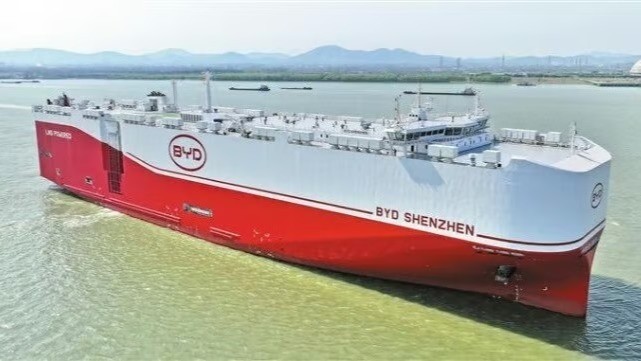

BYD has bought another 10 ships, Executive Vice President Stella Li said in a recent interview with 21News, outlining further expansion of the Chinese carmaker’s maritime transport capacity. According to the interview, Li repeated the figure when the interviewer asked for confirmation, then added that the company was still seeking more capacity from partners in Italy and France.

Her comments come after the delivery of BYD’s initial eight car carriers and point to a further expansion of the shipping resources supporting its international business. The interview did not disclose vessel sizes, shipyards, prices or delivery schedules. It also did not explain whether the additional ships would be owned directly, financed through leasing structures or secured in cooperation with other shipowners.
For the maritime industry, the commercial message extends beyond the number of vessels. BYD wants greater control over vehicle deliveries while continuing to work with professional shipping companies. Its fleet is also beginning to serve production outside China, adding another dimension to the carmaker’s transport requirements.
Building on the first eight ships
Xinde Marine began reporting on BYD’s plans to establish a car-carrier fleet in 2022. Those plans became an operating business in January 2024, when BYD EXPLORER NO.1 entered service. The 7,000-car-equivalent-unit vessel was built by CIMC Raffles for Zodiac Maritime and chartered to BYD, establishing a relationship between the manufacturer, an international shipowner and a Chinese shipbuilder.
The initial eight-ship programme combined chartered tonnage with vessels ordered directly by the carmaker. As previously reported by Xinde Marine, it comprised two 7,000-CEU ships built by CIMC Raffles and introduced through charter arrangements, two 7,000-CEU vessels from Guangzhou Shipyard International, and two 9,200-CEU vessels each from China Merchants’ Nanjing Jinling yard and Haimen base. Professional shipowners and shipbuilders have therefore been part of BYD’s maritime operations from the outset.
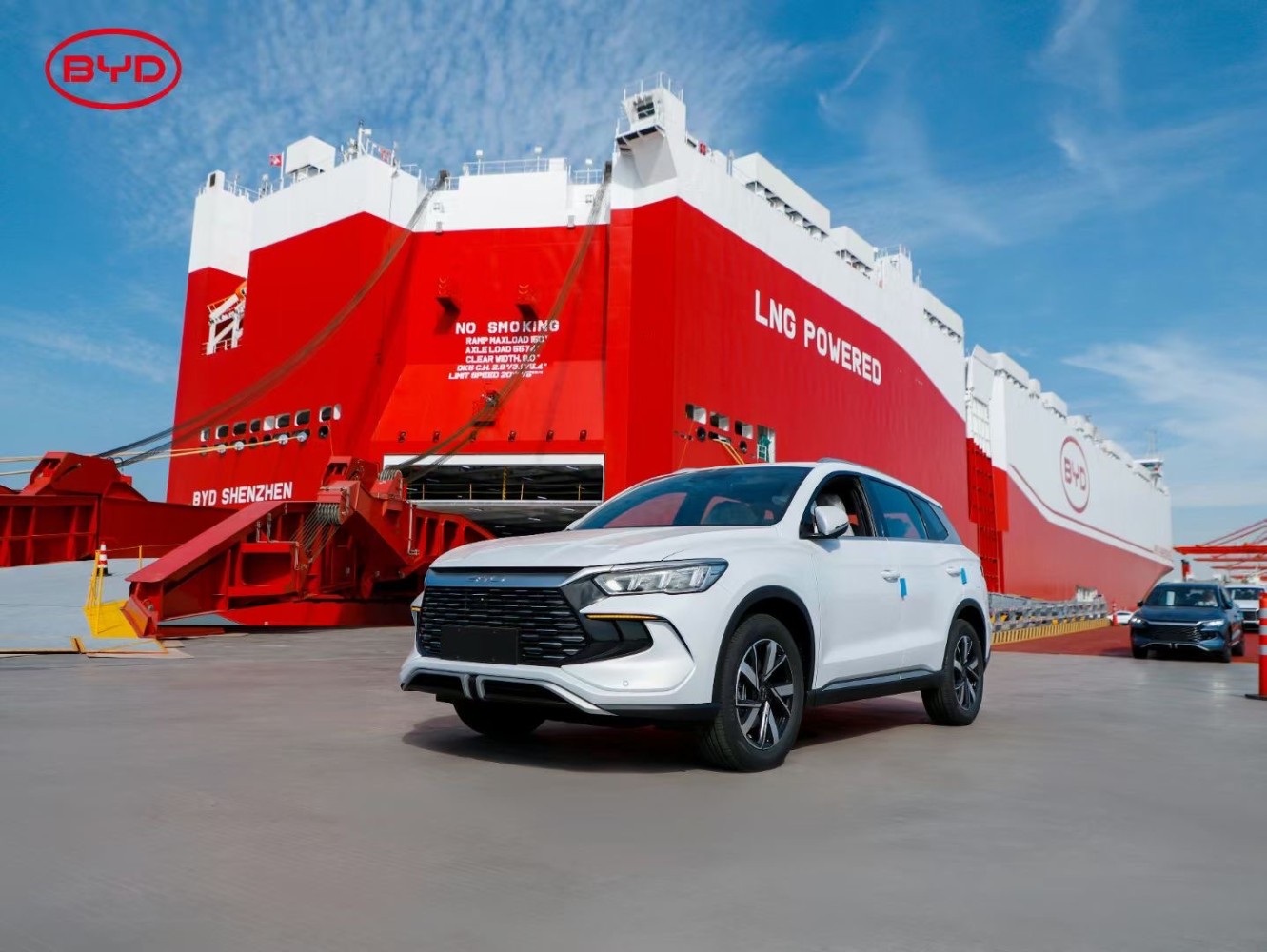
BYD SHENZHEN, delivered in Yizheng on 22 April 2025, became the fourth ship in the operating fleet, with capacity for 9,200 cars. The delivery of the eighth vessel, BYD JINAN, in Haimen on 28 September 2025 completed the initial programme.
Further expansion has been under discussion during 2026. On 15 September, Xinde Marine reported that BYD was exploring additional car-carrier capacity and talking to shipyards, with 8,600-CEU and 9,200-CEU designs among the options. Market reports in early October subsequently described an eight-ship, 11,000-CEU proposal, with some arrangements still awaiting formal contracts. Li’s interview did not explain how the 10 ships she mentioned relate to those earlier proposals.
Shipping as part of vehicle delivery
Li explained the company’s investment in shipping in terms of the difficulty of matching logistics capacity with rapidly growing demand. Existing services had been unable to provide all the capacity BYD required, prompting the company to consider buying ships. She placed particular emphasis on controlling transport schedules and gaining flexibility.
That priority has practical consequences for a vehicle manufacturer. Production can be scheduled against orders, but overseas deliveries also depend on when cars can be loaded, when ships reach their destinations and how quickly vehicles move through ports and distribution networks. A mismatch between production and transport can affect dealer inventories, model launches and customer delivery dates.
Viewed through that operating requirement, dedicated shipping capacity can support several parts of the business at once. More predictable sailings help factories organise dispatches and allow receiving ports and distributors to plan ahead. Greater influence over vessel deployment can also give the manufacturer room to adjust shipments between markets as demand changes. The economic value of the ships is consequently linked to the efficiency of the wider vehicle-delivery operation.
Li’s account of BYD’s earlier development offers a parallel. In the same interview, she described how supplier pricing and long delivery periods encouraged the company to develop more components internally. Her explanation of the shipping investment follows a similar commercial logic: when access to an essential service constrains growth, the company considers bringing part of that capability under its own control.
A continuing role for professional shipowners
Li’s comments about seeking capacity from Italian and French partners indicate that outside shipping services remain part of BYD’s plans. The interview did not identify the companies involved or specify whether discussions concerned vessel charters, cargo space or other transport arrangements. It nevertheless described continuing demand for external capacity alongside the company’s own fleet expansion.
From a transport-planning perspective, these resources can serve different requirements. Relatively stable cargo volumes can support dedicated tonnage over a longer period. New destinations, seasonal shipment patterns and concentrated delivery campaigns may require additional services. Professional car-carrier operators can contribute port coverage, established routes and the ability to combine cargo from several manufacturers.
The effective capacity of a fleet also depends on how its ships are employed. Voyage distance, intermediate calls, port turnaround and cargo readiness all influence the number of vehicles a ship can carry over a given period. A vessel’s nominal CEU capacity is one input into that calculation; the time needed to complete successive voyages is equally relevant to the manufacturer’s delivery plan.
Li’s assessment that more capacity was still required should therefore be understood in relation to BYD’s transport needs. For professional operators, her comments suggest scope for further business built around dependable schedules and access to the markets the carmaker serves. BYD’s first charter arrangements with Zodiac Maritime already provide an example of how dedicated vehicle transport can be organised through cooperation with an established shipowner.
Overseas factories extend the fleet’s role
The same interview covered BYD’s European manufacturing plans, including its Hungarian factory, local supplier development and consideration of further production facilities. These investments are proceeding alongside the company’s efforts to secure more shipping capacity.
An operating example of how overseas manufacturing can change the fleet’s work emerged in Thailand in August 2025. BYD’s Thai subsidiary announced that more than 900 locally manufactured DOLPHIN electric vehicles would be exported to Europe, with the UK, Germany and Belgium among the destinations. BYD ZHENGZHOU carried the vehicles on its first sailing from Thailand to Europe.
That voyage demonstrated a role for the fleet in connecting a manufacturing base outside China with overseas sales markets. As production locations change, so can loading ports, destinations and route combinations. A factory established to serve a regional market may also become an export base, creating transport requirements elsewhere in the network.
Local production can shorten some delivery routes, while exports from overseas plants can generate other international movements. The resulting shipping requirement will depend on how production and sales are distributed between countries. For BYD, the task is to align vessel deployment with those changing flows of finished vehicles.
Turning additional ships into dependable capacity
A larger fleet increases the resources available to the carmaker, together with the work needed to coordinate them. Factory dispatches, port storage, vessel arrivals and destination distribution must fit into a delivery plan. Loading levels and turnaround times then determine how much transport capacity the fleet can provide in practice.
The additional 10 ships described by Li will attract attention across the car-carrier market as their specifications and commercial arrangements become clearer. Her account already identifies the operating objective: to keep transport capacity aligned with business development and give BYD greater flexibility over international deliveries.
For shipowners and logistics providers, this points to demand for services that connect vessels with the manufacturer’s production and sales network. As BYD’s overseas factories take on export work, the ability to organise reliable transport between more origins and destinations will become an increasingly important part of that relationship.


READ MORE
 Car Carriers
Ningbo Ocean Shipping Plans Two More PCTCs to Expand Its Car Carrier Fleet
 Car Carriers
Another Chinese Shipowner Enters PCTC Market — and Another Chinese Yard Moves into 5,000-CEU Construction
 Car Carriers
Up to 26 PCTC! Höegh Autoliners Signs 6 More Aurora Car Carriers with China Merchants
 Car Carriers
China Merchants Takes Delivery of Methanol Dual-Fuel Car Carrier CM WUHAN
 Car Carriers
917 Chinese Vehicles Arrive at Chancay as COSCO SHIPPING Expands Rack-Based Auto Logistics
 Car Carriers
BYD Orders Another 10 x 9,200 CEU-CEU Car Carriers?
 Car Carriers
Up to 14 More PCTCs: Höegh Doubles Down on China as Aurora Programme Could Grow to 26 Ships
 Car Carriers
PCTC Are Running Short: COSCO Moves 13,052 Chery Vehicles to Europe in Containers, Tapping Boxship and Multipurpose Vessel Networks
 Car Carriers
Ningbo Ocean Shipping Officially Enters the Car Carrier Market
 Car Carriers