


Middle East war leaves mounting toll on merchant shipping
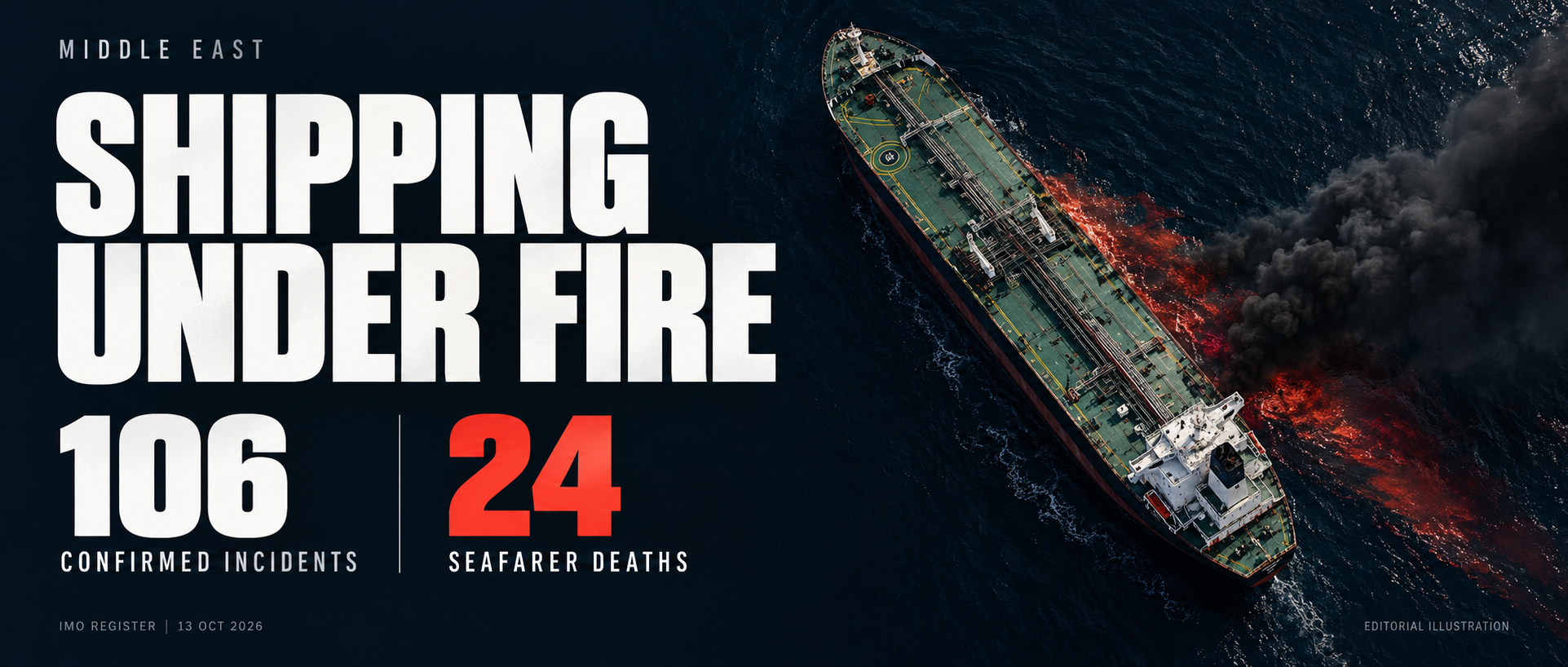

The IMO has confirmed 106 maritime security incidents and 24 seafarer deaths. Vessel losses, insurance claims and prolonged disruption reveal a wider cost that remains difficult to quantify.
Click here to read the full list of incidents:
Middle_East_Maritime_Incidents_English_Tables_2026-10-14.xlsx
More than seven months after the latest Middle East war escalated, merchant shipping continues to bear the consequences through deaths, damaged vessels, disrupted voyages and mounting insurance claims.
The International Maritime Organization’s Middle East incident register recorded 106 confirmed incidents and 24 seafarer fatalities as of 13 October 2026. Those figures provide an authoritative starting point, but they do not constitute a complete accounting of the war’s impact on commercial shipping.
An examination of the register identifies 104 distinct affected vessels after removing a repeat entry and separating out a drilling rig. A further nine named vessels appear in other official statements, investigations and news reports.
Together, those records cover at least 113 vessels. That is a compilation of identified cases with different levels of confirmation—not an IMO-endorsed total of ships attacked.
The distinction matters. Counting incidents, individual vessels, sinkings and insurance claims produces different measures of the same crisis.
A sustained pattern of disruption
A monthly breakdown of the IMO register shows that incidents have continued throughout the conflict. October had already accumulated 15 entries in the snapshot published on 13 October, matching September’s full-month total.
| Month, 2026 | Confirmed incidents | Recorded seafarer fatalities |
|---|---|---|
| March | 20 | 11 |
| April | 9 | 0 |
| May | 12 | 1 |
| June | 8 | 3 |
| July | 14 | 2 |
| August | 13 | 4 |
| September | 15 | 3 |
| October, through the 13 October snapshot | 15 | 0 |
| Total | 106 | 24 |
Calculated from the IMO register using incident dates. Zero indicates that no fatalities were listed in the relevant entries; it should not be read as a completed casualty assessment of every event.
The figures demonstrate persistence rather than a single, short-lived interruption. They do not, however, establish the probability of a vessel being attacked. That calculation would also require comparable data on the number of transits, routes taken and time spent in exposed waters.
Why 106 incidents does not mean 106 ships
The IMO register includes Hercules Star twice, for incidents on 1 March and 9 September. Its entry for 2 May names both the tug Volans and the barge Badr, but identifies the barge as damaged.
The list also includes Arabia III, a jack-up drilling rig rather than a conventional merchant ship. Its status as an offshore drilling unit is confirmed by operator Borr Drilling.
Counting Hercules Star once, excluding the rig and conservatively counting only the explicitly affected barge in the Volans/Badr entry produces 104 distinct vessels.
The additional nine cases identified outside that register are MSV Al Faiz Noore Soleimani-I, MSV Haji Ali, MSV Faize Noore Oliya, Encelia, NCC Masa, Daisy, Tihamah, Amzan and Ocean Molica.
Their records span the Strait of Hormuz, Gulf of Oman, Red Sea and Gulf of Aden. Evidence ranges from government and shipowner statements to reporting that still requires qualification. Several involve smaller regional trading vessels, illustrating why a tally focused exclusively on large oceangoing tankers would miss part of the commercial impact.
Sinkings, abandonment and detention carry different meanings
Four named sinking cases can be traced through the available records, although their evidentiary basis differs.
| Vessel | Incident date | Reported outcome and evidence |
|---|---|---|
| Safeen Prestige | 4 March | Subsequently recorded as sunk in the IMO register, with an oil slick detected. The incident date should not be treated as the sinking date. |
| MSV Al Faiz Noore Soleimani-I | 7 May | Reportedly sank after being caught in naval crossfire. Reporting citing the Indian Sailing Vessels Association recorded one crew member killed. |
| MSV Haji Ali | 13 May | Sank following an attack off Oman; all 14 crew members were rescued. A co-owner confirmed the vessel’s loss in an interview. |
| MSV Faize Noore Oliya | 4 August | Sank in the Red Sea; all 14 crew members were rescued. Yemen’s foreign ministry subsequently issued a statement. |
The Al Faiz Noore Soleimani-I sinking remains attributed to reporting citing the vessel association. The other cases draw on the IMO register, a shipowner interview or a government statement. They should not collectively be described as four sinkings confirmed by the IMO.
Abandonment presents another category. The IMO register explicitly records seven vessels as abandoned, while three entries record damaged vessels being detained or seized.
Evacuating a ship does not automatically make it a total loss. A vessel may remain afloat, be taken under tow and eventually return to service. Establishing its ultimate loss status requires subsequent evidence from owners, salvors, surveyors or insurers.
Military claims also require separate treatment. On 10 October, US Central Command said that, since its blockade resumed on 14 July, US forces had disabled four commercial vessels and destroyed 10 tankers linked to Iran’s Islamic Revolutionary Guard Corps. Without a complete vessel-level reconciliation, those claims cannot simply be added to the IMO figures. Nor does “destroyed” establish that every vessel sank.
The human toll extends beyond one register
The IMO’s 24 confirmed seafarer deaths are distinct from casualties among shore workers and rescuers.
A calculation from the register also identifies 47 explicitly recorded injuries and five missing seafarers. The injury count includes one person on the drilling rig. Separately, the Stena Imperative entry records one shipyard worker killed and two seriously injured.
The Red Sea attack on Tihamah illustrates the difficulty of reconciling casualty reports. The IMO issued a separate statement confirming multiple seafarer fatalities after the vessel was struck off Al Mokha, Yemen.
Other reporting recorded four crew members and two rescuers killed. However, Indonesia’s foreign ministry said on 13 August that one Indonesian crew member remained missing, conflicting with some accounts that had reported the individual dead.
Those differences prevent the figures from being combined uncritically into a definitive regional death toll.
Insurance claims approach $2 billion—but total losses remain unknown
One of the clearest public estimates of the financial impact emerged in early September.
On 3 September, gCaptain quoted David Osler, law and marine insurance editor at Lloyd’s List, as estimating approximately $2 billion in war-risk claims across more than 70 claims since fighting began.
That was an industry estimate at the time of publication. It was not an audited October total, a statement that all claims had been paid, or a calculation of shipping’s overall economic losses.
A much larger figure published by Allianz Commercial measures something different.
In June, Allianz estimated that approximately 1,150 cargo-carrying vessels above 100 gross tonnes were in the Persian Gulf awaiting the resumption of operations. Their combined vessel and cargo value was approximately $125 billion.
That represented assets exposed to disruption—not $125 billion of destroyed ships and cargo. It was also a historical assessment, rather than a current count of vessels stranded in October.
For shipowners, the bill can extend beyond physical damage to include salvage, towage, inspections, repairs, crew evacuation and lost operating time.
Cargo interests may face damaged goods, delayed deliveries, replacement purchases and additional inventory financing. Insurance recoveries can overlap with those losses, making simple addition misleading.
As of 14 October, the reviewed public sources did not provide a comprehensive, consistently defined total covering vessel damage, cargo losses, casualties, pollution and business interruption.
Alternative routes face their own exposure
The latest attacks suggest that commercial disruption remains acute.
The Financial Times reported on 13 October that six vessels had been attacked around Hormuz on 11 October, taking its two-week tally to 24. It also identified Chinese shipowner New Treasure Shipping among the interests affected.
That short-period media tally cannot be added to the IMO’s cumulative register. The Chinese ownership reference also requires vessel-level confirmation before a specific ship, condition or crew outcome can be assigned to it.
Meanwhile, attacks involving Encelia, NCC Masa, Daisy, Tihamah and Amzan demonstrate exposure along the Red Sea and Gulf of Aden corridor. Moving cargo away from Hormuz does not necessarily remove the security risks associated with its onward voyage.
For Chinese and international shipowners alike, the commercial question extends beyond whether a ship can make a single transit. It includes whether crews can be relieved safely, assistance and repairs remain available, insurance is obtainable on workable terms and cargo can reach its destination reliably.
The loss figures will continue to evolve as vessels are surveyed, missing-person cases are resolved and insurers assess claims. A durable recovery will depend on sustained safe passage and the restoration of the services that make commercial navigation possible.
Scope: This review covers publicly documented cases associated with the latest escalation beginning on 28 February 2026. It excludes naval vessel losses and cumulative Red Sea incident totals from 2023–2025.


READ MORE
 Safety
Attacked Just 42Days After Delivery: George Prokopiou’s 115,000-Dwt Tanker Hit in Hormuz
 Safety
Five Seafarers Reported Dead as Puntland Retakes Hijacked Tanker Honour 25
 Safety
China-U.S. Consensus Highlights Free Navigation: No Country or Entity Should Impose Transit Fees on International Waterways
 Safety
US Says It Disabled Hong Kong-Owned Bulker off Oman
 Safety
1 seafarer killed, Fatal attack in the Strait of Hormuz: Capesize bulker CAPE DAO hit by unknown projectile
 Safety
25 Crew Abandon MSC Container Ship in the South China Sea — All Rescued, Vessel Still Adrift
 Safety
MSC Hermes III Adrift Unmanned in South China Sea After 25 Crew Abandon Ship
 Safety
Dangerous Goods Container Fire Reported at NPCT1 Terminal in Jakarta
 Safety
Suspected Cyber Incident Diverts LNG Carrier After Cargo-Control Failure
 Safety