


Hengli Signs 11 VLAC Contracts in One Week
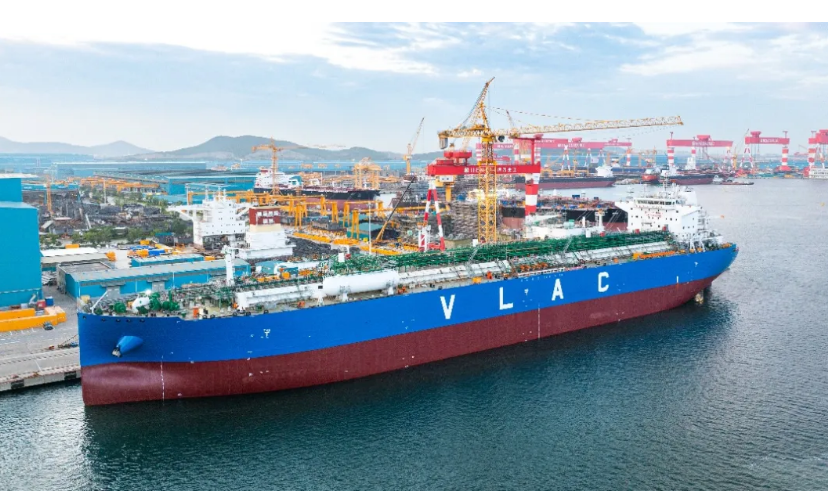

The Chinese shipbuilder is expanding its large gas-carrier business across three vessel sizes, building on repeat orders from international owners and investment in cargo-tank and engine manufacturing.
Hengli Heavy Industries has signed contracts for 11 very large ammonia carriers (VLACs) within a single week, extending its expansion into a specialised shipbuilding market alongside its established bulker and tanker business.
The contracts cover vessels of 88,000, 90,000 and 93,000 cubic metres, the company said. Buyers, contract values, delivery schedules and the number of ships in each size category were not disclosed.
Hengli says it already held the world’s largest VLAC orderbook before the latest agreements. The announcement did not provide an updated vessel total.
The Dalian-based shipbuilder, part of China’s Hengli Group, acquired the former STX Dalian assets in 2022 and began operating its shipbuilding industrial park in January 2023. Its subsequent expansion into gas carriers has combined initial group-backed projects with orders from overseas owners.
Repeat orders broaden the customer base
Hengli’s VLAC programme dates to 2024, when industry reports identified an initial order for four 93,000-cubic-metre vessels from its parent group. Those projects established a starting point for the yard’s entry into large gas-carrier construction.
International contracting subsequently gathered pace. In July 2026, Hengli disclosed six effective VLAC construction contracts with three international shipowners: four vessels of 93,000 cubic metres and two of 88,000 cubic metres.
A further expansion followed in September, when Greek shipping group Dynacom agreed to build six 93,000-cubic-metre VLACs and two very large crude carriers at Hengli. The combined eight-ship package was valued at nearly $1 billion. Together with an earlier pair, the agreement increased Dynacom’s VLAC programme at the yard to eight ships.
That relationship illustrates how Hengli has expanded through existing customers. Its cooperation with Dynacom began with Kamsarmax bulk carriers before extending into large crude tankers and gas carriers. Hengli had already delivered bulkers and VLCCs to the group before the latest VLAC expansion.
For Hengli, repeat contracting provides a commercial route into increasingly demanding vessel categories. For owners, extending an established yard relationship offers continuity in supervision and project management, although each new ship type brings its own engineering and operational requirements.
Manufacturing capacity supports the expansion
Hengli attributes the latest contracts partly to its ability to manufacture and integrate key equipment, including Type A cargo tanks, dual-fuel main engines and generating sets.
The potential advantage lies in coordinating equipment production with hull construction. Large gas-carrier programmes require close alignment between cargo-tank fabrication, structural assembly, machinery installation and commissioning. Greater control over these interfaces can help a yard manage production schedules across a series of vessels.
Hengli delivered its first locally manufactured LPG dual-fuel engine on October 28, 2025. The unit can operate on liquefied petroleum gas or diesel. Hengli Engine (Dalian) is listed by Everllence, formerly MAN Energy Solutions, as a licensed manufacturer of its two-stroke engines.
Ship construction has also reached a significant milestone. Hengli launched its first 93,000-cubic-metre VLAC on June 23, 2026, before moving it alongside for outfitting. According to the company, the vessel incorporated cargo tanks manufactured in-house and a Hengli-built LPG dual-fuel engine.
The vessel was assembled on a slipway and launched using a floating dock. This approach gives Hengli another production route for gas carriers, offering greater flexibility when allocating facilities across its tanker, bulker and other shipbuilding programmes.
As the VLAC series grows, the commercial benefit will depend on how consistently the yard can coordinate tank fabrication, machinery supply and commissioning. Hengli has not disclosed project-level figures quantifying the resulting cost or construction-time savings.
Cargo flexibility connects current and future markets
The investment case for these ships extends beyond the prospective marine ammonia-fuel market.
Hengli’s published specification for its 93,000-cubic-metre VLAC design includes the ability to carry ammonia, propane and butane. That cargo flexibility offers owners access to established LPG trades while new ammonia supply chains develop.
Longer-term ammonia demand could come from power generation, energy transport and marine fuels, alongside existing industrial uses. The timing of new production plants, offtake agreements and terminal investment will determine when those opportunities translate into sustained shipping demand.
In a September commentary, DNV gas-carrier executive Martin Cartwright cited analysis suggesting that seaborne ammonia trade for energy use could reach around 120 million tonnes annually by 2050. He also highlighted project delays, reductions and cancellations, stressing the need to develop ships, terminals and storage infrastructure together.
For Hengli, the immediate task is to organise an expanding gas-carrier programme across three vessel sizes. The latest contracts broaden that programme, while repeat business supplies an established customer base. Delivery performance, cargo-system reliability and the results achieved across successive vessels will shape the yard’s ability to secure further orders.


READ MORE
 Shipbuilding
China ZWI Enters Ocean Shipping with VLGC Acquisition and Chemical Tanker Newbuild Project
 Shipbuilding
World’s First 325,000-DWT Methanol Dual-Fuel Ore Carrier Delivered
 Shipbuilding
CIMC Raffles Extends NOCC Car Carrier Programme to 2030
 Shipbuilding
Hengli Secures 12 Tanker Orders, Retaining World’s Largest VLCC Orderbook
 Shipbuilding
Grimaldi Advances New ConRo and Multipurpose Projects as Fleet Renewal Continues
 Shipbuilding
COSCO Shipping Specialized Carriers Shifts Eight 60,000-DWT Heavy-Lift Ships from Chengxi to Dalian
 Shipbuilding
DryDel Orders Two Kamsarmax Bulkers at Tsuneishi
 Shipbuilding
Erasmus Orders Two More Feeders in Fourth Huangpu Wenchong Deal in Six Months
 Shipbuilding
Chipolbrok Begins Construction of First 60,800 DWT Forward-Accommodation Heavy-Lift Vessel
 Shipbuilding