


A Frenchman's View of Chinese Shipbuilding: GTT's Adnan Ezzarhouni on a Decade in China

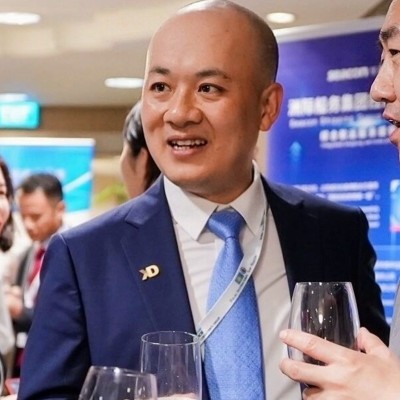
China's share of LNG carrier construction is likely to grow further, but sustaining that expansion will depend on the combined capabilities of shipyards, suppliers, engineering teams and quality systems, according to Adnan Ezzarhouni, general manager of GTT China. Drawing on around a decade working in the country, the French executive sees further opportunities in gas shipping while identifying labour availability and automation as important factors in the industry's future.
Speaking during an onstage interview at the TradeWinds Shipowners Forum in Hong Kong on 18 November 2026, Ezzarhouni recalled arriving in China when GTT's local technical support team was relatively small and its work focused largely on LNG carrier projects at Hudong-Zhonghua. The involvement of additional shipyards has widened the market for cooperation. His personal experience forms part of a longer industrial relationship: as Xinde Marine News reported in December 2021, Hudong-Zhonghua and GTT began technical cooperation in 2001 and signed a technical cooperation agreement in 2002.
The day before the interview, GTT announced another contract involving the Chinese yard. On 17 November, GTT Energy said it had received an order from Hudong-Zhonghua for the tank design of five new LNG carriers to be built for MISC. Each vessel will have a capacity of 174,000 cubic metres and use the NO96 Super+ membrane containment system, with deliveries scheduled between the fourth quarter of 2029 and the third quarter of 2030. The project connects a Chinese shipbuilder, an international shipowner and a French technology provider through a single series of specialised vessels.
Ezzarhouni's discussion of China's LNG shipbuilding capabilities repeatedly returned to the industrial ecosystem supporting construction. Shipyards need suppliers capable of producing critical equipment and components, alongside engineering expertise and technical assistance throughout a project. GTT's role includes technology licensing, engineering preparation and continuing support during construction. For the yard, these different contributions must come together in production processes that deliver vessels consistently across successive projects.
Quality requirements shape that process. Ezzarhouni described the demanding testing involved in containment-system construction and the challenges shipyards face as they develop the necessary capabilities. Progress requires sustained work by both partners, from understanding the design and mastering production methods to completing tests and resolving issues on site. In this account, technical cooperation involves an accumulation of practical engineering work through which both manufacturing capability and confidence in the partnership develop.
GTT's agreement with Hengli Shipbuilding offers a further example of how new participants prepare to enter this field. On 22 January 2025, GTT announced a Technical Assistance and License Agreement with the Dalian-based shipbuilder covering applications including LNG and ethane carriers. Hengli's qualification process began in 2024 and included study cases and the construction of a Mark III technology mock-up. The sequence illustrates the engineering preparation involved in adopting a containment technology, with production methods and project experience providing the connection between licensing and shipbuilding capability.
When discussing how foreign technology providers can succeed in China, Ezzarhouni repeatedly characterised Chinese partners as pragmatic. His experience suggests that a clear, credible business case is essential: a supplier needs to explain what value its technology will bring to the specific project. Chinese partners, he said, are willing to consider technology developed overseas when they can see a practical benefit from adopting it.
Understanding local culture has also been an important part of his work. Ezzarhouni recalled arriving with a French way of thinking and gradually learning about local culture and business practices through work and exchanges across China. That experience reinforced the importance of taking time to understand how partners assess problems and make decisions. For a technology business, the relationship develops through repeated engagement with the people responsible for putting a project into practice.
His description of trust was similarly specific. Partners want to understand the local representative: how that person behaves, how they handle problems and whether they can be relied upon. They then develop a deeper understanding of the enterprise and technology behind that individual. Maintaining a presence, responding to practical questions and providing consistent support can help establish dependable working relationships. LNG carrier projects extend across design, construction and subsequent technical support, giving those relationships a long period over which to be tested.
Ezzarhouni also sees opportunities in gas transportation beyond LNG. He discussed ethane trade, particularly the relationship between US supply and demand for petrochemical feedstock in Asia. Petrochemical producers' comparisons of feedstock economics can influence procurement and transport arrangements, creating demand for large gas carriers. In this market, containment technology and vessel design are closely connected to the customer's requirements for securing and moving raw materials.
One publicly disclosed example is the cooperation between Jiangnan Shipyard and Eastern Pacific Shipping. On 19 September 2024, GTT announced an order for the tank design of six 150,000-cubic-metre ultra-large ethane carriers to be built by Jiangnan for EPS, using the Mark III membrane containment system. GTT also said that the 150,000-cubic-metre ULEC design developed with Jiangnan had received Approval in Principle in 2019. The progression from design development to a shipowner's order shows how technical cooperation can develop around a specific transportation requirement over several years.
The Chinese market also offers applications in onshore storage. In April 2023, GTT and PipeChina Engineering Technology Innovation Co. Ltd., a subsidiary of PipeChina, signed a cooperation agreement to evaluate and further promote GTT's GST membrane full-containment tank technology for upcoming PipeChina LNG projects. Ezzarhouni signed the agreement on behalf of GTT China. Shipbuilding, gas transportation and onshore storage present different engineering conditions, requiring technology providers to understand the operating requirements of customers across the gas supply chain.
Asked about the biggest challenges ahead, Ezzarhouni turned first to labour. In his assessment, changes in employment in the construction sector have provided some workers for shipbuilding, while future demographic and labour-supply changes could create pressure for the industry. His comments raise a practical question about the durability of production capacity: expanding construction activity also requires training skilled people, staffing critical operations and maintaining stable performance over time.
Automation consequently featured prominently in the latter part of the interview. Ezzarhouni sees China's industrial capabilities, supplier base and capacity to apply technology as favourable conditions for greater automation in shipbuilding. He hopes improvements in production methods can reduce labour intensity and ease pressure on personnel. This expectation connects with his earlier emphasis on the wider industrial ecosystem: introducing new production tools requires equipment, processes, technical support and effective application on the factory floor to work together.
There is already a concrete example within GTT's cooperation with Hudong-Zhonghua. Xinde Marine News reported that Ezzarhouni took part in the launch of a new automated insulation-box production line at the yard in December 2021. Insulation-box manufacturing is an important part of containment-system production. Such projects connect technology with a specific manufacturing operation, providing a practical setting in which automation can support LNG shipbuilding.
Ezzarhouni expects energy trade and the transportation of related gases to generate demand for additional vessels and new ship types. Supporting that demand will require continued cooperation between GTT and shipyards on technology applications and production methods, helping sustain the construction capabilities needed by the global gas-shipping market.


READ MORE
 Shipbuilding
Global Shipping Briefing: COSCO Orders 16 VLCCs, Hapag-Lloyd Raises Earnings Outlook
 Shipbuilding
Chemnav Linked to Another Suezmax Pair at Jinglu
 Shipbuilding
Inside Waigaoqiao Shipbuilding: How China Is Building Its Cruise Ship Capabilities
 Shipbuilding
40 VLCCs! COSCO SHIPPING Energy Unveils Mega Newbuilding Programme
 Shipbuilding
Asia Break Bulk Partners with Schoeller and Columbia on Four Heavy-Lift Newbuildings
 Shipbuilding
China Delivers Its Second Large Cruise Ship as 13-Year Development Programme Concludes
 Shipbuilding
China Merchants Advances Another Shipyard Revival in Quanzhou
 Shipbuilding
Up to 34 Newbuilds: Why China Is Central to Venergy’s Expansion
 Shipbuilding
Nanjing Tanker Proposes US$324 Million Investment in 14 Newbuildings
 Shipbuilding