


Attacked Just 42Days After Delivery: George Prokopiou’s 115,000-Dwt Tanker Hit in Hormuz


A new tanker delivered by a Chinese shipyard just six weeks earlier has been struck by an unidentified projectile in the Strait of Hormuz, sustaining damage to its engine room.
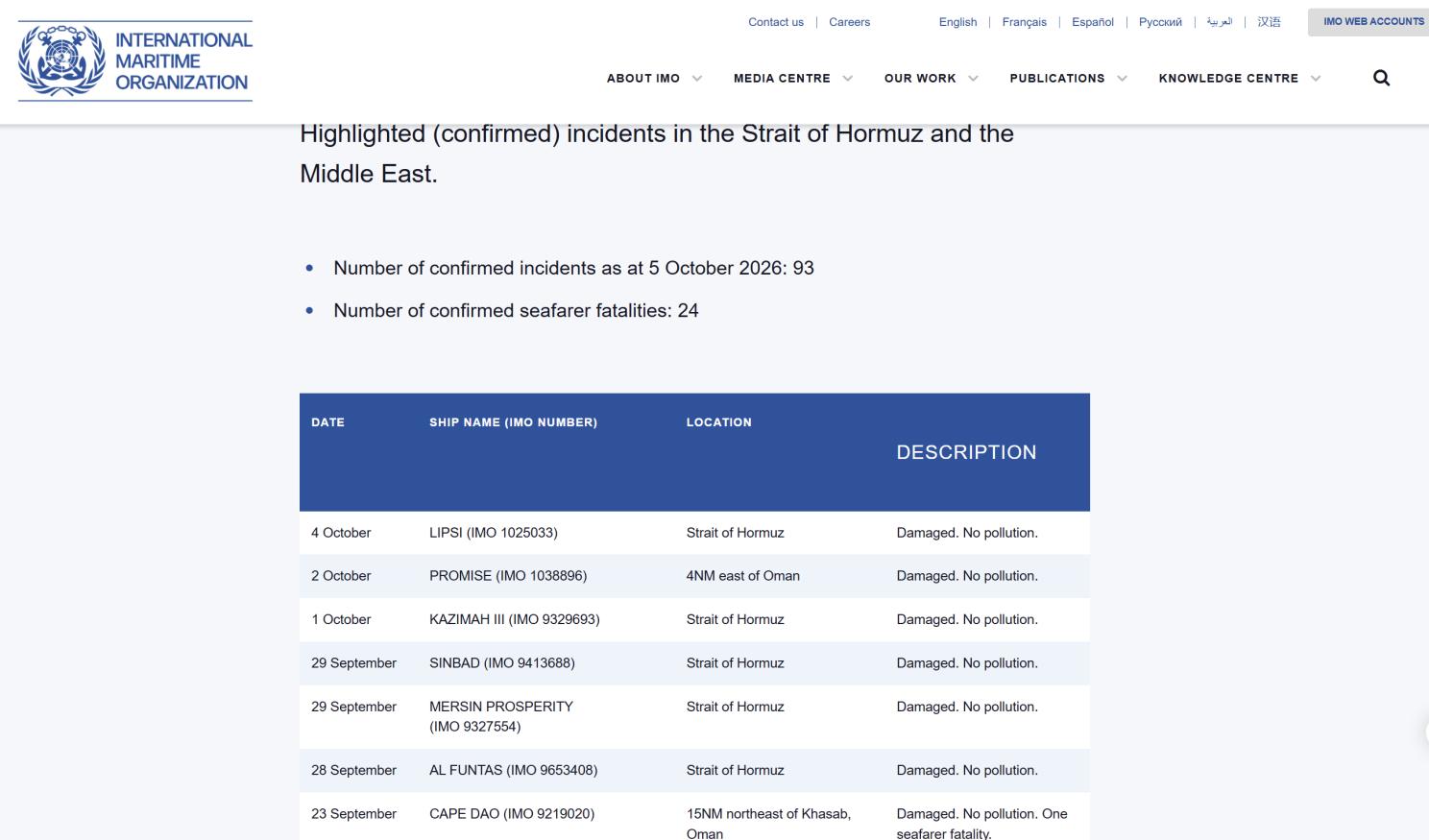
The 115,000-dwt LR2 tanker Lipsi, operated and managed by George Prokopiou’s Dynacom Tankers Management, was hit on 4 October. Initial reports said the crew were safe and no pollution had been reported. A subsequent navigational warning identified the vessel as drifting in the strait, and the International Maritime Organization (IMO) has included the incident in its list of confirmed events.
The journey from a Chinese shipyard’s delivery ceremony to a security incident on one of the world’s most sensitive energy routes took little more than a month. For Dynacom, Lipsi is the third tanker reported struck in the wider Hormuz area in less than three months.
The repeated incidents also bring the Greek company’s commercial choices into focus. While many owners remain cautious about operating in high-risk waters, Dynacom has continued to participate in Persian Gulf trades. The financial incentive is substantial: tanker services requiring passage through Hormuz are commanding markedly higher market returns than several other major routes.
Delivered 160 days early, then hit shortly after entering service
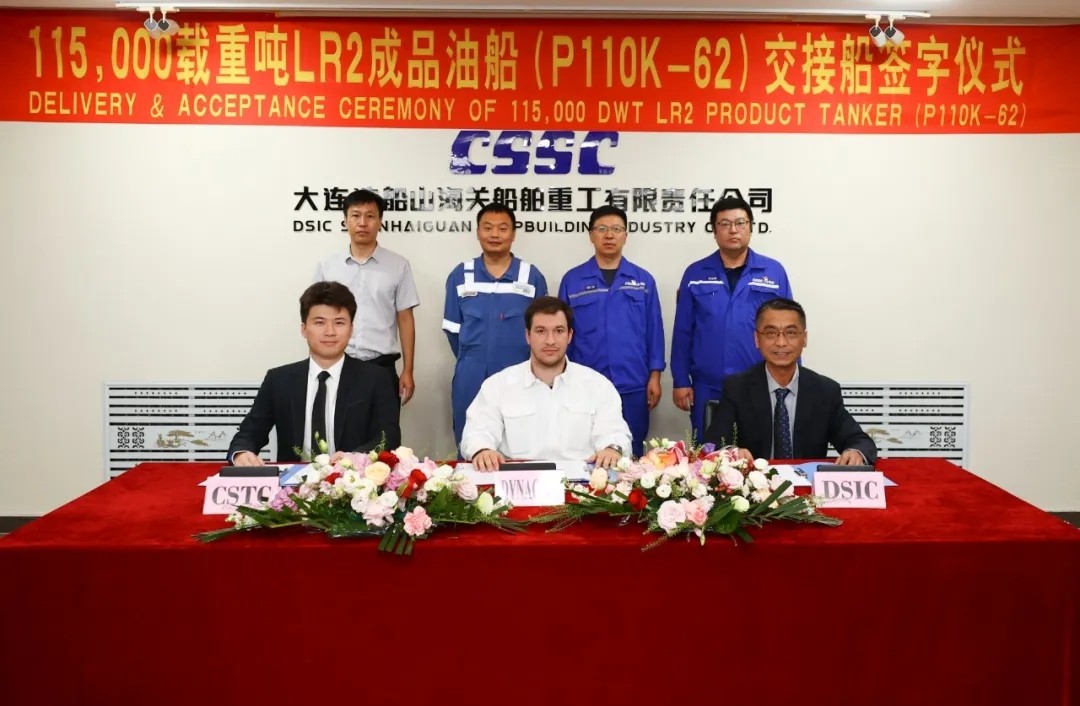
Lipsi was built by Shanhaiguan Shipbuilding, part of CSSC’s Dalian Shipbuilding group, and delivered to Dynacom on 24 August 2026—160 days ahead of its contractual delivery date. Approximately 249.8 metres long and 44 metres wide, the LR2 tanker is designed to carry both crude oil and refined petroleum products.
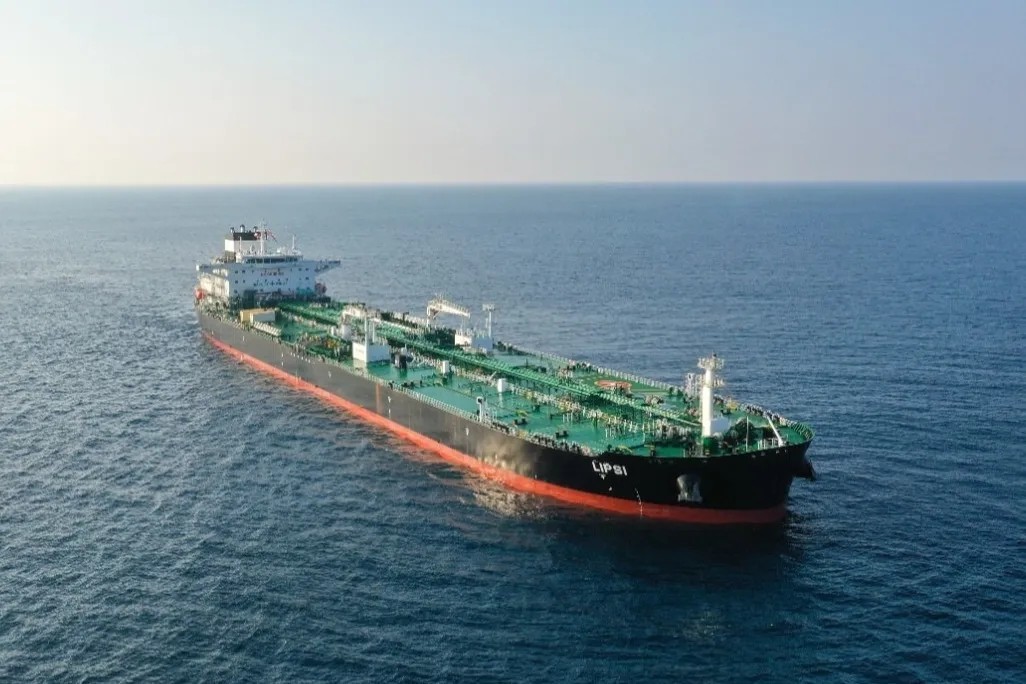
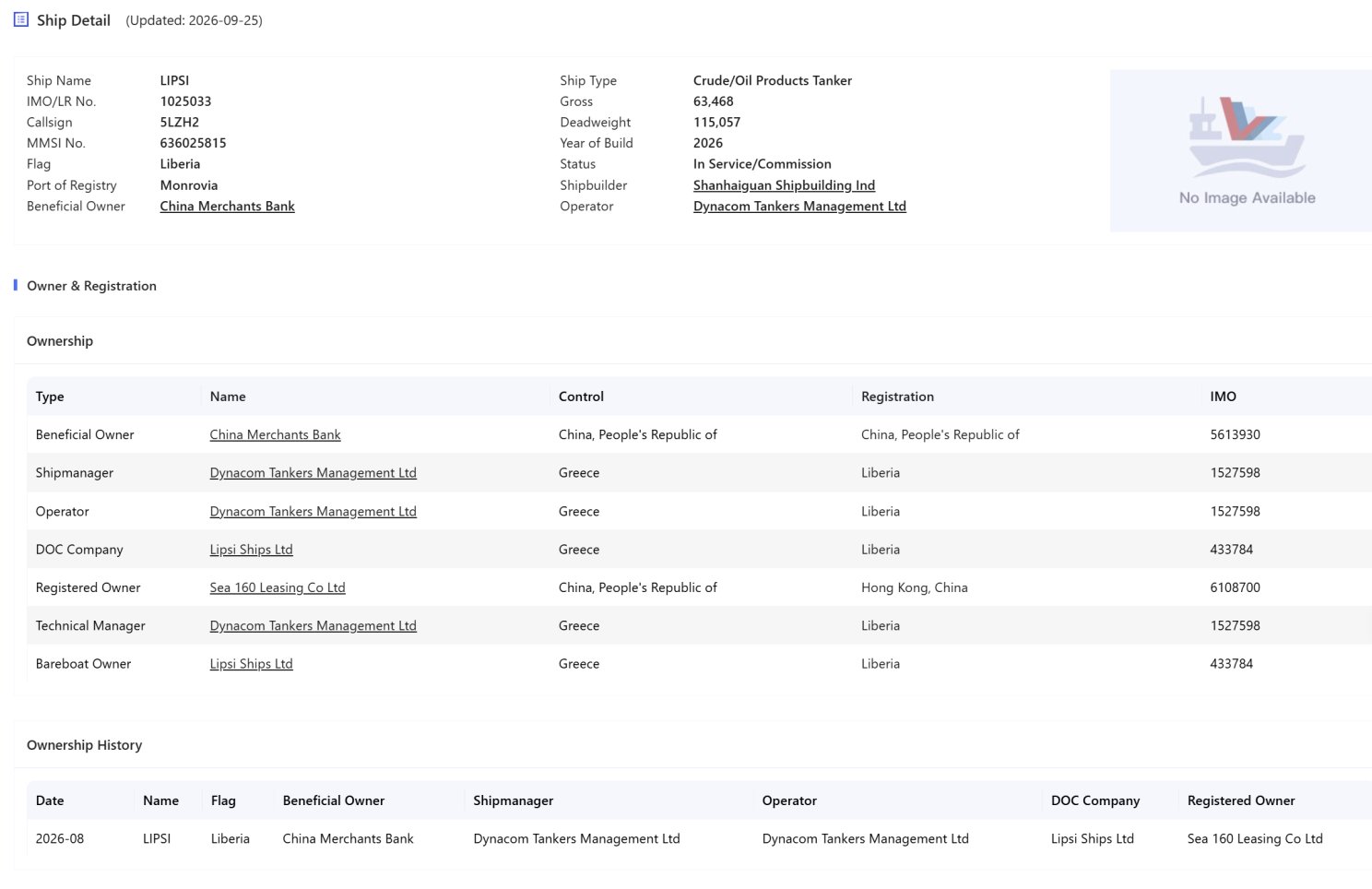
The vessel flies the Liberian flag and carries IMO number 1025033. TradeWinds has reported that its ownership structure involves a Chinese leasing institution, with Dynacom responsible for its operation and management.
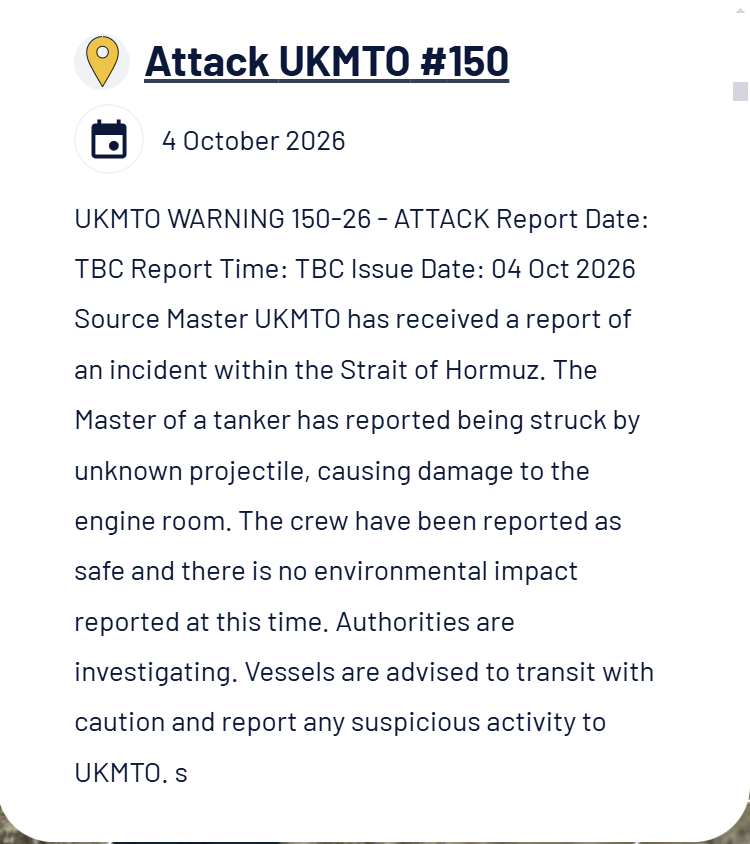
UK Maritime Trade Operations (UKMTO) Warning 150-26 stated that the master of a tanker had reported being struck by an unknown projectile in the Strait of Hormuz, causing engine-room damage. The initial UKMTO notice did not name the vessel or identify the party responsible. Maritime security firm Vanguard Tech subsequently identified the tanker as Lipsi.
A NAVAREA IX navigational warning also named Lipsi, reporting that it was drifting approximately 3.9 nautical miles northeast of Jazirat Um Al Fayarin and advising mariners to exercise caution. The IMO’s confirmed-incident list separately records Lipsi as damaged on 4 October, with no pollution.
The engine-room damage and subsequent drifting indicate that the incident affected the vessel’s ability to navigate normally. At the time of the initial reports, the full extent of the damage, repair arrangements and timetable for returning to service had not been publicly established.
There were 41 elapsed days between delivery on 24 August and the attack on 4 October, or 42 calendar days if the delivery date is counted as day one. The vessel appears to have been on its maiden trading voyage after leaving Shanhaiguan. For a tanker at the very beginning of its commercial life, the incident is particularly striking.
Repeated attacks in Hormuz, explosions near the Red Sea entrance
Lipsi was struck during a renewed concentration of maritime security incidents around the Strait of Hormuz.
The IMO’s confirmed-incident list records damage to Sinbad and Mersin Prosperity in the strait on 29 September, followed by Kazimah III on 1 October, Promise east of Oman on 2 October, and Lipsi on 4 October. As of 5 October, the IMO’s relevant list for Hormuz and the wider Middle East contained 93 confirmed incidents and recorded 24 seafarer fatalities. Those are cumulative figures, illustrating the human and operational consequences of the continuing crisis.
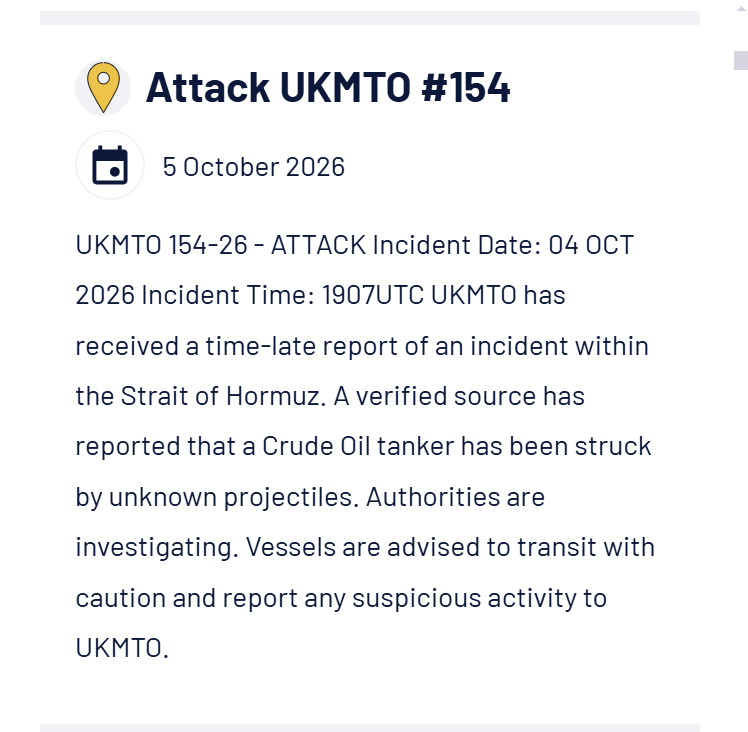
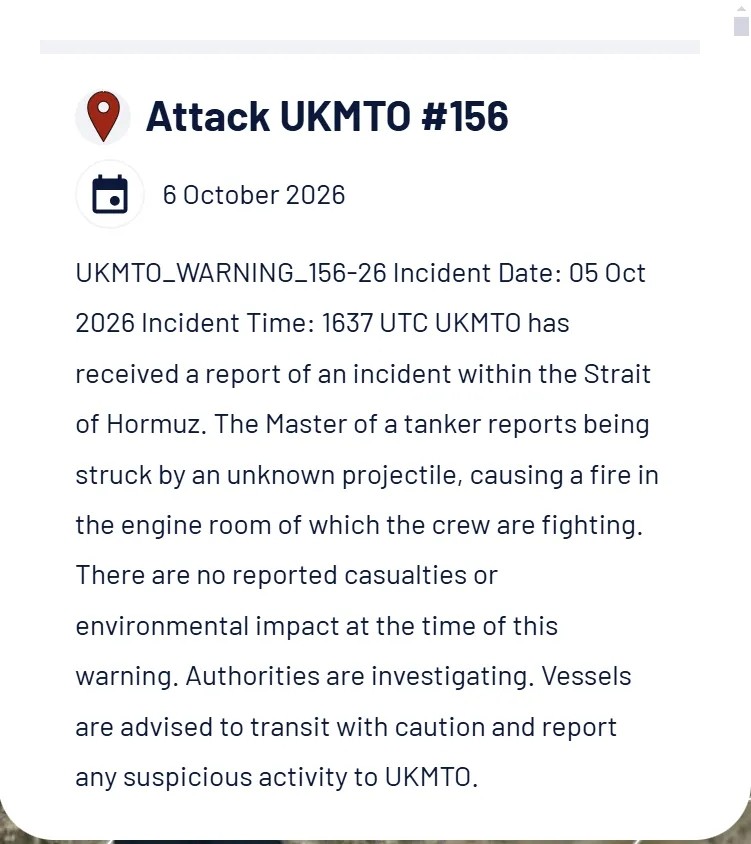
The danger persisted on 5 October. UKMTO issued four attack warnings within roughly four hours, according to reporting that day. Three concerned incidents on 3 and 4 October that had been reported late; the fourth concerned a vessel struck on 5 October, with a fire in its engine room. The reporting delays also underline why the date a warning is issued should not automatically be treated as the date of an attack.


In a separate advisory on 5 October, UKMTO said an inbound tanker approximately 11 nautical miles north of Khasab, Oman, had been hailed by Iran’s Islamic Revolutionary Guard Corps and instructed to turn back or face being targeted. The master confirmed that the vessel had complied.
For owners and charterers, the exposure therefore extends beyond physical damage. A vessel can remain intact while its planned voyage is interrupted or prevented from proceeding.
Conditions near the southern entrance to the Red Sea were also unsettled. On 4 October, the approximately 74,000-dwt product tanker Chrystal Sky reported multiple explosions around 60 nautical miles south of Mokha, Yemen. One reportedly occurred about 100 metres off its starboard side. The vessel, operated by Singapore-based Executive Ship Management, was sailing from Sikka, India, to Barcelona. Initial reports indicated no damage, and it continued its voyage.
The incident came amid an escalation in the conflict in Yemen and confrontation between Saudi Arabia and the Houthis. Saudi oil shipping along the Red Sea coast had already faced threats, including an August incident in which a tanker was struck west of Yanbu and suffered a fire. Shifting exports towards the Red Sea to reduce dependence on Hormuz therefore introduces another set of port and transit risks.
The two chokepoints affect different parts of the transport chain. Hormuz governs access between the Persian Gulf and the open sea; Bab el-Mandeb and the southern Red Sea connect the Indian Ocean with the Suez route. Simultaneous disruption narrows owners’ routing options and spreads the costs of waiting, diversion and cargo transfers through the wider shipping network.
A Hengli-built VLCC was also hit
For Prokopiou, the Lipsi incident follows several earlier attacks involving Dynacom-managed vessels.
Around 19–20 July, the tankers Acheloos and Kavomaleas were struck in the wider Hormuz area.
Acheloos is a 306,000-dwt VLCC delivered by Hengli Heavy Industries. The Chinese shipbuilder named and delivered Acheloos and its sister vessel Evros on 5 June, meaning Acheloos had been in service for only about a month and a half when it was attacked. Security reports indicated a strike affecting the steering-gear compartment.
Kavomaleas, a roughly 75,000-dwt LR1 tanker built in 2025, was struck by two projectiles of unknown origin, according to Dynacom’s statement at the time. The crew subsequently identified an engine-room fire. After deploying the onboard fire-suppression system, the master ordered an evacuation, and the crew were safely transferred ashore.
Dynacom’s exposure also extended to the Black Sea. On 19 July, the tanker Asia was attacked by drones while loading at the Caspian Pipeline Consortium’s offshore export terminal near Novorossiysk. The resulting fire was brought under control. The terminal primarily exports crude from Kazakhstan, underscoring the importance of a vessel’s operating location in determining its exposure to conflict.
Taken together, these publicly reported incidents identify at least four Dynacom-managed tankers struck this year in the Hormuz region and the Black Sea. Two—Acheloos and Lipsi—were recently delivered ships built in China.
A young fleet and modern equipment can improve operating efficiency and commercial competitiveness. They offer limited protection against the external threat posed by armed conflict.
How much more does a Hormuz voyage pay?
The scale of the earnings gap helps explain why some owners continue to accept Persian Gulf employment.
The Baltic Exchange’s Week 40 tanker report, published on 2 October, gave the following round-trip time-charter-equivalent (TCE) assessments for major VLCC routes:
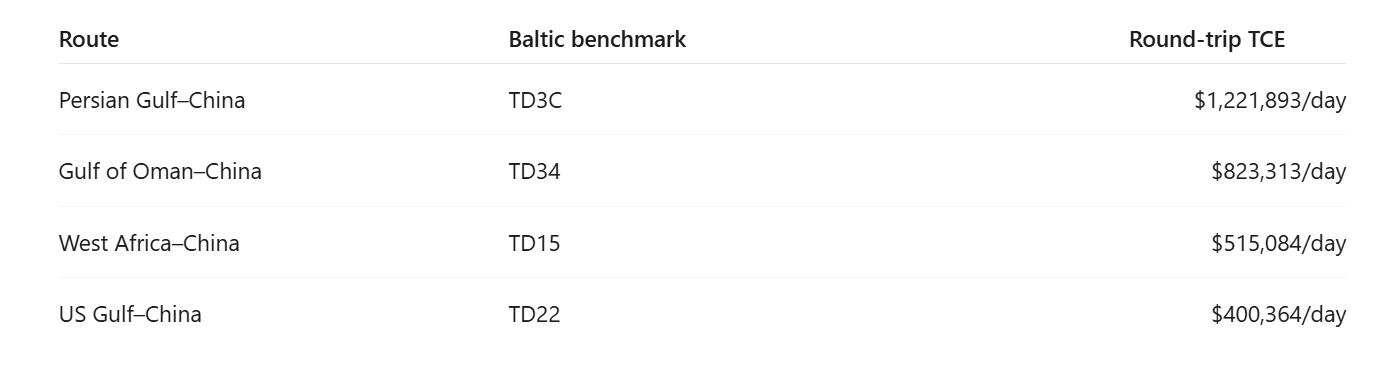
On those assessments, Persian Gulf–China earnings were approximately 2.37 times the West Africa–China figure and 3.05 times the US Gulf–China figure. They were also around 48% higher than the Gulf of Oman–China assessment.
A China-bound voyage loading in the Gulf of Oman does not require the vessel to pass through Hormuz after loading, although operations there remain exposed to regional security conditions and the wider balance of available tonnage.
The differences create a powerful incentive for owners willing to enter the Persian Gulf. However, they also reflect voyage length, vessel positioning and supply-and-demand conditions. The entire gap should not be interpreted as a discrete fee for taking the risk of transiting Hormuz.
A similar contrast is visible in the LR2 market, which is more directly relevant to Lipsi. In the same Baltic report, the Persian Gulf–Japan TC1 route generated a round-trip TCE of approximately $268,900/day, compared with about $67,800/day on the Mediterranean–East TC15 route—a difference of almost four times.
The million-dollar daily figures concern VLCCs and should not be applied to Lipsi. TCE is a voyage-based earnings measure, rather than company net profit, and neither the actual freight agreed for Lipsi’s voyage nor Dynacom’s realised return has been publicly established.
In an early-October analysis, Poten & Partners highlighted the combined effects of war-related inefficiencies, attack exposure, higher insurance costs and restrictions on available tonnage. For a VLCC discharging in Asia, the choice between repositioning to the US Gulf, West Africa or the Persian Gulf now presents sharply different potential returns. Those differences influence where owners send their ships, further reshaping vessel availability across regions.
Prokopiou’s commercial approach
Dynacom’s publicly reported Persian Gulf activity illustrates an approach involving higher risk in pursuit of higher returns. When other operators reduce their participation, the company continues to offer transportation and can seek the premiums created by scarce available tonnage and difficult passage conditions. This is an interpretation of its observable commercial behaviour; individual voyage approvals, risk assessments and contractual returns have not been fully disclosed.
Prokopiou’s willingness to accept risk predates the present crisis. A Financial Times profile published in March cited remarks he made in 2014, describing risk-taking as a fundamental part of shipping. After traffic through Hormuz was severely disrupted this year, Dynacom vessels including Shenlong and Smyrni completed transits, followed by further activity involving Marathi and Pola.
The commercial logic rests on differences in owners’ willingness and ability to accept exposure. When some companies suspend or avoid a trading area, producers still need to export and buyers still need cargoes delivered. The owners prepared to provide that service gain greater bargaining power. A vessel able to arrive promptly, meet loading requirements and complete the voyage becomes especially valuable.
Dynacom has also continued to invest in new tonnage. Following an additional order for four VLCCs at Hengli, reporting in August put its cumulative VLCC orders at that yard at 20, of which four had then been delivered. The company was also pursuing newbuilding projects at other Chinese yards.
Its continued Persian Gulf activity and fleet investment therefore represent two related commercial commitments: accepting more exposed employment in pursuit of higher voyage returns, and increasing its longer-term exposure to the tanker market.
The first depends on completing individual voyages safely. The second depends on the market providing adequate returns after new ships enter service. Exceptional current earnings strengthen the appeal of investment, while also creating a risk that long-term capital decisions become anchored to unusually high short-term returns.
Recovering exports do not mean normal shipping conditions
One of the most easily misunderstood features of the current market is that Middle Eastern oil exports can recover while maritime security deteriorates.
Reuters reported on 5 October, citing preliminary Kpler data, that regional crude exports exceeded pre-war levels on 14 days in September. The seven-day moving average stood at approximately 18.3 million barrels per day on 30 September.
That regional measure includes shipments through Hormuz, Red Sea exports, and movements from terminals and ship-to-ship transfers in the Gulf of Oman. It should not be read as evidence that traffic through Hormuz itself has fully returned to normal.
The organisation of voyages is also changing. The Wall Street Journal reported on 5 October that some VLCCs were performing shuttle runs: entering the Persian Gulf through Hormuz, loading oil, exiting the strait and transferring the cargo to another vessel outside it. Such arrangements help sustain exports, but add transfers, waiting time and vessel commitments.
Moving the same barrel of oil may consequently require more ships, more complex operations and more time before it reaches the final buyer. Export recovery and exceptionally high freight rates can therefore coexist. The cargo continues to move, while the cost and allocation of transport risk change substantially.
For operators such as Dynacom, continued participation offers unusual revenue opportunities. Repeated attacks show that the potential losses behind those premiums can also materialise. Repairs, towing, assistance, downtime and subsequent scheduling disruption can erode the expected return from a lucrative fixture. Crew safety carries consequences that cannot be reduced to a freight calculation.
Lipsi’s passage from delivery 160 days ahead of schedule to engine-room damage roughly six weeks later captures the tension in today’s tanker market. New vessels are entering service, cargo interests urgently need transportation, and owners prepared to accept greater exposure can command higher prices. Reliable passage remains elusive.
For Prokopiou, continuing to transit Hormuz offers higher potential returns while repeatedly exposing vessels to risks that have already affected several ships under Dynacom’s management. High freight rates can attract tonnage into dangerous waters. Completing each voyage safely remains essential to turning those opportunities into lasting commercial returns.


READ MORE
 Safety
China-U.S. Consensus Highlights Free Navigation: No Country or Entity Should Impose Transit Fees on International Waterways
 Safety
1 seafarer killed, Fatal attack in the Strait of Hormuz: Capesize bulker CAPE DAO hit by unknown projectile
 Safety
25 Crew Abandon MSC Container Ship in the South China Sea — All Rescued, Vessel Still Adrift
 Safety
Five Seafarers Reported Dead as Puntland Retakes Hijacked Tanker Honour 25
 Safety
MSC Hermes III Adrift Unmanned in South China Sea After 25 Crew Abandon Ship
 Safety
Dangerous Goods Container Fire Reported at NPCT1 Terminal in Jakarta
 Safety
Suspected Cyber Incident Diverts LNG Carrier After Cargo-Control Failure
 Safety
Xinde Marine Forum London 2026: Shipping Moves from Lean Logistics to Resilience by Design
 Safety
Almost the Entire Black Sea Is Now a War-Risk Listed Area
 Safety