


Sinokor’s Hormuz Windfall Meets Reality as Loaded VLCC Is Hit and Crew Evacuated
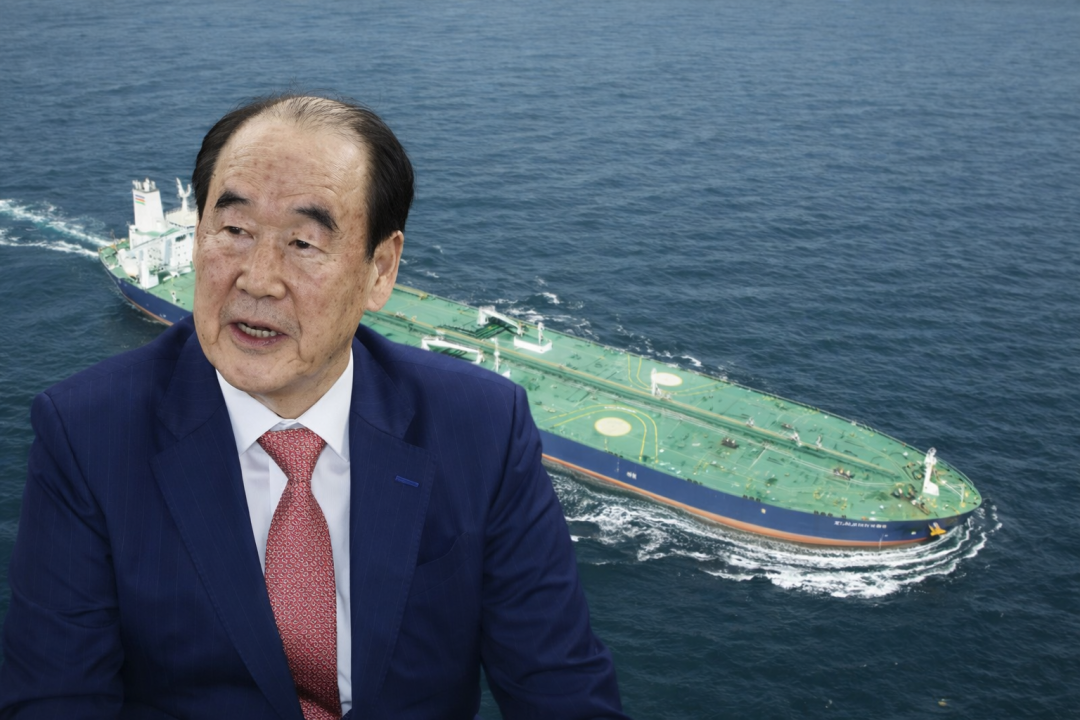

The world’s largest commercial VLCC operator has been one of the clearest beneficiaries of record tanker rates generated by the Hormuz crisis. Now the same risk premium that helped lift earnings to extraordinary levels has materialised on one of its own ships, after the fully laden Senegal Prosperity was struck, disabled and evacuated.
A fully laden VLCC operated by South Korea’s Sinokor Maritime has been left without propulsion and listing in the Strait of Hormuz after being hit by three projectiles described by maritime security authorities as “rockets”, putting one of the tanker market’s biggest recent winners directly in the path of the risk that has driven freight rates to historic highs.
The Joint Maritime Information Center, or JMIC, confirmed on September 1 that the 320,780-dwt Senegal Prosperity had sustained damage to its port-side engine room and ballast tank. Communications were subsequently lost, the vessel became dead in the water and developed a port list before anchoring.
All crew members were evacuated by local authorities and no casualties have been reported.
Reuters reported that the tanker was carrying about 2 million barrels of Saudi crude loaded at Juaymah.
There is so far no confirmed report of damage to the cargo tanks or any release of crude oil. The distinction is important: damage to a ballast tank does not in itself mean that cargo containment has been breached.
For Sinokor, however, the casualty carries significance well beyond one ship.
The Korean owner entered the Hormuz crisis after completing one of the most aggressive VLCC acquisition programmes seen in the tanker market in years. By the time escalating conflict sharply reduced commercial traffic through the strait, Sinokor had accumulated a fleet large enough to give it exceptional exposure to — and bargaining power in — the shrinking pool of ships willing to trade into the Gulf.
By August, estimated earnings for VLCCs prepared to load inside the Strait of Hormuz had reached as much as $800,000 per day.
The Senegal Prosperity casualty is a reminder of what that extraordinary number was pricing in.
From buying spree to the top of the VLCC market
Sinokor’s rise has been unusually rapid.
Beginning in late 2025, the privately held Korean shipping group embarked on a large-scale secondhand tanker buying programme, absorbing a significant number of VLCCs as owners elsewhere took advantage of strong asset prices.
By February 18, Signal Ocean was describing Sinokor as the world’s largest commercial VLCC operator.
A day later, Argus, citing market participants and Signal Ocean data, estimated that the company controlled about 78 VLCCs, equivalent to roughly 17% of the mainstream VLCC fleet. When the shadow fleet was included in the overall denominator, the estimated share fell to around 13%.
The expansion did not stop there.
By August 20, Riviera Maritime Media, citing Clarksons data, reported that Sinokor’s VLCC fleet had reached 93 vessels with more than 28.3 million dwt of capacity, while its total tanker fleet stood at 162 ships.
Veson Nautical data cited in the market indicated that Sinokor had bought 73 tankers in 2026 alone, committing close to $6 billion.
Fleet numbers vary materially between databases because “owned”, “managed”, “commercially operated” and “chartered-in” tonnage are not interchangeable categories.
Lloyd’s List, for example, estimated earlier this year that Sinokor’s broader VLCC exposure could approach 150 vessels once chartered tonnage was included, representing close to one-fifth of the compliant VLCC fleet.
That figure should not be directly compared with the 93-ship owned or managed fleet estimate. But the different datasets point in the same direction: Sinokor has accumulated a level of commercial influence rarely held by a single VLCC operator.
The timing proved crucial.
Much of that fleet had already been accumulated before the Hormuz disruption reached its most severe stage.
As the security situation deteriorated and a growing number of owners became unwilling to send ships into the Gulf, the VLCC market effectively split into two pools: ships prepared to enter the high-risk area, and ships that were not.
Sinokor had both scale and ships available to participate in the former.
When $800,000 a day becomes possible
The resulting freight market has been extraordinary even by tanker-market standards.
Clarksons Securities estimated in late August that VLCCs willing to load inside the Strait of Hormuz could achieve equivalent earnings of around $800,000 per day, a record assessment.
That compared with roughly $220,000 per day for loadings around Fujairah or Oman and about $190,000 per day in the Atlantic Basin.
Even after excluding the exceptional inside-Hormuz trades, mainstream VLCC spot earnings were estimated at around $200,000 per day.
The distinction matters.
The $800,000 figure was not a confirmed daily hire rate for the Senegal Prosperity voyage. It was a market assessment for voyages involving particularly high exposure to the Hormuz risk zone.
Sinokor was nevertheless among the operators most visibly active in this trade.
Reuters reported in August that several Sinokor-controlled VLCCs — including Malaysia Prosperity, Algeria Prosperity and Singapore Prosperity — were involved as Saudi Aramco resumed crude loadings requiring vessels to trade through the strait.
Each VLCC could carry around 2 million barrels.
Some cargoes were moved across the Strait of Hormuz before being transferred by ship-to-ship, or STS, operations near Fujairah and Sohar to tankers waiting outside the highest-risk area.
Vessel-tracking data in August showed Singapore Prosperity carrying about 301,000 tonnes of Saudi Aramco crude through Hormuz towards Sohar, where an STS operation was expected. Other Sinokor VLCCs were also loading Aramco crude at the time.
Reuters subsequently reported that Saudi Aramco was increasing sales involving STS transfers outside Hormuz, with at least 4 million barrels of crude sold to China under such arrangements.
The commercial logic was straightforward.
A VLCC willing to trade inside the Gulf was no longer merely a long-haul crude carrier. It had become a scarce shuttle asset capable of transporting crude across a geopolitical bottleneck that many competing vessels were unwilling to enter.
Scarcity translated directly into pricing power.
And few operators had a larger pool of vessels available than Sinokor.
The other side of the risk premium
The casualty involving Senegal Prosperity illustrates why the freight premium became so extreme.
High-risk Hormuz rates were never simply a function of stronger cargo demand. They incorporated the cost of accepting a much higher probability of operational disruption, war-risk exposure, crew concerns and potentially severe casualty losses.
According to JMIC’s September 1 advisory, Senegal Prosperity lost communications after the attack, became dead in the water and developed a port list.
Its reported anchoring position was 26°19'N, 56°33'E.
For a fully laden VLCC carrying around 2 million barrels of crude, that creates several immediate operational questions.
Stability
Damage to a ballast tank does not mean a cargo tank has been breached.
Ballast tanks, however, form part of the system used to control a vessel’s draft, trim and stability. With the ship already reported to be listing, salvors will need to establish whether there has been water ingress, whether liquid is moving between compartments and whether the heel is stable or continuing to develop.
Propulsion and control
Engine-room damage combined with loss of propulsion creates a separate challenge.
A fully loaded VLCC cannot simply be handled like a small disabled merchant vessel. Its displacement, draft and enormous momentum mean that towage arrangements, anchoring conditions, currents, weather and proximity to navigation routes all become relevant to the salvage plan.
Pollution exposure
There is currently no confirmed evidence that the Senegal Prosperity has released crude oil.
JMIC has not reported a cargo-tank breach, while earlier UKMTO reporting did not identify an environmental impact.
Claims that 2 million barrels of crude are already at risk of spilling would therefore go beyond the available evidence.
Nevertheless, a disabled and listing VLCC carrying such a large cargo inevitably requires pollution-prevention measures to form part of the emergency response, particularly if the vessel’s condition deteriorates.
Insurance and salvage
The financial consequences can also spread rapidly beyond the physical damage to the ship.
If the casualty requires major towage, lightering or an STS transfer of the cargo, questions may arise involving the shipowner, cargo interests, hull and machinery insurers, war-risk underwriters, protection and indemnity insurers and salvors.
A declaration of general average could also become relevant depending on how the casualty develops and what extraordinary measures are required to preserve ship and cargo.
This is why exceptional Hormuz earnings cannot be viewed simply as windfall profit.
The market is attaching a very large price to a relatively low-frequency but potentially extremely expensive risk.
For one of the biggest beneficiaries of that premium, the risk has now become physical.
One tanker attacked — or two?
There is also a material discrepancy between the currently available accounts of what happened.
Reuters, citing Marisks and Kpler, reported that two VLCCs carrying Saudi crude were struck by unidentified projectiles while leaving the Strait of Hormuz on August 31.
One was Senegal Prosperity.
The other was reported as Bahri-operated Sidr.
Both were said to be carrying around 2 million barrels of Saudi crude, with the two incidents occurring only minutes apart.
JMIC’s September 1 incident update presents a different evidentiary picture.
It explicitly confirms the attack on Senegal Prosperity, but lists the incident time as 22:00 UTC on August 30, creating a roughly one-day discrepancy with the Reuters chronology.
More importantly, JMIC said the two confirmed attacks in the Strait of Hormuz over the preceding 48 hours involved Burgan and Senegal Prosperity.
Sidr was not listed in that advisory as a separate confirmed attack.
That means the reporting needs to remain carefully qualified.
The attack on Senegal Prosperity has been formally confirmed through the maritime security reporting system.
Reports that Sidr was separately attacked within minutes are supported by Reuters and commercial maritime intelligence sources, but had not received the same level of confirmation from JMIC in its September 1 advisory.
The reason for the discrepancy in dates also remains unclear.
Attribution requires similar caution.
JMIC continues to classify the threat level in the Strait of Hormuz as SEVERE and its wider security assessment discusses Iran-related attacks, harassment and pressure on commercial shipping.
That wider assessment does not in itself identify the party responsible for the specific attack on Senegal Prosperity.
Until an investigation or competent authority provides attribution, the attacker should therefore be regarded as unconfirmed.
The bigger question for Sinokor
One damaged VLCC will not materially alter the scale of a fleet containing more than 90 such ships.
The more important question is whether the incident changes the commercial calculation behind deploying those vessels into the Gulf.
JMIC’s latest figures underline how unusual current trading conditions remain.
Its 2025 historical benchmark is about 138 vessel transits per day through the Strait of Hormuz. Commercial traffic remains well below normal levels, while JMIC continues to assess the risk of deliberate hostile action as severe.
That scarcity is one of the foundations supporting very high VLCC earnings.
If more owners withdraw ships following the latest attacks, the immediate result could be an even tighter pool of available tonnage. Owners still prepared to enter the Gulf could demand higher freight, war-risk compensation and crew-related premiums.
But there is a limit to that mechanism.
If physical risk rises beyond the tolerance of owners, insurers or crews, the issue ceases to be simply one of higher freight.
At some point, the question becomes whether ships will enter the area at all.
Sinokor’s competitive advantage during the crisis has rested on two factors: it controls an unusually large number of VLCCs, and it has been prepared to deploy some of them into waters that other operators have avoided.
The Senegal Prosperity casualty does not remove that scale advantage.
It does, however, make the cost attached to the strategy much more tangible.
The tanker, built by Samsung Heavy Industries in 2011 and formerly named Oceanis, reportedly joined the Sinokor fleet this year. Market reports put its acquisition price at about $68 million.
From that purchase, to record-high assessments of $800,000 per day for inside-Hormuz VLCC employment, to a fully laden casualty now without propulsion and with its crew evacuated, the vessel encapsulates the extreme economics of the 2026 tanker market.
High risk created scarce tonnage.
Scarce tonnage created extraordinary freight rates.
And when the risk actually reaches the ship, the cost behind that premium begins to crystallise.
For Sinokor and the wider VLCC market, three variables now matter most: whether Senegal Prosperity can be stabilised and regain power; whether salvage, towage or cargo lightering becomes necessary; and whether Sinokor changes the way it deploys its exceptionally large VLCC fleet into the Gulf.
Any of those developments could alter the supply of vessels willing to trade inside Hormuz — and with it, the extraordinary risk premium currently embedded in the VLCC market.


READ MORE
 Safety
Xinde Marine Forum London 2026: Shipping Moves from Lean Logistics to Resilience by Design
 Safety
Almost the Entire Black Sea Is Now a War-Risk Listed Area
 Safety
Saudi pipeline attack exposes limits of Hormuz bypass strategy
 Safety
Suspected Cyber Incident Diverts LNG Carrier After Cargo-Control Failure
 Safety
Engine Room Fire Epidemic Prompts Global Safety Alert After Qingdao Shipyard Tragedy
 Safety
Major Collision Off India: 21 Crew Evacuated After KMAX EMPEROR Suffers Heavy Damage
 Safety
Houthis Seize Mocha as Bab el-Mandeb Risks Rise — but Signal “Safe Passage” for Non-Saudi Shipping
 Safety
Shipping’s New Risk Equation: Flexibility Becomes the Premium Asset
 Safety
25 Killed in Fire Aboard Ocean Melody at Qingdao Beihai Shipyard
 Safety