


MSC’s 500-Ship Secondhand Buying Spree Pushes Fleet Capacity Close to 7.4 Million TEU
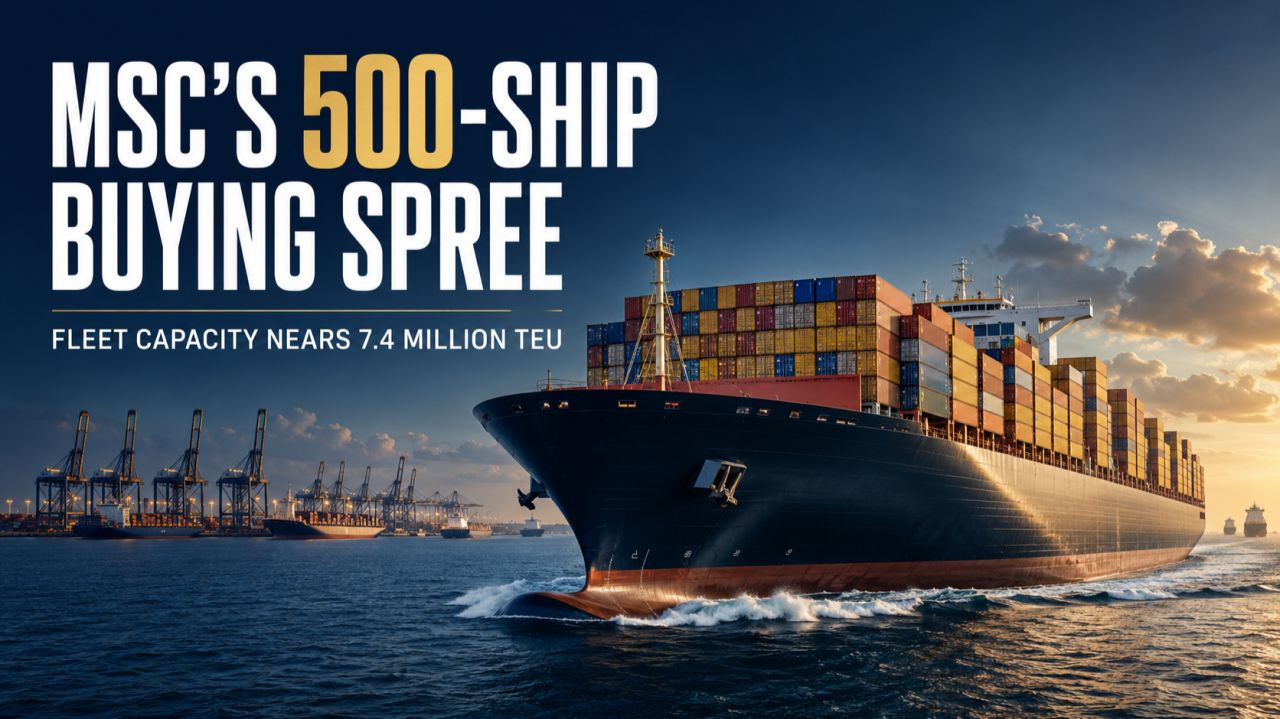

Six years after launching an unprecedented acquisition campaign, MSC has accumulated 500 secondhand containership purchases. Its operated fleet has expanded from roughly 3.8 million TEU to 7.39 million TEU, while a further 2.94 million TEU is now on order.
Mediterranean Shipping Company has reached a fleet milestone that no other liner operator is considered likely to match.
According to Issue 33 of the 2026 Alphaliner Weekly, MSC’s latest purchases have taken the number of secondhand containerships acquired since August 2020 to 500.
The milestone was reached with the reported acquisitions of the 2,796 TEU CALANDRA and the 1,732 TEU FITZ ROY. Alphaliner described MSC’s six-year buying campaign as unique in the history of container shipping and unlikely ever to be matched by another carrier.
Spread across the period since August 2020, the total represents an average of more than 80 ships per year—or roughly one secondhand containership every four to five days.

Two ships take the cumulative tally to 500
The 2,796 TEU CALANDRA is a “Wenchong 2800” design built by Guangzhou Wenchong Shipyard in China in 2010. MSC reportedly paid around $27 million for the vessel.
The ship has a deadweight of 41,411 tonnes, a length of 212.5 metres and a beam of 32.2 metres. Originally built with cranes, it was converted into a gearless vessel in 2015 and is equipped with 506 reefer plugs.
The second acquisition, the 1,732 TEU FITZ ROY, was built by the same Chinese shipyard in 2011. Formerly named HANSA ALTENBURG, the ship has a deadweight of 23,639 tonnes and is fitted with two 40-tonne cranes and 300 reefer plugs. Its purchase price was reported to be in excess of $26 million.
Neither vessel is currently deployed in MSC’s own liner network. The CALANDRA remains on charter to Gold Star Line until the second quarter of 2027, while the FITZ ROY is chartered to COSCO SHIPPING Lines until the fourth quarter of 2026.
The two purchases therefore change vessel ownership without immediately adding their combined 4,528 TEU to MSC’s operated capacity.
This distinction is essential when interpreting the 500-ship milestone. It is a cumulative acquisition count compiled by Alphaliner, rather than the number of secondhand vessels currently operating in MSC services. Some acquired ships were already chartered to MSC, some remain chartered to other operators, and others may subsequently be sold, recycled or withdrawn.
The prices paid also underline the continued strength of the secondhand containership market. Alphaliner reported limited availability of prompt sale candidates, sustained buyer interest and firm prices, particularly for vessels in the 1,000–4,000 TEU range.
From approximately 3.8 million to 7.39 million TEU
When MSC launched its latest large-scale secondhand buying campaign in August 2020, its operated fleet stood at approximately 3.8 million TEU.
According to live Alphaliner Top 100 data checked on 24 August 2026, MSC now operates 1,010 vessels with a combined capacity of 7,389,280 TEU. The fleet represents 21.5% of total global liner capacity.
MSC has therefore added approximately 3.59 million TEU in six years, expanding its operated capacity by about 94% and bringing the fleet close to twice its August 2020 size.
The current operated fleet includes 759 owned vessels with a combined capacity of 4,737,110 TEU. A further 251 chartered ships contribute 2,652,170 TEU.
Chartered vessels still account for 35.9% of MSC’s operated capacity, confirming that the carrier remains a major participant in the charter market. Its acquisition programme has nevertheless shifted a substantial volume of previously chartered tonnage into company ownership. Owned vessels now represent about 64.1% of its operated capacity.
MSC’s lead over its nearest competitor has also widened dramatically. The carrier currently operates around 2.67 million TEU more capacity than second-ranked Maersk.
Newbuildings, charters and secondhand purchases
MSC’s growth has been driven by three parallel sources of tonnage: newbuilding deliveries, fresh charter agreements and secondhand acquisitions.
The relative importance of each source was demonstrated when MSC became the first liner company to surpass 7 million TEU of operated capacity in November 2025.
The milestone was reached following the near-simultaneous deliveries of the 16,000 TEU-class MSC SALERNO and MSC GRACE. MSC required only 15 months to grow from 6 million to 7 million TEU.
According to an AXSMarine and Alphaliner analysis, 68 newbuilding deliveries contributed approximately 799,000 TEU during that period. These included 33 Neo-Panamax ships in the 14,000–16,000 TEU range.
MSC also fixed more than 50 ships on charters commencing during the same 15-month period. Around half were charter extensions and therefore capacity-neutral, while approximately 25 fresh charters added about 135,000 TEU.
Secondhand transactions involving MSC or related entities accounted for more than 250,000 TEU during the period. Many of the acquired vessels were already sailing for MSC under charter, so only part of that capacity represented a net addition to the operated fleet.
The 500 acquisitions must consequently be considered alongside newbuilding deliveries, fresh charters, charter returns, vessel sales and recycling. MSC’s net fleet growth is the combined outcome of all these movements.
MSC chief executive Søren Toft has previously identified growth, fleet renewal, cost competitiveness and the replacement of chartered ships as the principal reasons behind the company’s purchasing strategy.
A secondhand campaign that reshaped the charter market
MSC’s acquisition programme has also changed the ownership structure of the wider containership fleet.
Data cited by Lloyd’s List showed that MSC purchased approximately 350 ships totalling 1.4 million TEU from non-operating owners between August 2020 and March 2025. These purchases removed a significant volume of tonnage from the independent charter market.
Across the industry, around 850 ships totalling 3.7 million TEU were sold by tonnage providers to liner operators during the same period. MSC was by far the largest individual buyer.
Its activity has reduced the pool of ships available to other carriers, contributed to a declining charter-fleet share and supported charter rates during periods of limited vessel availability.
By November 2024, MSC had already acquired 402 secondhand ships with a combined capacity of approximately 1.66 million TEU. Their average age was around 20 years, highlighting the role of these purchases in securing immediate capacity while MSC waited for its much larger newbuilding programme to be delivered.
The scale of the newbuilding orderbook will also allow MSC to renew parts of this ageing acquired fleet over time.
Nearly 2.94 million TEU still on order
MSC’s expansion programme remains far from complete.
The latest Alphaliner Top 100 data shows that the carrier has 166 containerships on order with a combined capacity of 2,935,318 TEU. This is equivalent to 39.7% of its existing operated fleet.
MSC’s orderbook alone is equal to approximately 77% of the company’s entire fleet capacity when the secondhand buying campaign began in August 2020.
A static calculation combining the present fleet and orderbook produces a potential total exceeding 10.3 million TEU. That figure is not a fleet forecast, as MSC will also return chartered ships, sell vessels, recycle older tonnage and use some newbuildings for replacement.
It nevertheless illustrates the scale of the capacity already secured for future delivery.
MSC’s fleet expansion has provided the company with the tonnage required to operate an independent global liner network following the end of the 2M partnership with Maersk in February 2025. The carrier continues to participate in selected slot-exchange arrangements, but it no longer depends on a global vessel-sharing partner to provide the ships needed for comprehensive East–West coverage.
From approximately 3.8 million TEU in August 2020 to 7.39 million TEU today, MSC has pushed the scale of a single liner operator to a new level. Its 500 secondhand acquisitions, 1,010-ship operated fleet and nearly 2.94 million TEU orderbook indicate that the expansion cycle is continuing.
Sources: Alphaliner Weekly 2026 Issue 33; Alphaliner Top 100;

READ MORE
 Containers
When the Market Turns, Who Turns Fastest? Maersk’s Lesson in Shipping Agility
 Containers
From a $256m Loss to an $83m Profit: Hapag-Lloyd Turns the Corner in Q2 as Gemini Gains Traction
 Containers
Ningbo Containerized Freight Index Weekly Commentary Schedule Disruptions Strained Supply; Freight Rates Rose on Most Routes
 Containers
Maersk Opens the Door to Fleet Growth as 20,000-TEU Newbuilding Talks Gather Pace
 Containers
Ningbo Containerized Freight Index Weekly Commentary North America Freight Rates Rose at High Levels; Overall Divergence Pattern Remained
 Containers
Is Peak Season Really Over? Asia–U.S. East Coast Rates Reach $9,400
 Containers
Ningbo Containerized Freight Index Weekly Commentary Freight Rate Trends Diverged Across Routes; Composite Index Continued Its Upward Trend
 Containers
Gemini Expands Red Sea Comeback: More Maersk-Hapag Lloyd Services Return to Suez
 Containers
COSCO, OOCL and ANL Launch New Weekly Qingdao–Australia East Coast Service
 Containers