


When the Market Turns, Who Turns Fastest? Maersk’s Lesson in Shipping Agility


How Shipping Companies Turn Uncertainty Into Profit in a More Volatile World
Maersk’s sharp earnings reversal offers a revealing case study in what it takes to compete in an era of geopolitical disruption, shifting trade flows and increasingly constrained supply chains. From a $192 million Ocean EBIT loss in the first quarter to a $935 million profit in Q2, the Danish shipping giant has demonstrated that in volatile markets, profitability depends on much more than freight rates. It increasingly depends on how quickly a company can read changing conditions, make decisions and redeploy its resources.
A.P. Moller - Maersk’s latest results provide a striking illustration of just how quickly fortunes can change in container shipping.
The group’s Ocean business moved from an EBIT loss of $192 million in the first quarter of 2026 to a profit of $935 million in Q2. At the beginning of the year, Maersk’s full-year underlying EBIT guidance still allowed for a loss of as much as $1.5 billion. Following two substantial upgrades, the group now expects underlying EBIT of between $4.5 billion and $6.5 billion.
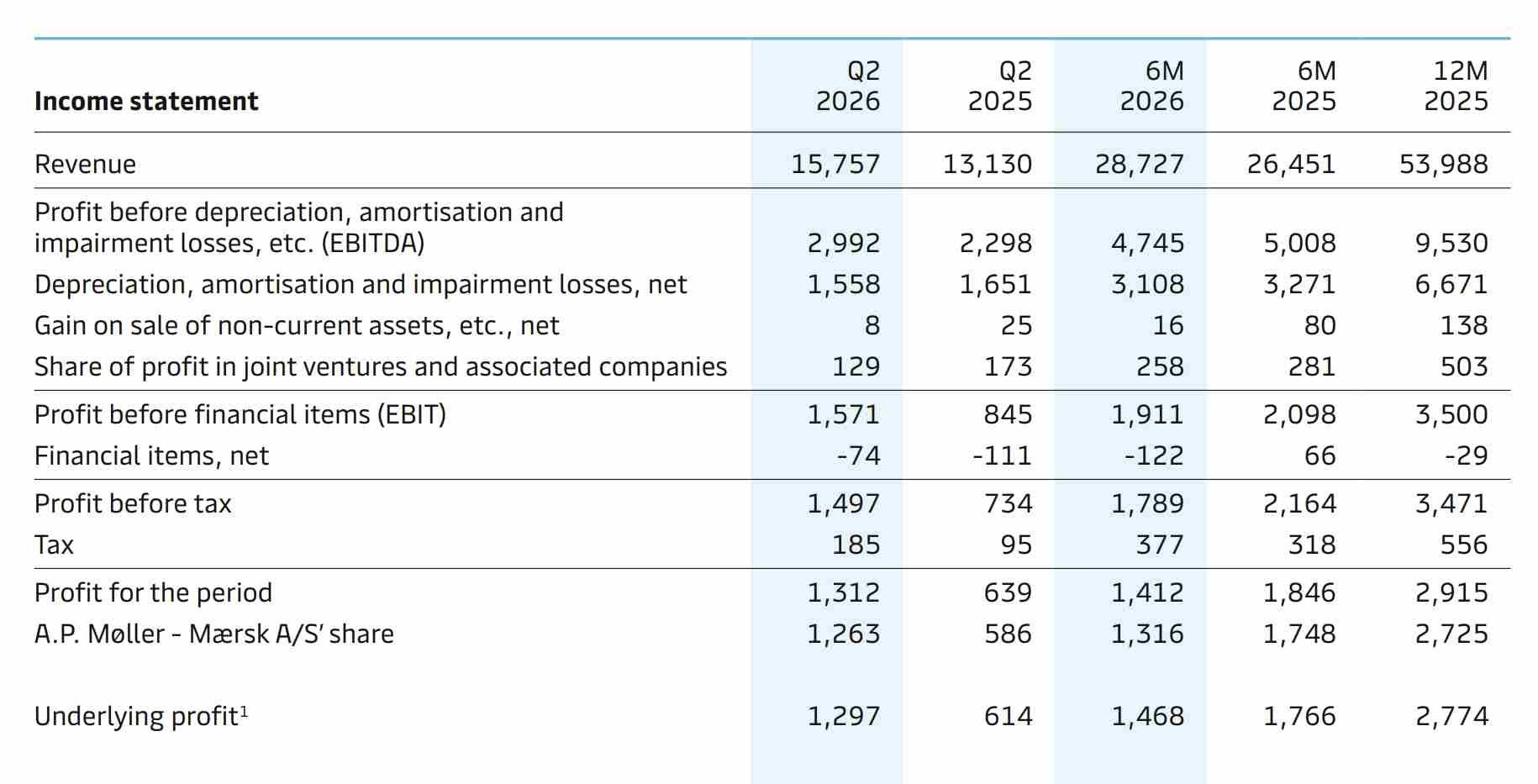
In Q2 alone, Maersk generated revenue of $15.76 billion, up 20% year on year. EBITDA reached $3.0 billion, EBIT rose to $1.6 billion and net profit more than doubled to $1.31 billion. Within Ocean, the average loaded freight rate increased by around 22% year on year, while vessel utilisation reached 96%.
It would be easy to interpret this simply as another familiar shipping-cycle story: demand strengthened, freight rates rose and a liner company made more money.
But that interpretation misses what may be the more important lesson contained in Maersk’s latest results.
In a recent video message, Maersk CEO Vincent Clerc attributed the company’s performance partly to capabilities that the group has spent years trying to build. He highlighted greater agility, faster decision-making, the ability to seize opportunities and the capacity to adapt quickly as market conditions change.https://www.linkedin.com/posts/vincent-clerc-56a7524_the-first-half-of-2026-is-a-strong-reflection-ugcPost-7493646548984111104--rhO/?utm_source=share&utm_medium=member_desktop&rcm=ACoAAAaK7Z8BykxVE0cJAeK6m6PhQT008T0zL8s
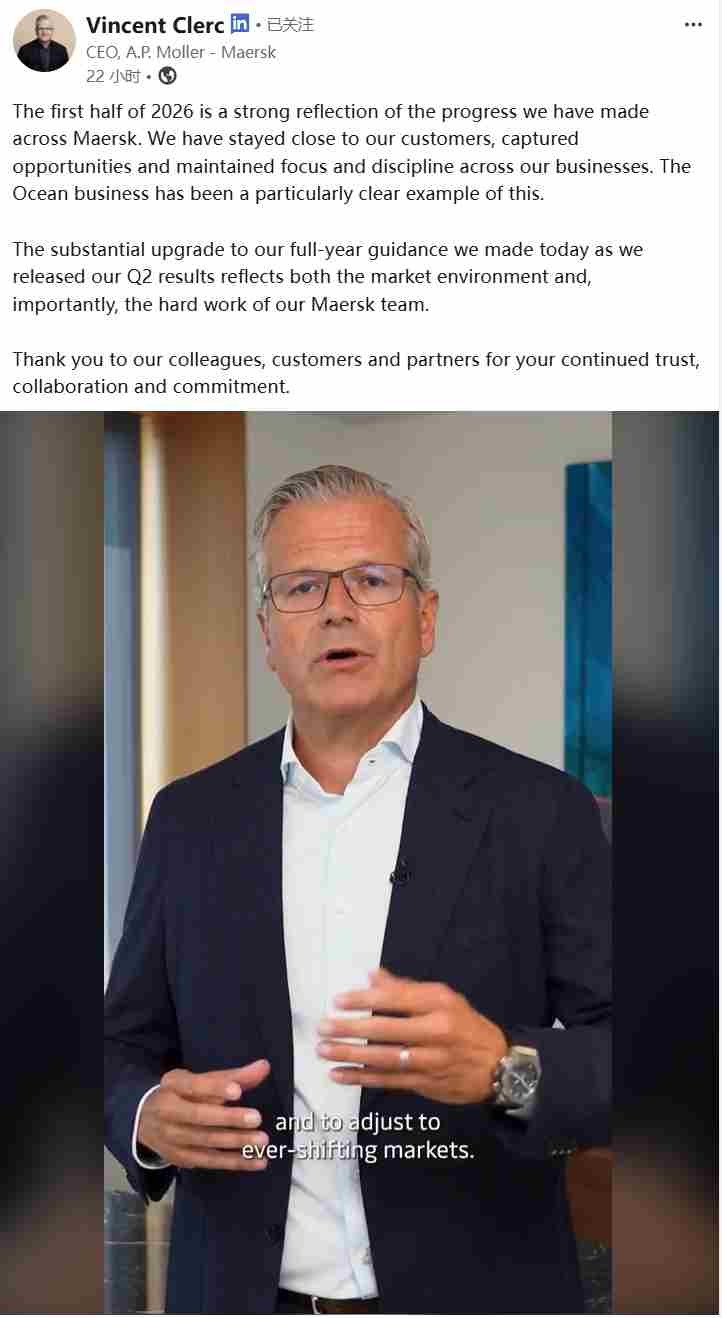
In today’s unusually volatile environment, Clerc said Maersk is putting considerable resources behind its ability to act quickly, respond to changes in the market and, in some cases, anticipate them — allowing the company to capture opportunities across costs, volumes and revenues.
That message deserves more attention than the headline profit numbers alone.
It raises a much broader question for the shipping industry: when several companies are sailing through the same storm, why do some sink, some barely make it back to port, while others return carrying the most valuable catch?
“The Rougher the Seas, the More Expensive the Fish” Was Never an Argument for Taking More Risk
Xinde Marine News previously used the expression “the rougher the seas, the more expensive the fish” to describe the opportunities that can emerge when tariffs, geopolitical conflicts and changing trade patterns disrupt established shipping markets.
But the idea has always carried an important qualification.
The high-priced fish ultimately belong only to the fishermen who can adjust their course, survive the storm and bring their vessels safely home.
Imagine 100 fishing boats sailing into a severe storm. If only ten return, the fish brought back by those vessels may indeed command far higher prices because supply has become scarce. But for the other 90 boats, greater volatility never became a business opportunity. It simply increased the probability that they would not return.
A vessel capable of surviving such a storm needs several things. It requires a reliable engine, equivalent in corporate terms to a business model capable of generating sustainable cash flow and serving real customer demand. It needs a strong hull, corresponding to a resilient balance sheet, sufficient liquidity, financing capacity and the ability to withstand unexpected losses. And it needs a captain capable of reading changing conditions and altering course in time.
For a company, that “captain” represents management’s ability to gather information, interpret it correctly, make decisions quickly and then adjust the business model and allocation of resources accordingly.
The point is therefore not whether companies should embrace risk. The real question is whether they can understand risk, survive it and then convert the changes in pricing and resource allocation created by that risk into sustainable returns.
Shipping provides an unusually clear illustration of this mechanism.
Wars, sanctions, pandemics, canal disruptions, tariffs and sudden trade-policy changes can all undermine the most efficient transportation routes. Cargo may have to find different origins, destinations or gateways. Sailing distances become longer, vessel turnaround slows, port waiting times increase and empty-container repositioning becomes more complicated.
For the global economy, these developments represent inefficiency and additional cost.
For the freight market, however, the same inefficiencies consume effective capacity. The amount of transportation capacity that can actually be used efficiently becomes scarcer, and the price attached to that capacity can rise sharply.
That is the economic logic behind the idea that “the fish becomes more expensive”.
The difficult part for shipping companies is not recognising that freight rates have risen after the event. It is determining how long the disruption will last, which routes will be affected, how cargo flows will change, what assets will become scarce and whether the company can alter course before the market has completely repriced the opportunity.
Maersk’s Q1 and Q2 Look Like Two Different Sea Conditions for the Same Ship
Maersk’s performance in 2026 provides a vivid real-world example.
When the company published its first-quarter results in May, the outlook was still distinctly challenging. Ocean EBIT was negative by $192 million. A large pipeline of containership newbuildings continued to enter service, global nominal fleet capacity was expanding rapidly and concerns about structural overcapacity and freight-rate pressure remained widespread.
Maersk’s full-year underlying EBIT guidance at that point ranged from a loss of $1.5 billion to a profit of $1.0 billion.
Within weeks, however, market conditions shifted.
Exports from the Far East remained strong, spot rates began to rise sharply, port congestion intensified and disruption around the Strait of Hormuz altered parts of the global container network.
By late June, Maersk had already made its first major guidance upgrade. Underlying EBITDA was raised from $4.5 billion-$7.0 billion to $8.0 billion-$10.0 billion, while underlying EBIT was lifted from negative $1.5 billion to positive $1.0 billion, to a new range of $2.0 billion-$4.0 billion.
After the Q2 results, those numbers were raised again. Maersk now expects underlying EBITDA of $10.5 billion-$12.5 billion and underlying EBIT of $4.5 billion-$6.5 billion. Its free-cash-flow outlook has also moved from potentially deeply negative territory to above zero.
In little more than three months, the lower end of Maersk’s EBITDA guidance increased from $4.5 billion to $10.5 billion — a $6 billion change. Its EBIT outlook moved from a scenario in which the company could have lost $1.5 billion to one in which it now expects to make at least $4.5 billion.
Such dramatic revisions clearly demonstrate how rapidly the container market itself has changed.
But they also highlight something else: in a market capable of changing a company’s full-year earnings outlook by billions of dollars within a matter of weeks, the speed at which management interprets and responds to new conditions has increasingly direct financial consequences.
That is why Clerc’s latest comments are important.
He did not explain Maersk’s Q2 improvement simply by pointing to a stronger external market. Instead, he emphasised the company’s efforts to shorten decision cycles, become more agile and reposition resources more quickly when conditions change.
The market provides the wind. The company still has to decide how to set the sails and turn the rudder.
Volatility itself does not determine profitability. The difference increasingly lies in how quickly companies respond after the wind changes direction.
The First Skill of a Good “Captain” Is Seeing the Change
Shipping has never suffered from a shortage of information.
Freight rates, vessel positions, port waiting times, AIS data, bunker prices, insurance premiums, customs statistics, trade data, inventories, order books, weather forecasts, wars, sanctions and ship-delivery schedules generate an extraordinary volume of information every day.
As information becomes more abundant, the scarcer capability is identifying which signals will actually alter market supply and demand.
Xinde Marine News previously described shipping, when examining the career of John Fredriksen, as something more than simply moving cargo from A to B. At its core, shipping is also about using information and judgement to price time in an uncertain market.
Fredriksen’s early career was shaped by the habit of gathering information continuously, identifying where value was emerging and acting before the entire market had incorporated the same information into prices.
The container market in Q2 2026 offers a good example of why that distinction matters.
Global containership capacity is still increasing and new vessels continue to be delivered. Under a conventional static supply-demand framework, fleet growth running ahead of cargo growth should create greater downward pressure on freight rates.
Yet the market moved in the opposite direction. Spot rates increased rapidly and Maersk’s Ocean business moved back into substantial profitability.
The explanation increasingly centres on effective capacity rather than nominal capacity.
Clerc has repeatedly pointed to strong Far East exports and increasingly imbalanced global trade flows. Large volumes are moving towards Europe, North America, Africa and Latin America, while ports, railways, roads, barges and other landside infrastructure are struggling to accommodate the increased pressure.
Maersk has also highlighted worsening congestion in Europe, the Middle East, the east coast of South America and West Africa, all of which are affecting network efficiency and freight rates.
The number of TEU added to the global fleet therefore cannot be treated as identical to the amount of additional transport capacity actually available to the market.
If a vessel could previously complete a transport cycle in 30 days but now requires 40 days because of diversions, port waiting and network congestion, the vessel’s nominal capacity has not changed. Its annual ability to move cargo, however, has fallen materially.
Similarly, when exports move heavily in one direction without equivalent back-haul volumes, carriers have to devote more vessels, containers and operating resources to repositioning empty equipment. The same asset base becomes less productive.
A good “captain” therefore has to see the changes hidden beneath headline statistics. Management needs to recognise when the gap between nominal and effective capacity is widening, and whether that gap represents a temporary disruption or a structural shift capable of shaping markets for several quarters or even years.
The Second Skill Is Making Decisions Before All the Information Is Available
There is another fundamental difficulty in shipping: markets do not wait for perfect information before they reprice.
By the time a waterway is formally closed, port waiting times are fully reflected in databases, charterers begin competing aggressively for vessels and spot freight rates have already surged, much of the opportunity may already have been incorporated into market prices.
Important commercial decisions therefore often have to be made before all the information is available.
Fast decision-making should not be confused with recklessness.
It requires companies to make probability-based judgements from incomplete evidence: separating temporary noise from potentially persistent change, distinguishing risks that should be avoided from those that are already adequately compensated by higher prices, deciding when to deploy more capacity and when to preserve cash, and knowing when to adjust routes, customers or commercial exposure.
A ship’s master operates in much the same way. He does not wait until the weather forecast reaches 100% certainty before changing course. He continually reassesses pressure, sea conditions, wind direction, speed and route.
Corporate decision-making in a highly volatile shipping market increasingly resembles the same process.
Maersk has talked for years about flexibility, agility and resilience. In a stable market, those expressions can sound like abstract management language. In 2026, they are increasingly visible in the income statement.
Ocean EBIT moving from a $192 million loss to a $935 million profit within a single quarter, while full-year earnings expectations change by billions of dollars over a few months, demonstrates that the strategic clock in shipping is accelerating.
Management’s ability to make sound decisions quickly is therefore moving beyond being merely a management quality.
It is becoming an economically valuable corporate asset.
The Third Skill Is Understanding How Risk Changes Prices
Another important dimension of “the rougher the seas, the more expensive the fish” is that risk and opportunity frequently originate from the same event.
Disruption around the Strait of Hormuz creates costs for Maersk. Fuel prices rise, cargoes may need to be redirected, vessels redeployed, landside solutions redesigned and customer supply chains reconfigured.
Every one of those changes increases cost and operational complexity.
The same disruption, however, changes the market in the opposite direction as well. Cargo can be redirected towards alternative ports. Vessel capacity can be redeployed towards stronger trades. Longer voyages and more complicated port arrangements reduce network productivity. Congestion absorbs more effective capacity. Cargo that would normally move through an ocean gateway may instead require landbridge, warehousing, forwarding or multimodal solutions.
Maersk’s Q2 results demonstrate this dual effect.
Ocean faced higher fuel and network costs, but the company simultaneously improved fuel efficiency and vessel utilisation while capturing higher volumes and stronger freight rates. Logistics & Services, meanwhile, handled some cargo affected by Gulf disruption through landbridge solutions.
Market disorder increased costs.
It also created new sources of revenue.
High-quality commercial judgement therefore cannot stop at asking, “How large is the risk?”
It must also ask, “How will this risk change prices?”
Faced with the same storm, one company may see only higher insurance and bunker costs. Another may simultaneously calculate how much longer voyages will become, how much effective capacity will disappear, which ports will become congested, where demand for inland transport will rise and how much customers might be willing to pay for greater certainty.
The difference between those two interpretations can eventually become the difference between loss and profit.
The Fourth Skill Is Actually Having the Tools to Change Course
Even a captain who correctly reads the weather cannot turn a ship if the rudder is broken, the engine has no power or the hull is already too weak to continue.
The same applies to companies.
Over recent years, Maersk has expanded far beyond Ocean, investing in terminals, warehouses, inland transportation, forwarding and end-to-end logistics capabilities. In stable conditions, these investments are often described as part of its transformation from a traditional liner operator into an integrated logistics group.
In today’s environment, however, they have another function.
They give Maersk more ways to change course.
If a Gulf gateway becomes inaccessible, cargo can potentially be rerouted and carried onwards by landbridge. If one port becomes severely congested, volumes can be redistributed through alternative nodes. If a customer’s supply chain is disrupted, ocean freight, warehousing, forwarding and inland transport can be combined into a redesigned solution.
The value of this system lies increasingly in the options it creates.
Clerc has also been emphasising the importance of port and landside infrastructure. He argues that bottlenecks in the global logistics system are becoming increasingly visible across ports, railways, roads and barge networks, while years of insufficient infrastructure investment mean that these constraints cannot be removed quickly.
Competition among large shipping groups is therefore expanding beyond the number of ships they operate.
Vessel capacity still matters, but whether cargo arrives reliably increasingly depends on how many terminals, warehouses, inland corridors, rail links, digital systems and alternative gateways a company can control or coordinate.
In an uncertain world, having more options has value in itself.
From Competing on Efficiency to Competing on Certainty
For much of the past several decades, efficiency has been one of the defining principles of global supply chains.
Bigger vessels, lower inventories, shorter transit times, higher asset utilisation and lower unit costs shaped the direction of logistics optimisation during the era of globalisation.
That model, however, rested on several assumptions: strategic waterways would remain largely open, major ports would operate predictably, trade policy would remain reasonably stable and global cargo flows would not repeatedly undergo major dislocations.
Those assumptions have been tested again and again.
The pandemic, the Ever Given blockage of the Suez Canal, the Russia-Ukraine conflict, drought restrictions at the Panama Canal, the Red Sea crisis and disruption around the Strait of Hormuz have all demonstrated that what the industry once regarded as a “normal” operating environment may itself be becoming increasingly scarce.
Xinde Marine News previously argued that the capability likely to become more valuable in such an environment is the ability to provide certainty, resilience and reliable delivery in an unstable world.
Maersk’s latest results increasingly suggest that this capability has measurable economic value.
Customers are no longer buying only a slot from Shanghai to Rotterdam. If the Red Sea becomes inaccessible, they need an alternative route. If Gulf ports are disrupted, they need a landbridge. If a terminal is congested, they need another gateway. If schedules collapse, they need containers, warehousing and inland capacity capable of keeping cargo moving.
What might once have been dismissed as “redundancy” therefore begins to look different.
More gateway options, more transport modes, alternative networks, a stronger balance sheet and some degree of capacity flexibility all represent corporate optionality.
And the more uncertain the environment becomes, the more valuable that optionality is likely to be.
The Real Question Is Why Maersk Was Able to Turn So Quickly
Maersk’s $1.31 billion Q2 net profit is certainly attention-grabbing.
But over a longer horizon, that may not be the most important number in the report.
Shipping earnings rise and fall with the cycle. What deserves closer attention is Clerc’s emphasis on the organisational capabilities behind the result: greater agility, faster decision-making, a stronger ability to seize opportunities and the capacity to redeploy resources as market conditions change.
That is very close to the “captain” in the fishing-boat metaphor.
But Clerc’s comments also take the idea one step further.
For a company of Maersk’s scale, the quality of the “captain” can no longer depend solely on the CEO. The speed at which the organisation changes direction depends on how the entire company gathers information, analyses it, makes decisions and executes them.
How quickly does a signal move from a customer, vessel or terminal to headquarters? How long does management need to understand its implications? How many layers of approval are required to change a service? Can vessels, containers, warehouses, terminals and inland capacity all be repositioned together? Can customer contracts be adjusted? Does the balance sheet provide enough room to support those decisions?
Together, those factors determine a company’s turning speed.
The modern “captain”, therefore, is no longer simply an individual executive with experience and courage.
It is an organisational system combining information, management structure, decision-making processes, assets, networks and financial strength.
Volatility Does Not Create Opportunities Equally — It Magnifies Differences
A more chaotic world does not mean every shipping company will make more money.
Quite the opposite.
The greater the volatility, the more rapidly relatively small differences between companies can be magnified.
In a stable market, being one week slower to make a decision may have little consequence. In a rapidly changing freight market, one week can be enough for prices to move completely.
In normal conditions, an additional approval layer may be only an efficiency problem. When a commercial window lasts only a few weeks, it can mean missing the opportunity altogether.
In benign credit conditions, greater leverage can amplify returns on assets. When the cycle turns, the same leverage can force a company to sell ships at precisely the wrong point.
Uncertainty therefore acts as a capability amplifier.
It magnifies the advantages of companies with better information, stronger judgement, healthier balance sheets and faster execution. At the same time, it magnifies organisational inertia, financial weakness and strategic mistakes.
Shipping history has repeatedly produced new winners during periods of severe disruption while eliminating many others for exactly this reason.
The full meaning of “the rougher the seas, the more expensive the fish” should therefore always contain its second half:
The fish may indeed become more valuable in a storm — but only those who make it back to port can sell them at that price.
The Next Competitive Advantage in Shipping May Be Who Can Turn Faster
Maersk’s Q2 reversal makes that metaphor unusually tangible.
The company has a relatively strong “hull”. The extraordinary cash accumulated during the pandemic boom has declined, but Maersk still maintains a substantial balance sheet and liquidity position.
It has a functioning “engine”. Ocean remains the group’s most powerful earnings generator, while Logistics and Terminals provide increasingly diversified revenue and profit streams.
It has also been building more tools with which to change direction. Gemini, terminals, warehouses, landbridges, forwarding operations, container equipment and a global logistics network give the group more ways to respond to different market conditions.
Clerc is now emphasising the final capability required to make those resources valuable: seeing change faster, understanding it more accurately, deciding more quickly and converting the decision into action.
No company can reliably predict where the next disruption will come from. It may be a war, sanctions, tariffs, extreme weather, a strategic port, a railway bottleneck or a sudden shift in regional cargo flows.
Companies cannot control when the wind begins to blow, nor can management make every judgement perfectly.
They can, however, decide how strong the hull is, whether the engines are reliable, how sensitive the radar is, how quickly information moves through the organisation and how long it takes to alter course once conditions change.
That may ultimately be the most important lesson from Maersk’s Q2 results — more important than the headline figure of $1.31 billion in quarterly profit.
In a high-volatility era, the assets carrying the highest value may no longer be ships and capacity alone.
The ability to make fast, accurate decisions — and turn those decisions into action before the market has fully repriced — is itself becoming increasingly valuable.
The rougher the seas, the more expensive the fish.
But whether a shipping company can actually bring that catch home still depends on the strength of the vessel — and how quickly it can change course when the wind turns.

READ MORE
 Containers
Ningbo Containerized Freight Index Weekly Commentary Schedule Disruptions Strained Supply; Freight Rates Rose on Most Routes
 Containers
Ningbo Containerized Freight Index Weekly Commentary North America Freight Rates Rose at High Levels; Overall Divergence Pattern Remained
 Containers
Is Peak Season Really Over? Asia–U.S. East Coast Rates Reach $9,400
 Containers
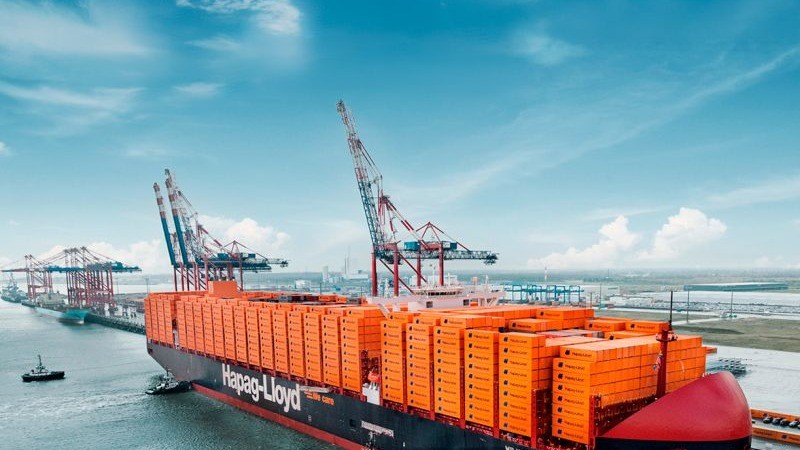
From a $256m Loss to an $83m Profit: Hapag-Lloyd Turns the Corner in Q2 as Gemini Gains Traction
 Containers
Ningbo Containerized Freight Index Weekly Commentary Freight Rate Trends Diverged Across Routes; Composite Index Continued Its Upward Trend
 Containers
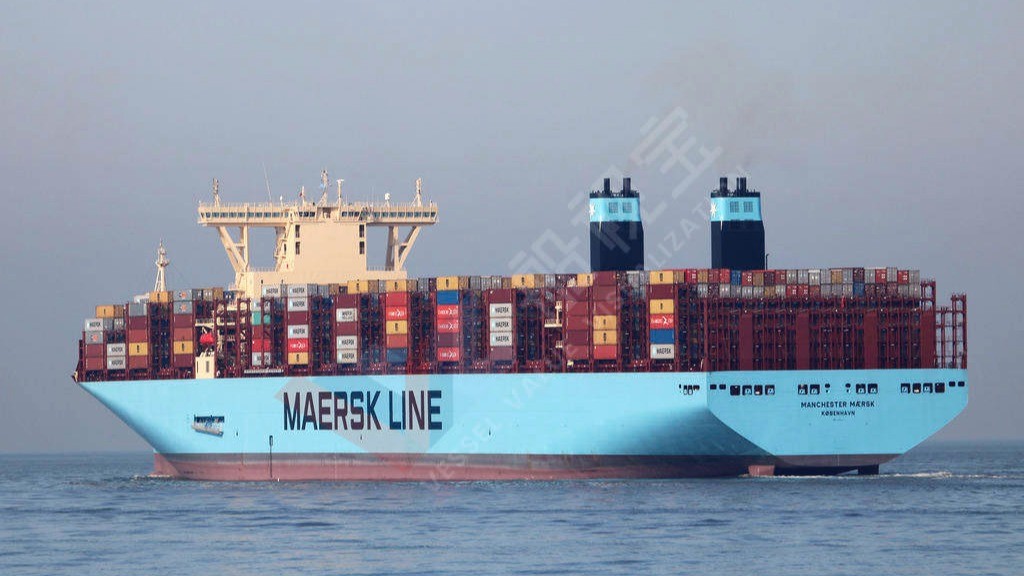
Gemini Expands Red Sea Comeback: More Maersk-Hapag Lloyd Services Return to Suez
 Containers
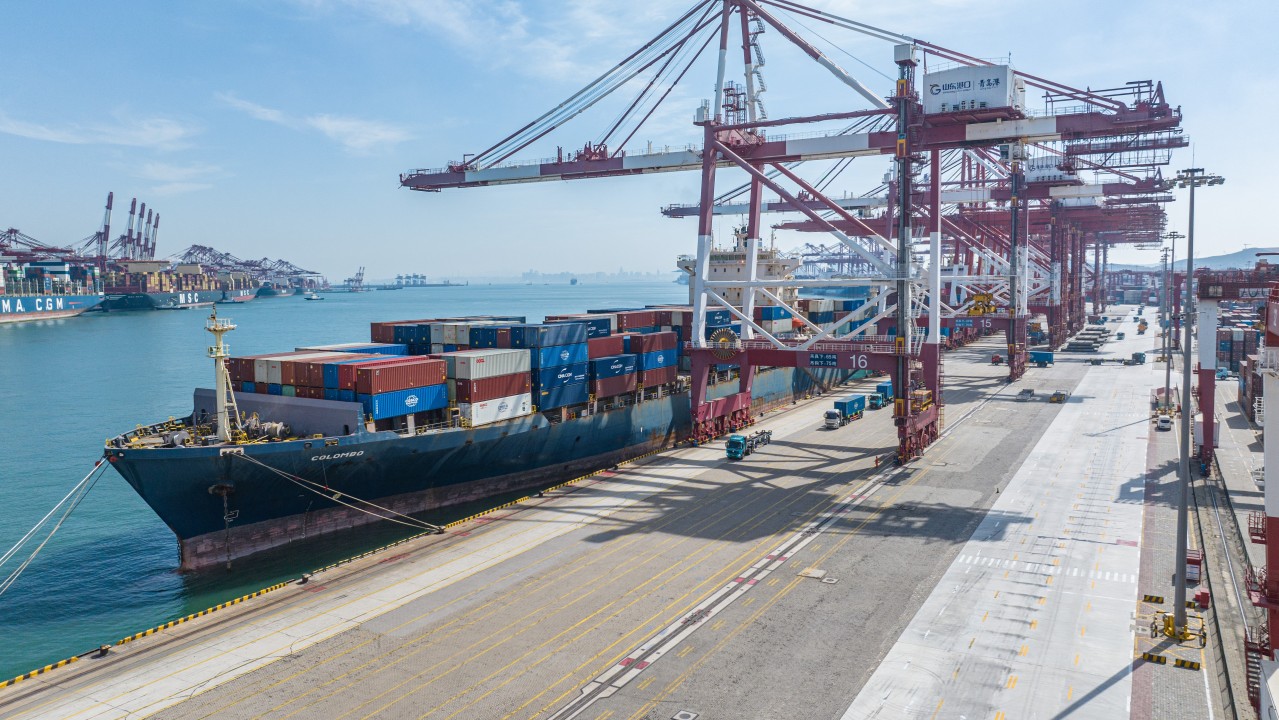
COSCO, OOCL and ANL Launch New Weekly Qingdao–Australia East Coast Service
 Containers
Bernhard Schulte Shipmanagement has reached a new milestone, with its global managed fleet surpassing 700 vessels.
 Containers
PIL strengthens India–East Africa connectivity with new Imara Express service
 Containers