

Hapag-Lloyd Suspends Calls at Ukraine’s Three Main Black Sea Ports
Maersk and CMA CGM have also withdrawn direct services as Ukraine-bound container cargo is rerouted through the Danube, Romania and Poland

Maersk and CMA CGM have also withdrawn direct services as Ukraine-bound container cargo is rerouted through the Danube, Romania and Poland
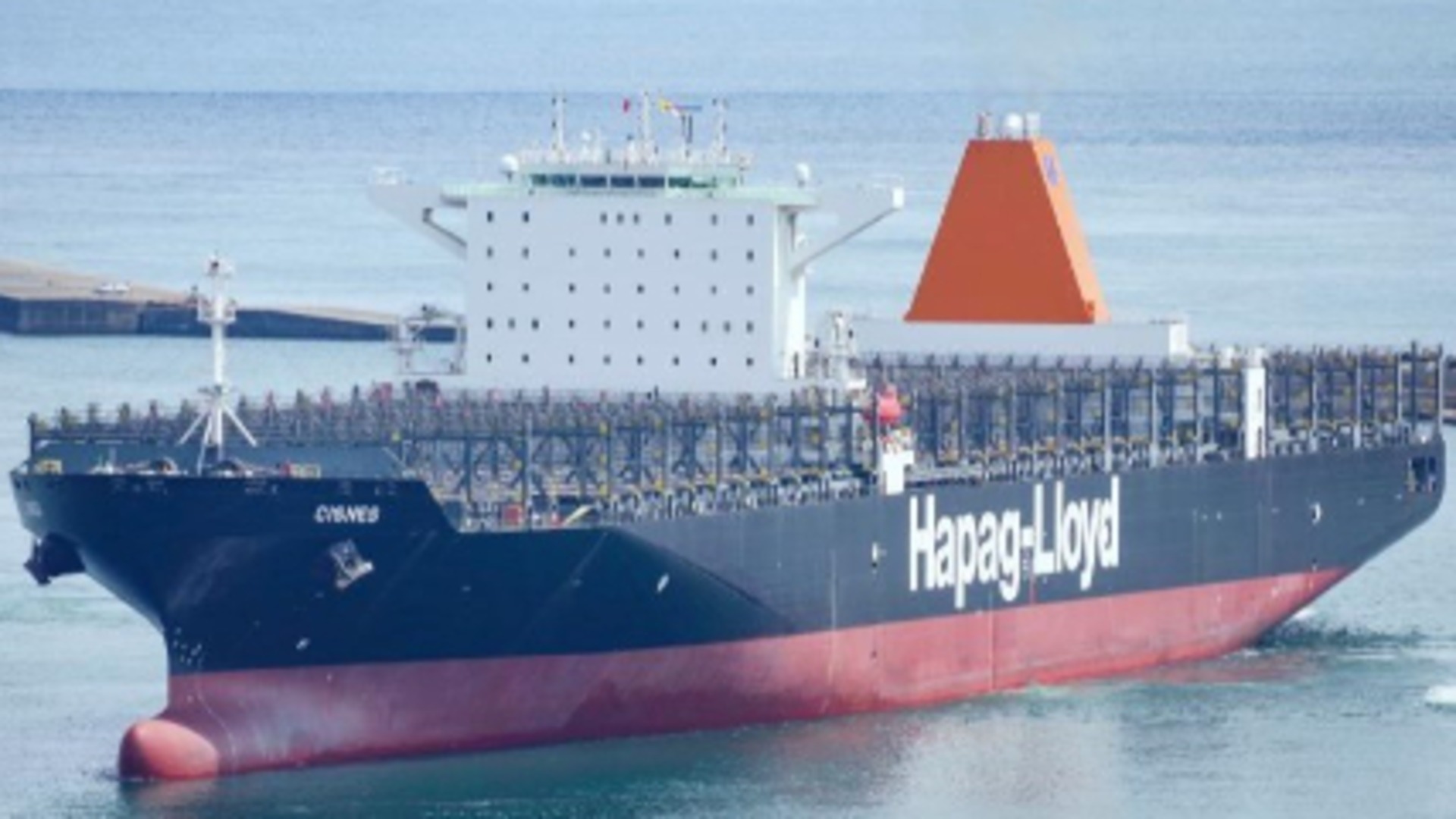
Ukraine’s direct container shipping links through the Black Sea have suffered another major setback after Hapag-Lloyd suspended feeder vessel calls at the country’s three principal ports in the Odesa region.
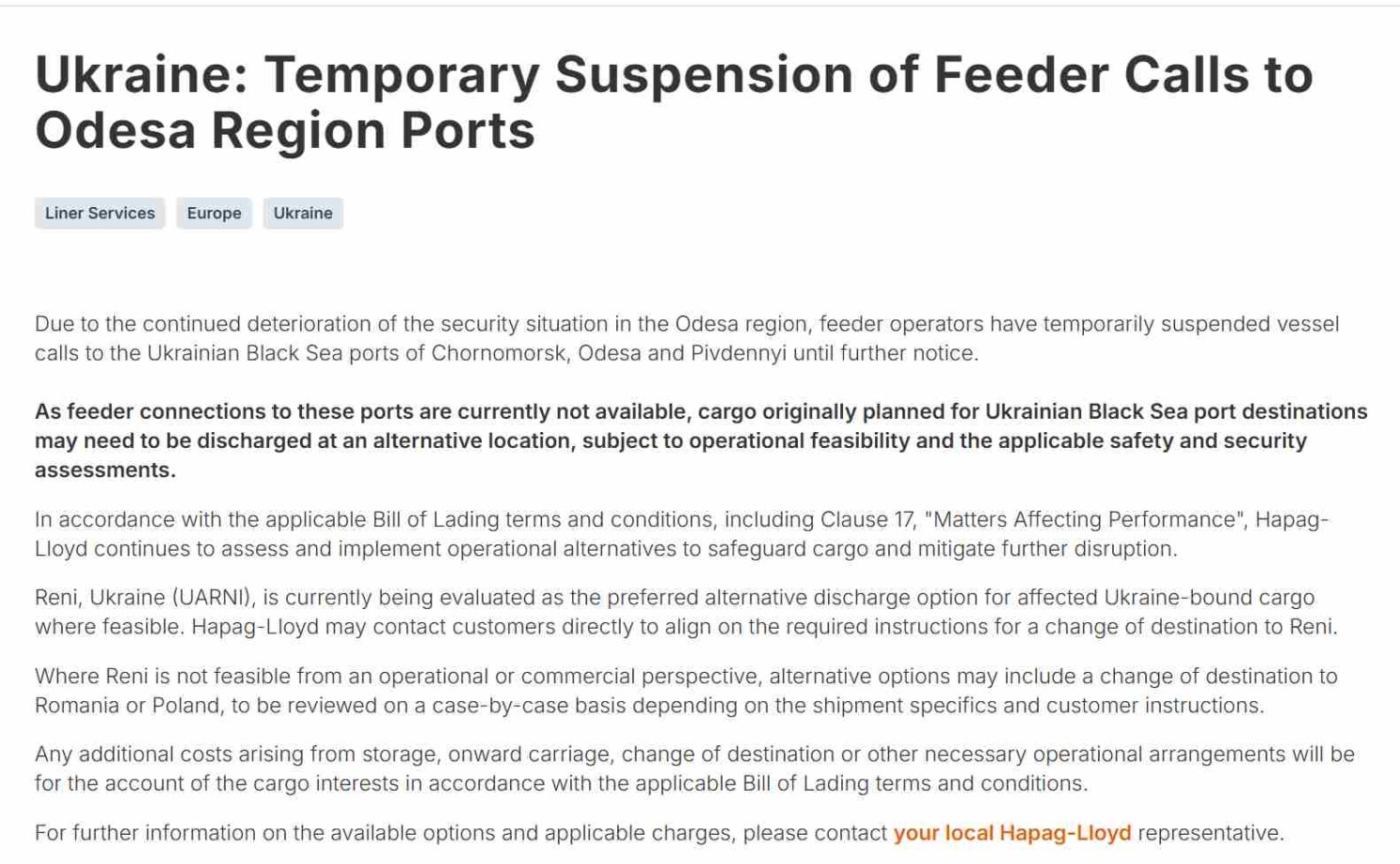
The German container shipping group said that feeder operators had temporarily stopped calling at Chornomorsk, Odesa and Pivdennyi because of the continued deterioration of the regional security situation. The suspension will remain in place until further notice.
The decision does not amount to Hapag-Lloyd’s withdrawal from the entire Black Sea market. It is specifically limited to feeder connections serving the three Ukrainian ports. Nevertheless, because Chornomorsk, Odesa and Pivdennyi form the core of Ukraine’s Greater Odesa maritime gateway, the suspension represents a significant further contraction of the country’s direct access to international container shipping networks.
Cargo may be diverted to Reni
Hapag-Lloyd said cargo originally booked for the affected Ukrainian Black Sea destinations might have to be discharged at alternative locations, subject to operational feasibility and safety assessments.
The carrier is evaluating Reni, a Ukrainian port on the Danube River, as its preferred alternative discharge point where circumstances permit. Customers may be contacted directly to arrange a change of destination.
Where Reni is not commercially or operationally feasible, Hapag-Lloyd may offer alternative discharge options in Romania or Poland on a case-by-case basis. The final arrangement will depend on the characteristics of each shipment and the instructions provided by the customer.
The company also warned that additional costs associated with storage, inland transportation, changes of destination and other operational arrangements would be charged to the cargo interests under the applicable bill of lading terms.
This means that the interruption is likely to affect more than vessel schedules. Importers and exporters may face longer transit times, additional border crossings, higher inland transportation costs and greater uncertainty over the final delivery of their cargo.
Maersk suspended Chornomorsk service first
Hapag-Lloyd’s decision follows similar action by other major container carriers.
On July 22, Maersk announced the temporary suspension of its service through Chornomorsk Fishing Port after its feeder operator became unable to continue serving the facility.
Maersk redirected cargo scheduled to arrive aboard MEDKON MIRA and other Chornomorsk-bound import shipments to Constanța, Romania. Cargo already at, or expected to reach, the transshipment hub of Port Said was also to be redirected to Constanța.
Customers unwilling to accept Constanța as the new discharge port were asked to submit change-of-destination requests.
For existing export bookings from Chornomorsk, Maersk offered customers the option of cancelling their bookings without cancellation or amendment fees. Containers that had already entered the terminal could be transferred to Constanța as the port of loading while retaining the original ocean freight rate, subject to the carrier’s specified procedures.
Maersk’s measure was limited to its service through Chornomorsk Fishing Port. It should therefore not be interpreted as a formal suspension of all Maersk activities across the Black Sea. However, the decision removed another direct maritime option available to Ukrainian container shippers.
CMA CGM unable to serve Odesa by sea
CMA CGM issued a separate advisory on July 23, stating that it was unable to continue serving Odesa by sea because of the situation affecting Ukrainian ports.
The French carrier said it could not confirm when maritime operations might safely resume for vessels, crews and cargo. However, CMA CGM continued accepting import and export bookings to and from Ukraine, subject to operational feasibility.
Instead of direct calls at Odesa, ocean transportation is being routed through two designated gateway ports: Constanța in Romania and Gdańsk in Poland.
Pre-carriage and on-carriage between those gateways and Ukraine may be incorporated into the overall logistics solution, although the arrangements remain subject to operating conditions, regulatory requirements and additional charges.
The CMA CGM arrangement illustrates an important distinction in the carriers’ current strategies. Shipping lines are not necessarily refusing Ukrainian cargo. They are removing vessels from the highest-risk port calls while attempting to maintain trade through a combination of alternative seaports, rail services, trucks and inland logistics.
Ukraine’s container gateway is becoming an inland logistics network
The measures announced by Hapag-Lloyd, Maersk and CMA CGM show how Ukraine’s container supply chain is being reorganised under escalating security pressure.
Direct feeder calls at the Greater Odesa ports are increasingly being replaced by three alternative corridors.
The first is the Danube route through Reni and potentially other river ports. This option keeps cargo within Ukraine for part of the maritime journey but is constrained by port capacity, river conditions and the availability of feeder and inland transport services.
The second is the Romanian route through Constanța, which has become the principal regional gateway in several carriers’ contingency plans. Cargo can be discharged in Romania before continuing to Ukraine by road, rail or other inland transportation.
The third is the northern route through Polish ports, particularly Gdańsk, followed by overland transportation into Ukraine.
These alternatives preserve a degree of access to global liner networks, but they also lengthen supply chains and introduce additional handling stages. Every extra transshipment, border crossing and inland movement creates potential costs, delays and operational risks.
A withdrawal led by feeder operators and security assessments
The official notices also demonstrate that the immediate decisions are often being driven by feeder operators rather than by the global carriers alone.
Deep-sea container lines generally rely on smaller feeder vessels to connect regional Black Sea ports with major transshipment hubs. When feeder operators, shipowners, crews or insurers determine that a port call is no longer acceptable, the global carrier may be unable to maintain the advertised service even if it remains willing to carry the cargo.
This helps explain why the three carriers have adopted different scopes of suspension. Maersk referred specifically to Chornomorsk Fishing Port, CMA CGM said it could no longer serve Odesa by sea, while Hapag-Lloyd’s latest notice covered Chornomorsk, Odesa and Pivdennyi.
Taken together, however, the decisions indicate that the commercial container shipping network serving Ukraine’s principal Black Sea gateway has been severely disrupted.
Direct liner connectivity is approaching a standstill
It would be inaccurate to say that Hapag-Lloyd has suspended all Black Sea services. The company’s advisory applies only to three Ukrainian ports and does not cover ports elsewhere in the region, including those in Romania, Bulgaria, Türkiye or Georgia.
It would also be premature to conclude that all Ukrainian maritime trade has stopped. The carriers continue to offer alternative arrangements, and the Danube ports remain under consideration for some cargoes.
The more defensible conclusion is that direct international container liner connectivity through the Greater Odesa port cluster is approaching a practical standstill.
For Ukrainian shippers, the consequences will include higher logistics costs, longer delivery times and greater dependence on Constanța, Gdańsk and the Danube corridor. For container carriers, the challenge will be to maintain service commitments while protecting vessels, crews and cargo from risks that increasingly fall outside the traditional limits of commercial shipping operations.
The latest Hapag-Lloyd suspension therefore marks more than another isolated port omission. It reflects the continuing transformation of Ukraine’s maritime supply chain from a direct Black Sea shipping system into a fragmented network of alternative seaports, river gateways and cross-border inland corridors.


READ MORE
 Safety
Collision-Damaged 181,000-dwt Capesize CAPE XL Safely Berthed in Qingdao — Three Months After Singapore Strait Collision
 Safety
CDB Leasing Moves to Auction Fire-Damaged LNG Carrier GasLog Salem as Lease Nears End
 Safety
Panama-Flagged Bulker Sinks in Bay of Bengal; 2 of 24 Crew Rescued, 20 Chinese Nationals Missing
 Safety
Rescued From One Drone Attack, Turkish Cook Dies in Second Black Sea Strike
 Safety
Five Grain‑Carrying Bulkers Hit in Succession; Novorossiysk‑Tuapse Shipping Route Under Siege
 Safety