

Drone Strike Hits FSRU and LNG Carrier at Egypt’s Damietta Port, Pushing Middle East Risk into the Mediterranean

A single unidentified drone may have crossed three sensitive boundaries within minutes: American-controlled capital, Egypt’s energy security and the perceived safety of Mediterranean shipping.
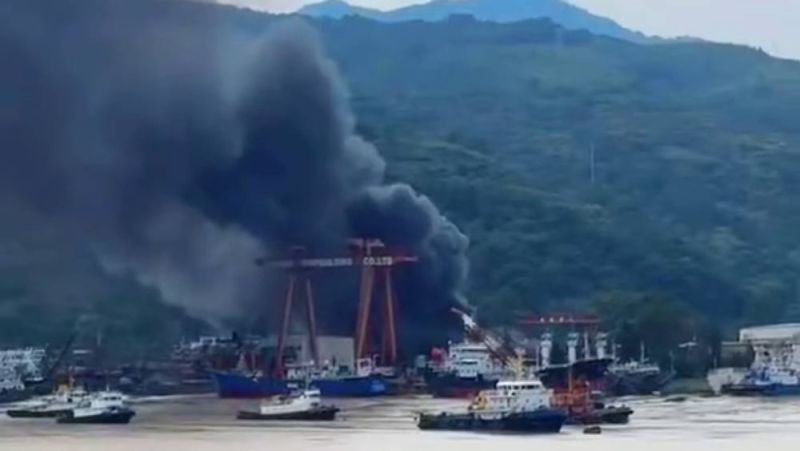
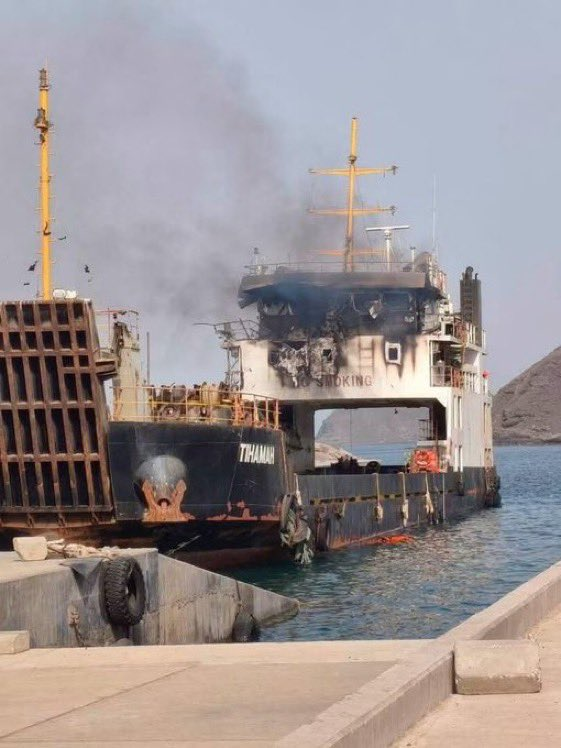
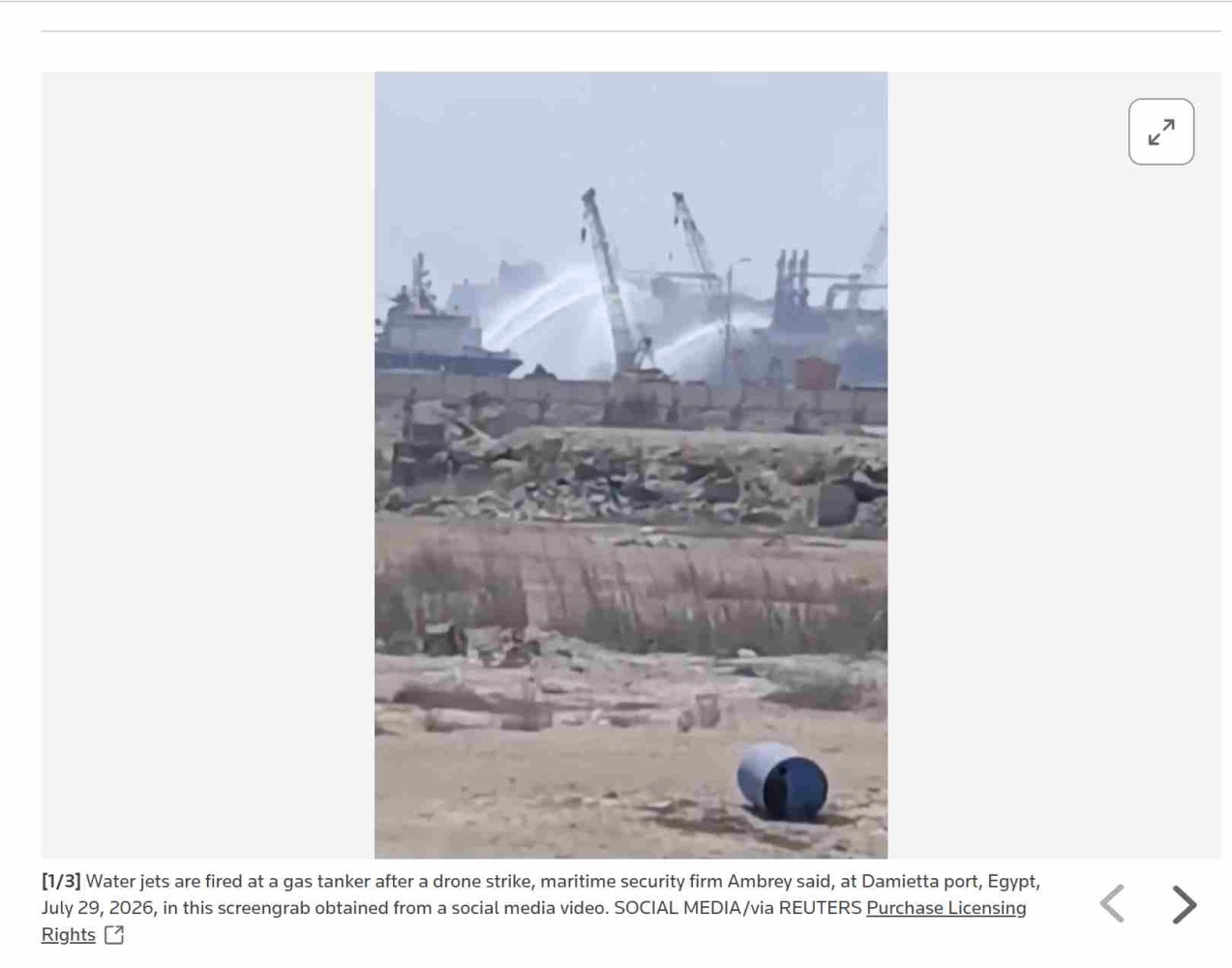
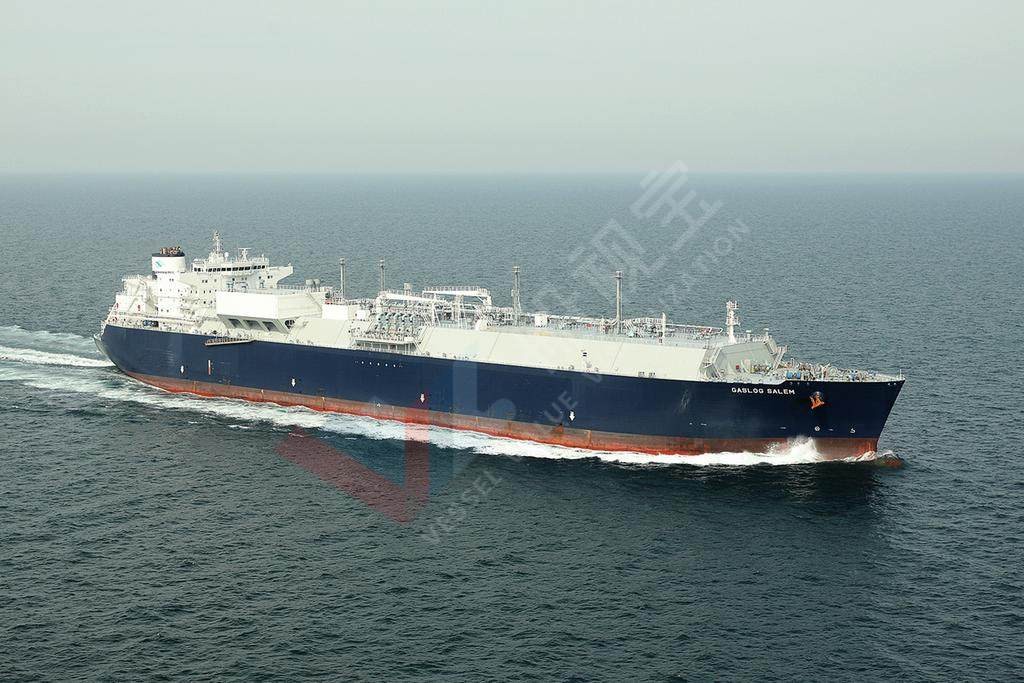
On 29 July, a fire broke out at the LNG terminal in Egypt’s Mediterranean port of Damietta, involving the floating storage and regasification unit Energos Winter and the nearby LNG carrier GasLog Salem. Egyptian authorities have since confirmed that the incident was caused by a drone. However, the identity of the attacker, the launch location and the motive behind the strike remain unknown.
No state or armed group has claimed responsibility. Iran, Yemen’s Houthi movement and Yemen’s internationally recognised government have all denied involvement.
The incident therefore leaves the maritime and energy industries with two separate conclusions. The nature of the event has become clearer: this was a drone-related security incident rather than an ordinary operational fire. Attribution, however, remains unresolved.
The fire was brought under control without reported casualties. Emergency, firefighting and technical teams were deployed, while Egypt’s Minister of Petroleum and Mineral Resources, Karim Badawi, travelled to the site to supervise the response. The two vessels were subsequently moved away from the terminal while authorities began assessing the damage and the potential impact on LNG operations.
Early accounts of the sequence remain slightly inconsistent. Some trading and security sources said Energos Winter was struck first and that the fire subsequently affected GasLog Salem. Maritime security assessments also raised the possibility that both vessels may have been hit by unidentified projectiles. GasLog Salem was reported to have suffered damage on its starboard side near the forward section of No. 2 cargo tank.
What is clear is that two major gas vessels were caught in the same event while LNG operations were reportedly under way.
A floating terminal at the centre of Egypt’s gas system
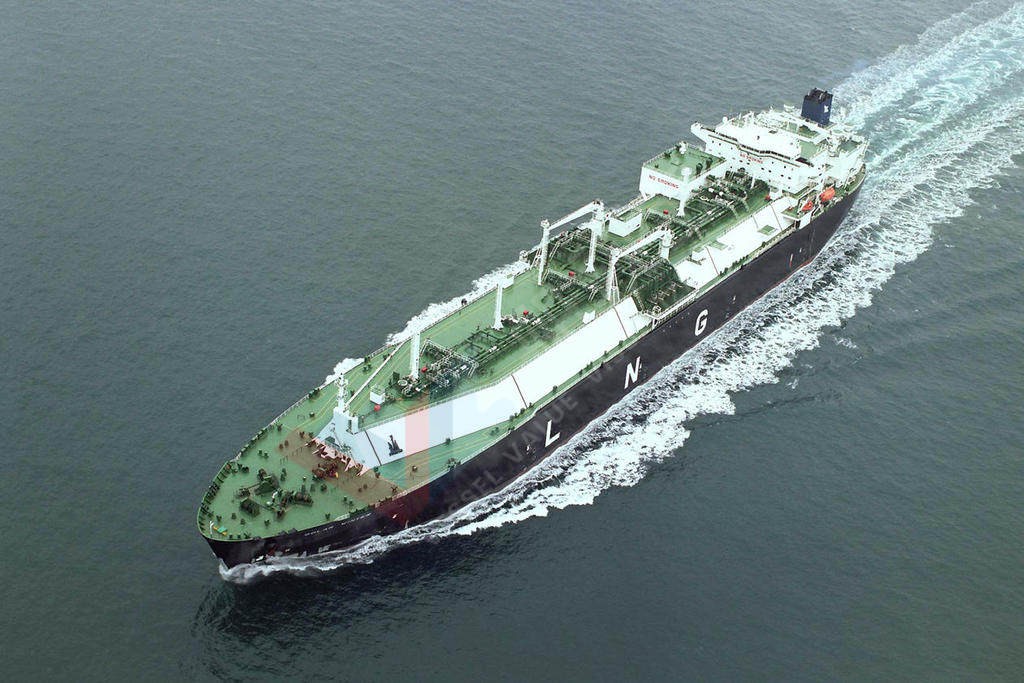
Energos Winter may look like a conventional LNG carrier, but its present role is closer to that of a floating gas import terminal.
The vessel has an LNG storage capacity of approximately 138,250 cubic metres and is deployed at Damietta to receive imported LNG, store it, regasify it and send the resulting natural gas into Egypt’s domestic pipeline network. Energos Infrastructure lists its peak natural gas send-out capacity at approximately 650 million standard cubic feet per day.
In July 2025, a subsidiary of New Fortress Energy entered into a five-year agreement with the Egyptian Natural Gas Holding Company, EGAS, for Energos Winter to provide regasification services at Damietta. At the time, the arrangement was presented as an important contribution to Egypt’s gas supply security.
This makes the consequences of the attack potentially much broader than the damage suffered by one vessel.
Any prolonged disruption to the FSRU’s regasification plant, transfer systems, connecting pipelines or associated terminal infrastructure could reduce Egypt’s LNG receiving capacity. Scheduled cargoes might need to be redirected, discharge windows rearranged and alternative terminals brought into use.
The consequences could then spread through the energy chain, from the port and national gas grid to power stations, fertiliser plants, industrial consumers and other downstream users.
The incident therefore carries the characteristics of an attack on critical energy infrastructure. Energos Winter is a ship, a terminal and a component of Egypt’s national gas supply system at the same time.
An American-controlled energy asset caught in the strike
The ownership structure of Energos Winter adds a politically sensitive dimension.
Energos Infrastructure was originally established by US-based New Fortress Energy and funds managed by Apollo. In February 2024, New Fortress Energy completed the sale of its remaining 20% interest in Energos Infrastructure to Apollo-managed funds.
Following that transaction, the platform came under the full control of Apollo-managed investment funds. Its fleet included nine FSRUs, two floating storage units and two LNG carriers.
Energos Winter can therefore accurately be described as an American-controlled FSRU or a floating LNG asset controlled by US capital.
This does not establish that the vessel was selected because of its American ownership. The attacker may have focused on its fixed position, strategic function, large visible profile, publicly available vessel information or the LNG transfer operation taking place at the terminal.
The motive can only be assessed through evidence including drone debris, radar records, flight-path analysis, communications data and intelligence findings.
Even without proof that the vessel’s US ownership influenced target selection, the symbolism is considerable. An American-controlled commercial energy asset serving Egypt’s national gas system was struck inside an Egyptian Mediterranean port.
For shipowners, infrastructure investors and energy companies, the event demonstrates how commercial ownership, national energy policy and regional conflict are becoming increasingly difficult to separate.
An asset may be registered in one jurisdiction, controlled by investors in another country, deployed in a third state and connected to an international supply chain extending across several regions. Each layer creates commercial value, but it may also add geopolitical exposure.
Middle East risk reaches an Egyptian Mediterranean port
Damietta lies on Egypt’s Mediterranean coast, north of the Suez Canal.
For much of the recent Middle East crisis, maritime risk assessments have concentrated on the Strait of Hormuz, the Arabian Sea, Bab el-Mandeb, the Red Sea and the southern approaches to the Suez Canal.
Many shipping companies have treated entry into the Mediterranean after transiting the Suez Canal as the point at which the most dangerous section of the voyage has ended.
The Damietta attack challenges that assumption.
A drone has now caused a fire involving two major gas vessels at a port on Egypt’s Mediterranean coast. This suggests that the security risk associated with the wider regional conflict may no longer be confined to the Red Sea and Gulf shipping corridors.
Vessels avoiding the Strait of Hormuz or Bab el-Mandeb could still face threats while berthed at Mediterranean energy terminals. Those threats may include long-range drones, launches from offshore platforms or shorter-range systems operated from locations closer to the target.
One isolated attack does not place the entire Mediterranean inside a continuous war-risk zone. There remains a significant difference between a single event and a sustained campaign against Mediterranean ports.
However, the incident shows that the Suez Canal can no longer be regarded as an automatic dividing line between high-risk and lower-risk waters.
Egypt has already suffered indirectly from the regional crisis through reduced Suez Canal traffic, Red Sea diversions, disruptions to pipeline gas imports and rising LNG procurement costs. Damietta introduces a more direct form of exposure: a security incident inside an Egyptian port involving infrastructure essential to the country’s energy system.
From disrupting shipping lanes to striking energy nodes
Previous attacks on merchant shipping have largely focused on vessels under way. Their objectives have included forcing ships to reroute, disrupting trade associated with selected states, increasing war-risk insurance costs and creating the practical effect of a partial maritime blockade.
The Damietta incident points towards a different and potentially more damaging model.
An attacker does not need to control an entire shipping lane to create significant economic disruption. Temporarily disabling a strategically important energy node may have a broader effect than attacking an individual ship at sea.
FSRUs are particularly exposed to this form of risk.
They normally remain in a fixed or predictable location. Their identity and position can often be found through commercial maritime data. Their operating patterns are relatively regular, and their large hulls are easy to identify. Most importantly, they are directly connected to shore-based gas networks, power systems and industrial production.
A relatively inexpensive drone does not need to sink an FSRU to create a major impact. A fire that forces the vessel to suspend operations, disconnect from the terminal, undergo inspection or move offshore can interrupt cargo schedules and generate significant economic costs.
Repair expenditure may form only one part of the loss. Additional costs can arise from operational downtime, replacement energy purchases, diverted LNG cargoes, delayed discharge, additional tug assistance, security measures and higher insurance premiums.
Damietta therefore reflects a wider transformation in maritime conflict. Merchant ships remain exposed at sea, while fixed energy assets inside ports are increasingly entering the same risk environment.
Two high-value gas vessels exposed in one location
The involvement of GasLog Salem highlights another important feature of FSRU operations: the concentration of risk.
When an LNG carrier delivers cargo to an FSRU, two large gas vessels, their cargoes, transfer equipment, cryogenic pipelines, support craft, firefighting systems and shore connections are concentrated within a limited area.
A single drone or projectile can therefore affect much more than one hull.
The incident may trigger emergency shutdown procedures, evacuation, tug deployment, port restrictions and extensive inspections even when the LNG containment systems remain intact.
The absence of reported casualties and catastrophic cargo-tank failure suggests that shipboard safety systems, containment technology and the port’s emergency response may have performed effectively. However, the simultaneous exposure of two high-value gas vessels is likely to prompt a broader reassessment of security during FSRU cargo transfers.
Future risk reviews may need to extend beyond conventional scenarios such as collision, leakage and fire. Ports and operators will increasingly have to consider low-altitude surveillance, drone detection, air-defence coordination, emergency disconnection, tug availability and the safe separation of vessels during LNG transfer operations.
The industry may also need to reconsider the assumption that conventional marine emergency planning is sufficient for terminals operating in regions exposed to geopolitical conflict.
The attack comes at a vulnerable moment for Egypt
The timing of the incident is especially sensitive because Egypt has become increasingly dependent on imported LNG.
Domestic gas production has declined, while demand from power generation, industry and households remains substantial. Egypt has consequently expanded LNG imports and strengthened its floating regasification capacity.
US Energy Information Administration data showed that Egypt’s LNG imports increased from an average of approximately 300 million cubic feet per day in 2024 to around 1.2 billion cubic feet per day in 2025.
Egypt has also been discussing multi-year LNG supply arrangements with major international energy companies. Reported procurement plans include monthly deliveries of 15 to 18 LNG cargoes under contracts potentially lasting between three and five years.
This confirms that FSRUs have become central to Egypt’s ability to balance its energy system.
The longer Damietta’s LNG operations remain restricted, the greater the pressure to redirect cargoes, adjust vessel schedules and rely on other import facilities. Such changes could add freight, diversion and procurement costs, particularly when the international LNG market is already being affected by security concerns around the Strait of Hormuz and other major energy routes.
Egypt now faces three interconnected challenges: securing sufficient gas supplies, transporting those supplies through increasingly contested waters and maintaining the infrastructure needed to receive them.
The Damietta incident brought all three risks together at one port.
Shipping and insurance markets will watch whether the risk map expands
The wider maritime consequences will depend on the findings of the investigation, the extent of the damage and the speed at which full LNG operations can resume.
Insurers may review the war-risk profile of Egyptian Mediterranean ports. Owners and charterers may seek stronger port-security assurances, shorter port stays, additional tug support and revised operational procedures.
Contracts may also come under closer examination, particularly clauses covering war risk, safe-port obligations, delay, deviation, force majeure and alternative discharge locations.
For FSRU owners and operators, the claims picture could be especially complex.
Physical damage to the vessel may represent only the first layer. Losses could also involve interrupted hire, suspended regasification services, terminal repairs, cargo delays and possible downstream supply obligations.
Responsibility may need to be divided among the vessel owner, technical manager, terminal operator, charterer, cargo interests, state energy company and multiple insurers.
Several important questions remain unanswered. Authorities have not yet publicly confirmed the full extent of damage to the cargo containment or regasification systems. It remains unclear whether LNG or natural gas escaped, when Energos Winter will resume operations, how the cargo aboard GasLog Salem will be handled and when the Damietta LNG terminal will return to full service.
The most politically important questions also remain open: who launched the drone, where it came from and why this particular target was selected.
A test case for a changing maritime security environment
The Damietta attack may become one of the defining maritime security cases of the current Middle East crisis.
An American-controlled commercial energy asset was struck inside an Egyptian port. An FSRU and an LNG carrier were drawn into the same fire. The incident occurred on the Mediterranean side of the Suez Canal, challenging long-standing assumptions about where the region’s highest maritime risks begin and end.
It also reveals a deeper change in the nature of maritime conflict.
Attacks are moving beyond ships under way and towards infrastructure directly connected to national gas networks, electricity systems and industrial production. A low-cost drone can create economic consequences far greater than its own value, particularly when it disrupts a concentrated energy node.
For owners and port operators, leaving a recognised high-risk shipping lane may no longer be enough to escape the wider conflict environment.
The attack has now been confirmed. The perpetrator has not.
That distinction will remain crucial as Egypt, the shipping industry and the international energy market assess whether Damietta was an isolated operation or the beginning of a broader expansion of the region’s maritime risk map.

READ MORE
 Safety
Collision-Damaged 181,000-dwt Capesize CAPE XL Safely Berthed in Qingdao — Three Months After Singapore Strait Collision
 Safety
CDB Leasing Moves to Auction Fire-Damaged LNG Carrier GasLog Salem as Lease Nears End
 Safety
Panama-Flagged Bulker Sinks in Bay of Bengal; 2 of 24 Crew Rescued, 20 Chinese Nationals Missing
 Safety
Rescued From One Drone Attack, Turkish Cook Dies in Second Black Sea Strike
 Safety
Five Grain‑Carrying Bulkers Hit in Succession; Novorossiysk‑Tuapse Shipping Route Under Siege
 Safety