


Global MPV Market Enters New Expansion Cycle as COSCO SHIPPING Specialized Strengthens Lead
.
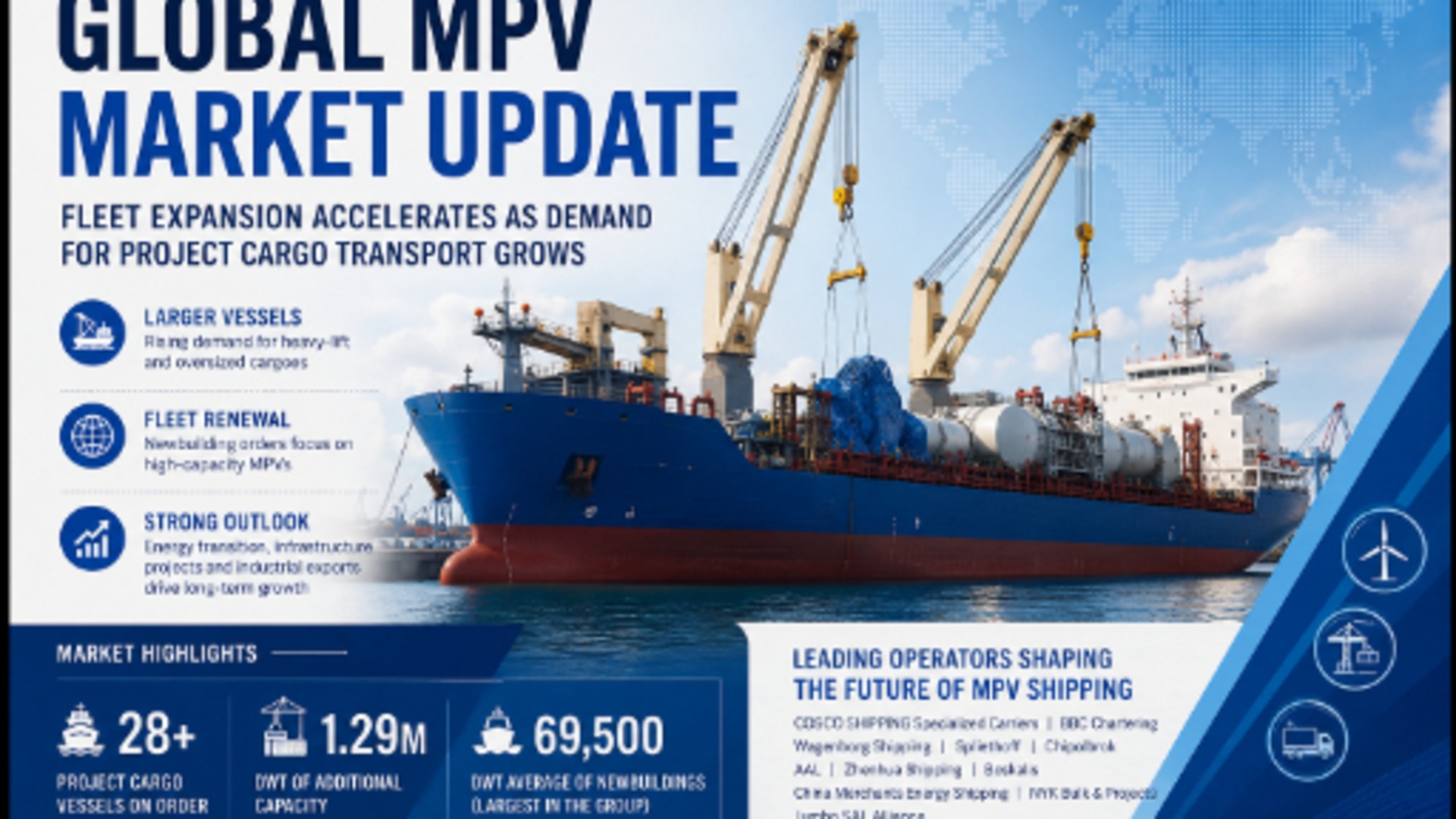

The global multipurpose vessel and project cargo market is entering a new phase of fleet renewal, supported by rising demand from offshore energy, wind power, port equipment, mining machinery and large-scale industrial projects.
Xinde Marine News has learned that recent industry data place COSCO SHIPPING Specialized Carriers, BBC Chartering, Wagenborg Shipping, Spliethoff, Chipolbrok, AAL, Zhenhua Shipping, Boskalis, China Merchants Energy Shipping, NYK Bulk & Projects and Jumbo SAL Alliance among the world’s major MPV and project cargo operators.
The figures reveal a highly differentiated market. Some operators rely on large fleets of small and medium-sized ships to maintain dense regional or global networks. Others focus on larger project cargo vessels designed to handle offshore modules, heavy machinery, port cranes and oversized industrial cargoes.
With a growing number of specialised newbuildings now under construction, the market is moving further towards larger ships, higher technical capability and more complex logistics services.
COSCO SHIPPING Specialized holds a clear capacity advantage
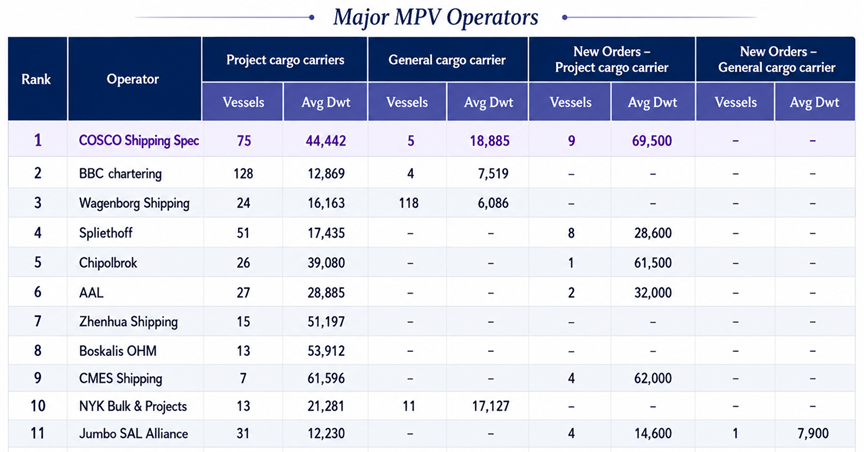
COSCO SHIPPING Specialized Carriers operates 75 project cargo vessels with an average deadweight of about 44,442 tonnes, together with five general cargo vessels averaging 18,885 dwt.
Based on vessel numbers and average deadweight, the two segments represent combined capacity of approximately 3.43m dwt, placing the Chinese operator well ahead of many of its international peers in total carrying capacity.
Its fleet profile is particularly suited to the transport of engineering vehicles, wind power equipment, offshore modules, port machinery, mining systems and other oversized or overweight cargoes.
The company also has nine project cargo vessels on order, averaging 69,500 dwt each. These ships would add around 625,500 dwt of capacity, giving COSCO SHIPPING Specialized one of the largest project cargo newbuilding programmes among the operators covered by the data.
The scale of the orderbook also reflects the company’s broader strategic direction. COSCO SHIPPING Specialized is expanding its presence in offshore logistics, vehicle and engineering machinery transport, bulk commodity logistics, advanced manufacturing exports and renewable energy projects.
Larger vessels provide more deck space, greater cargo flexibility and improved economies of scale on long-haul routes. They also support the company’s transition from conventional ocean transport towards integrated logistics corridors and end-to-end supply chain services.
BBC Chartering leads by vessel numbers
BBC Chartering operates 128 project cargo vessels, the largest number among the companies included in the data. Its ships average about 12,869 dwt.
BBC has built its market position around a large and diverse fleet of multipurpose and heavy-lift vessels serving industrial ports and project cargo centres worldwide. Its comparatively smaller average vessel size gives the company considerable flexibility in port access, scheduling and the transport of small and medium-sized project cargoes.
The contrast between BBC Chartering and COSCO SHIPPING Specialized illustrates two distinct operating models within the MPV sector.
BBC focuses on fleet scale, deployment flexibility and broad global coverage. COSCO SHIPPING Specialized combines a large fleet with substantially higher average deadweight, giving it greater exposure to large industrial and engineering cargoes.
Wagenborg Shipping also operates a fleet shaped by regional and industrial cargo demand. The company has 24 project cargo vessels averaging 16,163 dwt, as well as 118 general cargo vessels with an average deadweight of 6,086 tonnes.
The high proportion of general cargo ships reflects Wagenborg’s strong presence in European short-sea shipping, forest products, steel, raw materials and regional industrial logistics.
Wilson EuroCarriers follows a similar regional model. It operates 77 general cargo vessels averaging 4,434 dwt and has one 3,150-dwt general cargo vessel on order. Its fleet is primarily positioned for European short-sea and small-parcel cargo trades.
Spliethoff accelerates fleet renewal
Spliethoff operates 51 project cargo vessels with an average deadweight of 17,435 tonnes. It also has eight project cargo vessels on order, averaging 28,600 dwt.
The newbuildings are significantly larger than the company’s existing fleet average, indicating a clear move towards higher-capacity ships and greater long-haul project cargo capability.
Spliethoff has long been active in the transport of forest products, pulp, steel, industrial equipment and project cargo. As customers place greater emphasis on efficiency, cargo flexibility and environmental performance, modernisation of its fleet will be central to maintaining competitiveness.
Chipolbrok operates 26 project cargo vessels averaging 39,080 dwt and has one 61,500-dwt vessel on order. The size of the newbuilding points to a continued shift towards larger multipurpose ships capable of carrying heavier and more complex cargoes.
AAL operates 27 project cargo vessels averaging 28,885 dwt, with two 32,000-dwt ships on order. The company has a strong position in energy, mining, infrastructure and heavy industrial cargoes, where large deck areas and heavy-lift capability are critical.
Chinese operators move further into large project cargo vessels
Beyond COSCO SHIPPING Specialized, both Zhenhua Shipping and China Merchants Energy Shipping show a strong preference for larger vessels.
Zhenhua Shipping operates 15 project cargo vessels with an average deadweight of 51,197 tonnes. Its fleet is closely linked to the transport of port cranes, large machinery and engineering equipment.
The transport of quay cranes and other oversized port systems requires extensive deck space, high deck strength and specialised loading and securing arrangements. This creates a fleet profile that differs markedly from conventional multipurpose shipping.
China Merchants Energy Shipping operates seven project cargo vessels averaging 61,596 dwt, one of the highest average vessel sizes in the group.
The company also has four project cargo ships on order, averaging 62,000 dwt. These vessels would add about 248,000 dwt of capacity, representing a substantial expansion relative to the existing fleet.
Large multipurpose vessels can carry project cargo, vehicles, industrial equipment and selected bulk or breakbulk cargoes. This cargo flexibility is particularly important when operators seek to improve backhaul utilisation and reduce exposure to the cyclical nature of individual project markets.
Boskalis and Jumbo SAL focus on technical capability
Boskalis operates 13 project cargo vessels averaging 53,912 dwt. Its fleet is closely associated with offshore construction, floating structures, heavy modules and marine engineering projects.
Such cargoes demand more than basic carrying capacity. Operators must provide detailed loading plans, stability calculations, sea fastening design, marine engineering and project management. These requirements create high technical and operational barriers to entry.
NYK Bulk & Projects operates 13 project cargo vessels averaging 21,281 dwt and 11 general cargo vessels averaging 17,127 dwt.
Its fleet structure allows the company to combine project cargo and conventional breakbulk operations, supported by the broader customer base and logistics network of the NYK Group.
Jumbo SAL Alliance operates 31 project cargo vessels averaging 12,230 dwt. It has four project cargo vessels on order with an average deadweight of 14,600 tonnes, as well as one 7,900-dwt general cargo vessel.
Deadweight alone does not fully reflect the competitive strength of a specialised heavy-lift fleet. Jumbo SAL’s position is built around high-capacity cranes, engineering expertise and the ability to transport offshore modules and heavy industrial units that conventional MPVs cannot handle.
Newbuilding investment shifts towards project cargo vessels
The orderbook shows that capital investment is increasingly concentrated in specialised project cargo ships.
COSCO SHIPPING Specialized, Spliethoff, China Merchants Energy Shipping, Jumbo SAL Alliance, AAL and Chipolbrok together have at least 28 project cargo vessels on order, representing approximately 1.29m dwt of additional capacity.
COSCO SHIPPING Specialized accounts for about one-third of these vessels by number. Because its newbuildings average 69,500 dwt, they represent close to half of the combined additional deadweight covered by the data.
The four 62,000-dwt ships ordered by China Merchants Energy Shipping and Chipolbrok’s 61,500-dwt newbuilding further underline the shift towards larger vessels.
By comparison, new orders for conventional general cargo ships remain limited. Investment is being directed towards vessels offering large deck areas, flexible cargo spaces, higher technical specifications and stronger heavy or oversized cargo capability.
This trend reflects changes in the global cargo base.
Offshore wind equipment is becoming larger, with longer blades, taller towers and more powerful turbines. Petrochemical, mining and energy projects require the transport of increasingly large modules. Chinese exports of construction machinery, port equipment, rail systems and vehicles are also creating additional demand for specialised ocean transport.
Larger project cargo vessels can combine different types of cargo on a single voyage, improve vessel utilisation and reduce the need to dismantle and reassemble major equipment. For engineering contractors and manufacturers, access to reliable, modern and globally deployable transport capacity has become an important part of project execution.
MPV competition moves beyond vessel numbers
The global MPV market is now divided into several distinct operating segments.
BBC Chartering, Wagenborg Shipping and Wilson EuroCarriers rely on large fleets of small and medium-sized ships to provide broad regional or global coverage.
Spliethoff, AAL, Chipolbrok and Jumbo SAL Alliance combine multipurpose transport with project cargo and heavy-lift capability.
COSCO SHIPPING Specialized, Zhenhua Shipping, Boskalis and China Merchants Energy Shipping place greater emphasis on large engineering cargoes, offshore projects and specialised heavy transport.
Future competition will increasingly be determined by vessel size, deck configuration, crane capacity, fuel efficiency, alternative-fuel readiness and the ability to organise complex global supply chains.
Ocean carriage alone is no longer sufficient for many large industrial customers. Transport planning, port coordination, inland logistics, cargo handling, securing engineering and project schedule management are becoming integral parts of the service offering.
Fleet renewal will also shape operators’ market positions for the next 10 to 20 years. New-generation MPVs are placing greater emphasis on efficient hull forms, propulsion performance, digital energy management and future regulatory compliance. Some designs are also being prepared for later conversion to methanol, ammonia or other alternative fuels.
COSCO SHIPPING Specialized already holds a strong position in fleet scale, average vessel size and future capacity. Spliethoff, China Merchants Energy Shipping, AAL and Chipolbrok are also moving ahead with significant renewal programmes.
As these vessels enter service over the coming years, the global MPV and project cargo market will continue to evolve towards larger, more specialised and more technically capable fleets. The ability to combine modern vessels with integrated logistics services will determine which operators gain ground in the next cycle.


READ MORE
 Shipbuilding
Chinese Shipyard Starts Work on First Wärtsilä 25 Ammonia Newbuild: Not Just “Ready”—It Will Run on Ammonia from Day One
 Shipbuilding
8 more!Wan Hai Steps Up Fleet Expansion with 50-Vessel Newbuilding Programme
 Shipbuilding
“The Whole World Is Asking for Chinese Cars”: Why PCTC Capacity Is Still Tight Despite Record Deliveries
 Shipbuilding
A Small Chinese Private Shipyard Is Now Building 5,000 CEU PCTCs — China’s Car Carrier Capability Is Expanding Beyond Major Yards
 Shipbuilding
Up to $489 Million, 17 Yards in the Running: Why Norway’s High-End Wellboats Are Heading to China
 Shipbuilding
Can a Ship Be Sold in Pieces? A $1,000 Ticket to Becoming a Digital “Shipowner”
 Shipbuilding
Hanwha Makes $1.2 Billion Bid for Austal USA in Major U.S. Naval Shipbuilding Push
 Shipbuilding
Why Uni-Asia Still Chose Japan for Its Return to Newbuilding
 Shipbuilding
Dynacom Orders Four More VLCCs at Hengli
 Shipbuilding