

China’s PCTC Delivery Boom Meets a Million-Car Export Month
Chinese shipyards are releasing a wave of large, greener vehicle carriers just as China’s monthly automobile exports exceed one million units for the first time. The long-awaited ships are arriving—and the cargo is arriving with them.
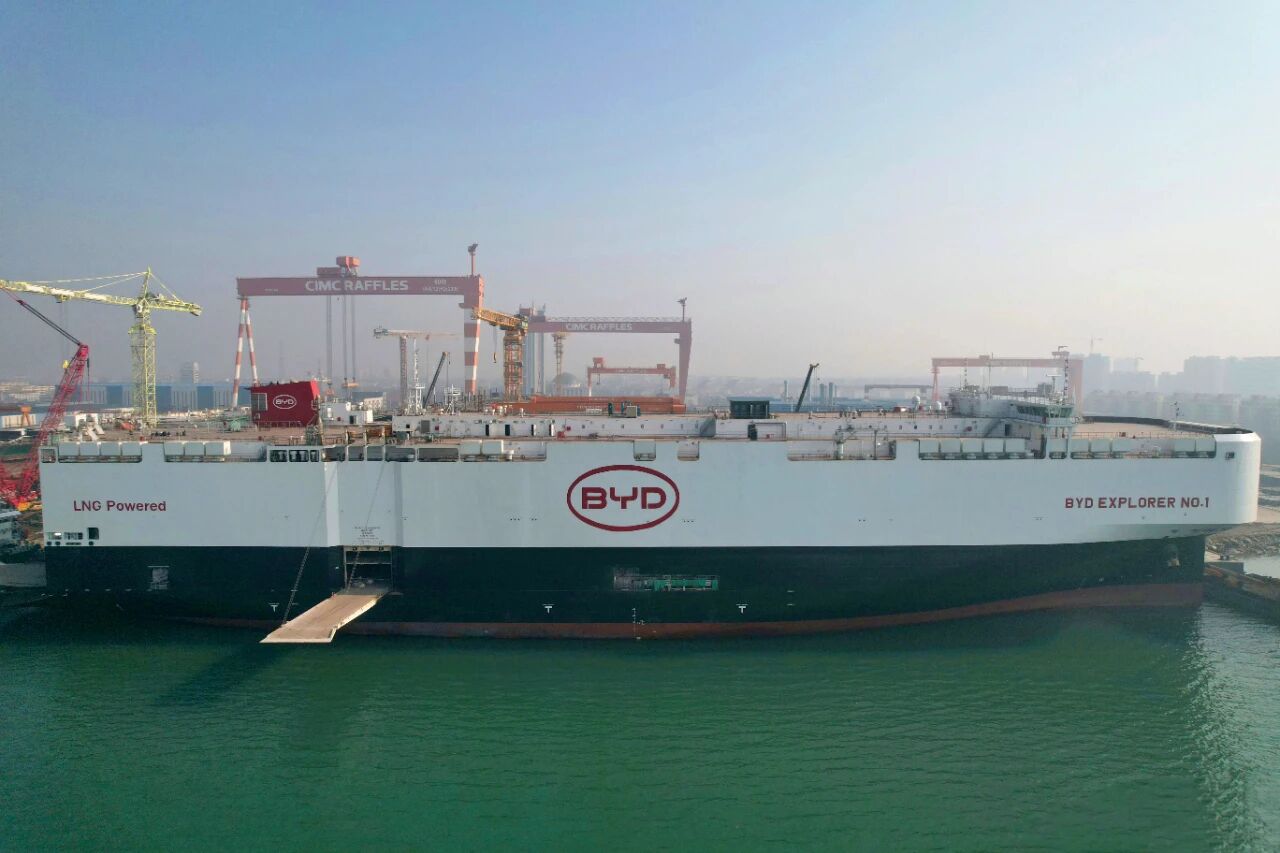

China’s rapidly expanding fleet of pure car and truck carriers is entering service at an unusually favourable moment.
In June 2026, China exported 1.0378 million vehicles, an increase of 75.1% year on year. It was the first time the country’s monthly automobile exports had exceeded one million units. During the first half of the year, cumulative exports surpassed five million vehicles, rising 65.3% from the same period in 2025, according to data released by the China Association of Automobile Manufacturers.
The milestone provides a powerful cargo backdrop for the large number of PCTCs now being delivered by Chinese shipyards.
Large PCTCs enter service in quick succession
On June 29, Guangzhou Shipyard International delivered another 10,800-ceu LNG dual-fuel PCTC, the third vessel of this size to be completed in China.
The ship measures 230 metres in length and 40 metres in breadth and is equipped with 14 vehicle decks. It can carry electric vehicles, hydrogen-powered vehicles, commercial trucks and other rolling cargo. The delivery confirms that China has moved beyond building individual prototype vessels and has established serial construction capability for the world’s largest class of vehicle carriers.
The first 10,800-ceu vessel in the programme, Glovis Leader, was delivered in Guangzhou on April 28. Built for South Korean carrier HMM and operated by Hyundai Glovis, it became the world’s largest PCTC by vehicle capacity at the time of delivery.
China Merchants Jinling Shipyard also delivered two 7,400-ceu LNG dual-fuel PCTCs, Ocean Express and Ocean Navigator, to Sallaum Lines in June. The ships entered commercial service immediately after delivery.
Sallaum said the additional capacity would help address previous constraints on its ability to meet customer demand. The company completed eight Far East–Europe sailings during 2026 and plans to launch a dedicated China–Europe service in 2027.
These ships form part of a much broader delivery cycle.
Clarksons-related data indicate that global PCTC deliveries increased from only 12 ships in 2023 to 46 in 2024 and a record 75 in 2025. A further 67 vessels representing approximately 518,000 ceu are expected to be delivered in 2026, followed by around 50 ships in 2027 and 26 in 2028.
Chinese shipyards are at the centre of this expansion. According to previous AXSMarine analysis, approximately 276 PCTCs are scheduled for delivery globally between 2023 and 2028, with 219—or close to 80%—being constructed in China.
The cargo base is expanding even faster
Concerns about PCTC overcapacity have grown as the newbuilding orderbook has moved into its delivery phase. Fleet growth is accelerating, charter rates have retreated from their previous peaks, and a substantial number of large vessels will enter service over the next two years.
China’s latest export figures, however, show why many operators continue to deploy additional capacity on trades connected with the country.
China’s annual vehicle exports increased from 2.015 million units in 2021 to 7.098 million units in 2025. By the end of June 2026, the country had already exported more than five million vehicles.
The expansion is being driven by a broader range of Chinese manufacturers, including BYD, Chery, Geely, SAIC and Great Wall Motor. Export destinations have also become more diversified, extending beyond Europe into Southeast Asia, the Middle East, Latin America, Africa and Australia.
This creates demand for more than basic vessel capacity. Automakers increasingly require fixed schedules, dedicated loading windows, predictable transit times and logistics networks capable of supporting spare parts, vehicle processing and inland distribution.
The entry of automaker-backed fleets and long-term chartered tonnage reflects this change. Vehicle manufacturers are seeking greater control over shipping capacity, while established PCTC operators are expanding their China-linked services and securing longer-term cargo relationships.
More ships do not remove the market risks
The million-vehicle monthly export figure should not be interpreted as one million vehicles moving exclusively by PCTC.
Some vehicles are transported in containers, while others leave China by rail or road. Chinese manufacturers are also developing overseas assembly plants, which may gradually shift part of the supply chain from complete-vehicle exports toward components and locally assembled vehicles.
Trade barriers, tariffs, port capacity and geopolitical disruptions can also alter routes and export volumes.
Meanwhile, 67 PCTC deliveries in a single year will still place pressure on vessel utilisation. Operators without contracted cargo or established distribution networks may face greater competition, particularly in markets where export growth is slower.
Older and smaller vessels are likely to feel the greatest pressure. The latest generation of PCTCs typically offers capacity of between 7,000 and more than 10,000 ceu, lower fuel consumption per transported vehicle, dual-fuel propulsion and greater flexibility for carrying trucks, machinery and high-and-heavy cargo.
The competitive benchmark is therefore shifting from simply owning a vehicle carrier to operating a large, efficient vessel within a reliable logistics network.
From vessel shortage to logistics competition
The global PCTC market is moving away from the severe capacity shortage experienced earlier in the decade. The next phase will be defined by fleet utilisation, cargo control and network efficiency.
China occupies an unusual position in this transition. It is simultaneously the leading builder of the new generation of PCTCs and the largest source of incremental vehicle-export cargo.
Its shipyards are delivering increasingly large and technically sophisticated vessels. Its automobile manufacturers are expanding overseas sales and building their own international logistics capabilities. Chinese ports, shipping companies and automotive groups are becoming more closely connected through dedicated services and long-term capacity arrangements.
For the PCTC market, the latest figures offer a clear signal: the delivery wave is substantial, but the ships are entering a market with a rapidly expanding cargo base.
The central question is therefore changing. The industry is moving from asking whether enough ships are available to determining who can fill them consistently, secure return cargo and operate the most efficient end-to-end vehicle logistics network.


READ MORE
 Shipbuilding
32 Ships Worth Over $2.06 Billion: Four Yangzhou Shipyards Secure Major Newbuilding Package
 Shipbuilding
After Spending $167 Million on Two Secondhand Ships, Hong Kong Owner CYH Shipping Is Linked to 4+2 VLGC Newbuildings
 Shipbuilding
CMES Approves 10-Vessel Newbuilding Plan, Securing 2028–2029 Delivery Slots
 Shipbuilding
KC Maritime orders two ultramax bulkers at SOHOInno-Tech
 Shipbuilding
ADNOC L&S Expands LNG Fleet with $900m Order for Four New Carriers
 Shipbuilding
Shipbuilding Orders Surge: Is 2026 Becoming Another 2008?
 Shipbuilding
MSC Makes PCTC Newbuilding Debut with 12-Ship China Programme
 Shipbuilding
ADNOC L&S Returns to Jiangnan with $900m LNG Carrier Order
 Shipbuilding
The Greek owner has booked three 1,800-teu Bangkokmax vessels at China Merchants’ Qingshan Shipyard
 Shipbuilding