

32 Ships Worth Over $2.06 Billion: Four Yangzhou Shipyards Secure Major Newbuilding Package
The concentrated signing covers seven vessel categories, including rocket launch and recovery ships, Aframax tankers, vehicle carriers, bulk carriers, containerships and LNG dual-fuel PCTCs
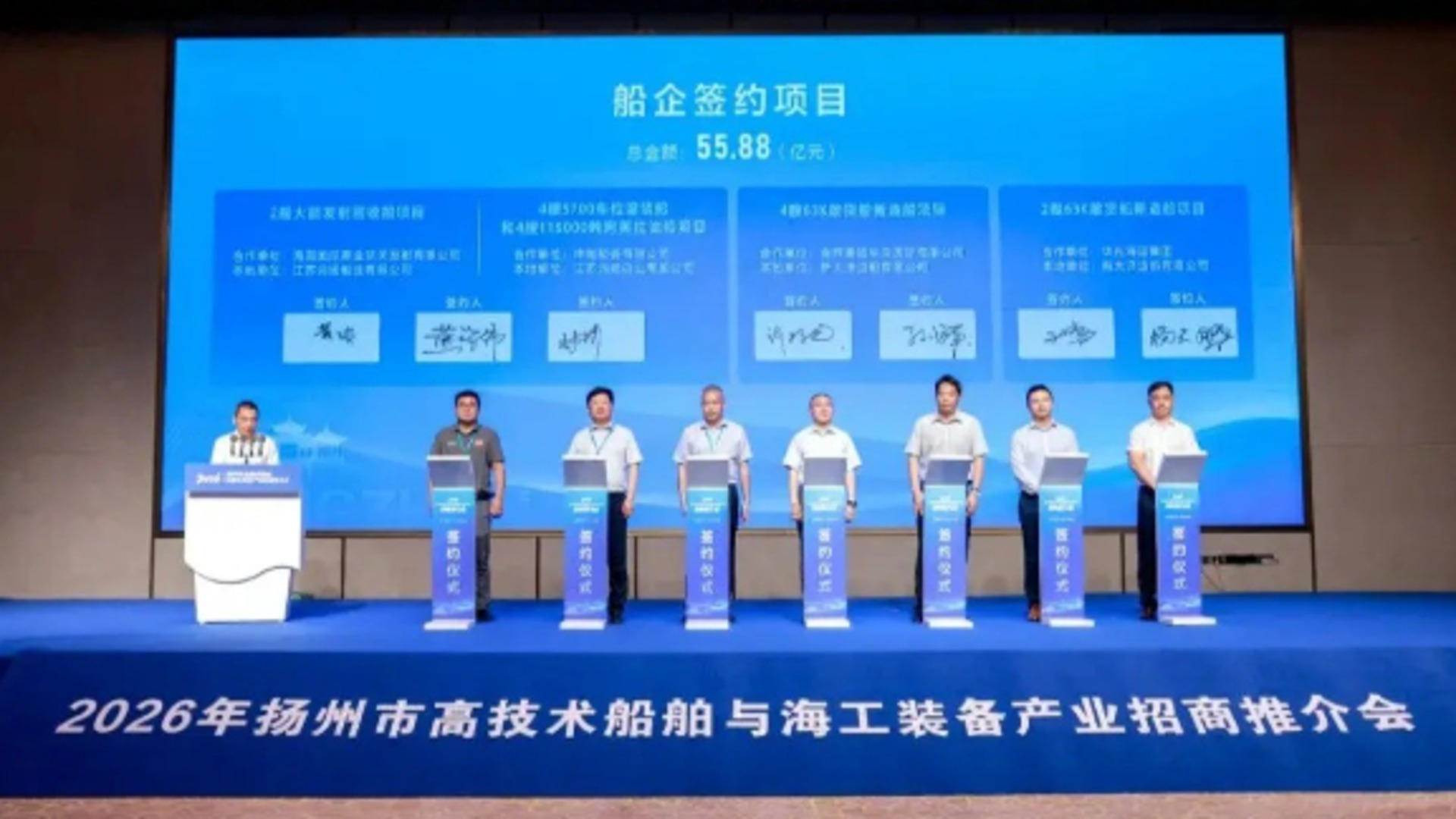
Four shipyards in Yangzhou have signed or formally presented contracts covering 32 newbuildings worth more than RMB14 billion, equivalent to approximately $2.06 billion, in one of the largest concentrated ship-order announcements by a Chinese shipbuilding city in recent years.
The contracts were announced on July 11 during the Yangzhou High-Tech Ships and Offshore Equipment Industry Investment Promotion Conference, held in conjunction with China’s 22nd Maritime Day.
Eight shipbuilding agreements covering seven vessel categories were included in the signing programme. The participating yards were Jiangsu Runyang Shipbuilding Co., Ltd., New Dayang Shipbuilding Co., Ltd., Yangzhou Guoyu Shipbuilding Co., Ltd. and China Merchants Jinling Shipyard (Jiangsu) Co., Ltd.
The order package includes rocket launch and recovery ships, 5,700-CEU vehicle carriers, 115,000-dwt Aframax tankers, 63,000-dwt-class Ultramax bulk carriers, 6,150-TEU containerships, 5,700-CEU PCTCs and 8,600-CEU LNG dual-fuel PCTCs.
In terms of vessel numbers, contract value and the range of ship types involved, the event represented one of the largest concentrated newbuilding signings held by a Chinese regional shipbuilding centre in recent years.
The conference also saw the signing of 12 shipbuilding and offshore-related industrial projects involving investment of more than RMB10 billion, equivalent to approximately $1.47 billion.
Together, the shipbuilding orders and industrial investments represented more than RMB24 billion, or around $3.54 billion. The value of the 32-vessel newbuilding package itself, however, was more than RMB14 billion.
Runyang Shipbuilding signs 10 vessels and enters larger tanker and vehicle carrier markets
Jiangsu Runyang Shipbuilding accounted for 10 of the 32 vessels included in the signing programme.
The shipyard signed an agreement with Hainan International Commercial Aerospace Launch Co., Ltd. for two rocket launch and recovery ships.
These highly specialised vessels are intended to support offshore rocket launches, recovery operations and related marine services. Their construction requires capabilities in areas including dynamic positioning, large working decks, specialised recovery equipment and integrated mission-support systems.
Runyang Shipbuilding also signed agreements with Zhongnan Shipping Co., Limited for four 5,700-CEU vehicle carriers and four 115,000-dwt Aframax tankers.
The two projects represent a significant expansion of Runyang’s product portfolio. The yard has traditionally focused on conventional merchant vessels, but the latest orders will take it further into larger and more technically demanding segments.
The 5,700-CEU ships are expected to feature multiple vehicle decks and systems designed for the efficient transportation of both conventional and new-energy vehicles.
The four Aframax vessels will also mark Runyang’s entry into the construction of large crude and product tankers.
Building 115,000-dwt tankers requires stronger capabilities in design coordination, production management, cargo system integration, coating, piping and quality control. Successful execution of the contracts could significantly strengthen Runyang’s position in the large commercial vessel market.
New Dayang adds six Ultramax bulk carriers
New Dayang Shipbuilding signed contracts covering six 63,000-dwt-class bulk carriers.
Four vessels were associated with Goldbeam International Limited, a subsidiary of Hong Kong-listed Jinhui Shipping and Transportation Limited, while another two vessels were signed with Wah Kwong Maritime Transport Holdings Limited.
Jinhui’s four vessels had previously been disclosed through two separate transactions.
The ships are understood to be 64,100-dwt Ultramax bulk carriers, with the four-vessel programme valued at approximately $136 million. Deliveries are scheduled between 2029 and 2030.
The Yangzhou event therefore represented the concentrated signing or presentation of some projects that had already been disclosed, rather than meaning that all 32 vessels were ordered for the first time on July 11.
Nevertheless, the six-vessel package further consolidates New Dayang’s established position in the Ultramax market.
The SUMEC-owned yard has developed a substantial international orderbook covering bulk carriers, multipurpose vessels, gas carriers, tankers, containerships and offshore support vessels.
Its combination of ship design, supply-chain management and project execution has helped the yard maintain a strong presence among international shipowners seeking standardised and fuel-efficient medium-sized commercial vessels.
Guoyu Shipbuilding signs eight containerships and PCTCs
Yangzhou Guoyu Shipbuilding signed three projects covering eight vessels.
The yard agreed to build two 6,150-TEU containerships for Changhong International Logistics Limited and four vessels of the same design for Shanghai Changshun Shipping Co., Ltd.
The 6,150-TEU design represents a major step up in containership size for Guoyu.
Vessels in this capacity range can be deployed on regional mainline routes, selected long-haul services and larger feeder networks. They provide owners with greater operational flexibility than ultra-large containerships that depend heavily on major hub ports.
Shanghai Changshun had previously been linked to a programme involving up to 10 vessels of 6,150 TEU at Guoyu, comprising six firm ships and four options.
The four vessels included in the Yangzhou signing may therefore represent the formal declaration, confirmation or presentation of part of that earlier programme, rather than an entirely separate order.
Guoyu also signed an agreement with Hainan Yanggang Hechuang Shipping Co., Ltd. for two 5,700-CEU PCTCs.
The contract marks Guoyu’s entry into the car carrier construction market.
PCTCs are significantly more outfitting-intensive than conventional bulk carriers. They incorporate multiple fixed and hoistable vehicle decks, internal ramps, stern and side ramps, large ventilation systems and enhanced fire-detection and suppression arrangements.
The growing transportation of battery-electric vehicles has also increased requirements related to fire safety, ventilation, cargo monitoring and emergency response.
The orders show Guoyu broadening its product portfolio beyond containerships, bulk carriers and tankers as the yard rebuilds its position in China’s commercial shipbuilding market.
China Merchants Jinling signs eight 8,600-CEU LNG dual-fuel PCTCs
The largest individual project announced at the event was an eight-vessel agreement between China Merchants Jinling Shipyard (Jiangsu) Co., Ltd. and GCC Global Car Carriers for 8,600-CEU LNG dual-fuel PCTCs.
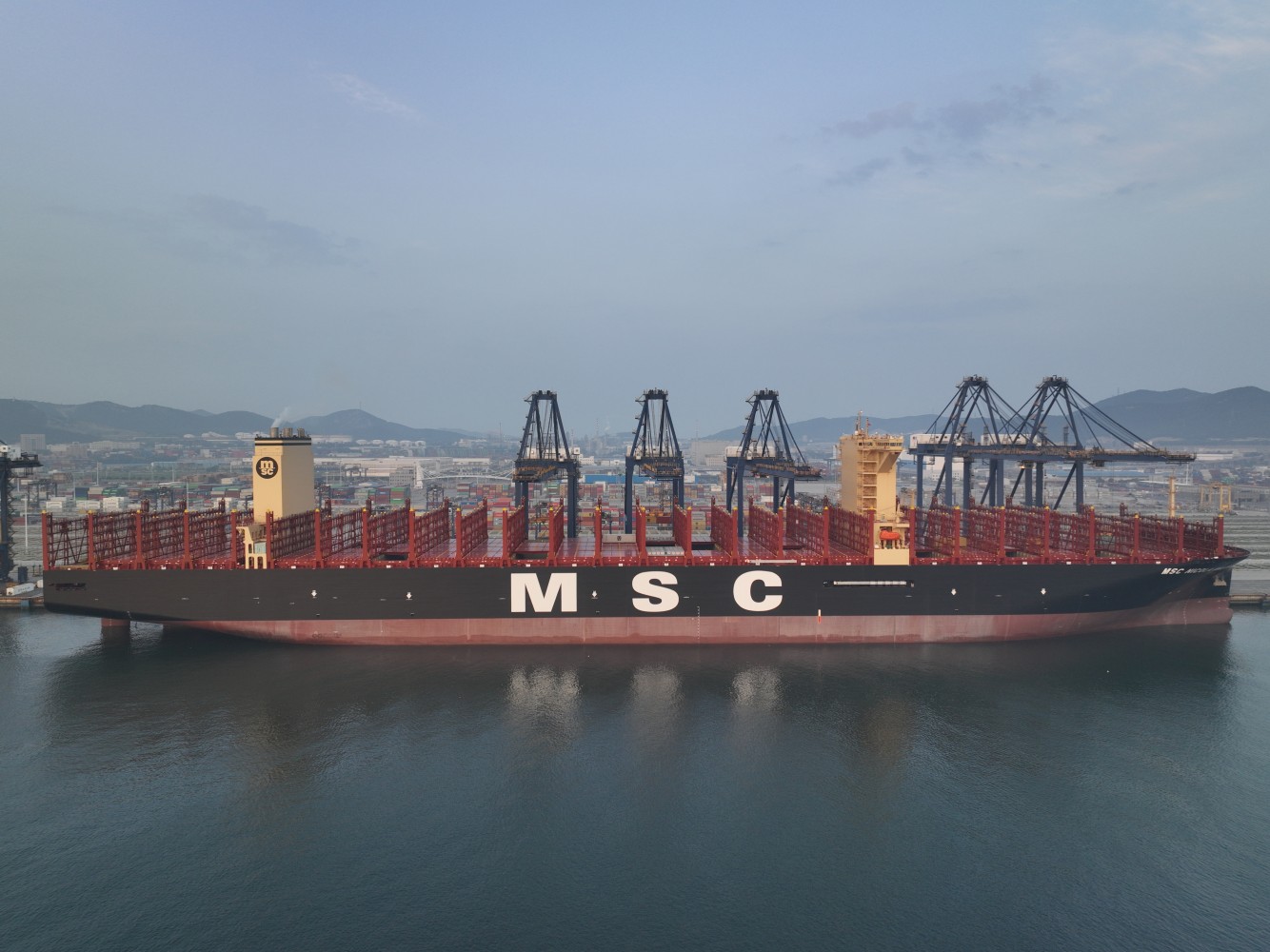
GCC Global Car Carriers is part of the MSC Group and was previously known as Gram Car Carriers.
MSC acquired the Norway-based car carrier tonnage provider in 2024 and subsequently rebranded the company while retaining the GCC abbreviation.
The newbuilding programme represents MSC’s first major direct move into the construction of car carriers.
According to previously disclosed information, GCC has assembled a 12-vessel PCTC orderbook at Chinese shipyards.
The programme includes eight 8,600-CEU vessels and four 7,000-CEU vessels, with deliveries scheduled between 2028 and 2030.
The eight 8,600-CEU ships included in the Yangzhou signing will significantly expand GCC’s capacity in the large car carrier segment and support MSC’s broader diversification into vehicle logistics.
There is, however, some discrepancy between the Yangzhou signing announcement and previously reported yard allocations.
The Yangzhou event attributed all eight 8,600-CEU vessels to China Merchants Jinling Shipyard (Jiangsu).
Other published information has suggested that six may be built at the Jiangsu facility, while another two could be assigned to China Merchants’ Weihai yard.
The difference may reflect a distinction between the legal contracting entity and the physical construction site. Final allocation will depend on further disclosures from China Merchants Industry or GCC.
Regardless of the final yard distribution, the project represents another significant order for Chinese shipyards in the large LNG dual-fuel PCTC market.
The vessels are expected to use LNG dual-fuel propulsion and may also incorporate battery energy-storage systems, shore-power capability and provisions for future conversion to alternative fuels.
They will be designed to transport both conventional vehicles and new-energy vehicles, including battery-electric and hydrogen-powered units.
Yangzhou’s shipbuilding portfolio is moving up the value chain
The importance of the 32-vessel package extends beyond its headline value of more than $2.06 billion.
Yangzhou’s shipyards are moving from a portfolio traditionally dominated by bulk carriers, containerships and smaller tankers into larger, greener and more specialised vessels.
Runyang Shipbuilding is expanding into Aframax tankers, vehicle carriers and commercial space-support vessels.
New Dayang is strengthening its established position in the Ultramax bulk carrier market.
Guoyu is combining larger containership construction with its first PCTC contracts.
China Merchants Jinling is further consolidating its position as one of China’s leading builders of large LNG dual-fuel car carriers.
The order mix also illustrates the increasingly diverse customer base available to Chinese shipyards.
The signatories include domestic shipping companies, Hong Kong shipowners, an MSC-controlled Norwegian tonnage provider and a Chinese commercial aerospace launch company.
The inclusion of rocket launch and recovery ships is particularly notable, showing that the shipbuilding industry is beginning to develop closer links with China’s expanding commercial space sector.
Strong industrial growth supports order expansion
Yangzhou is one of Jiangsu province’s principal shipbuilding centres and has developed a broad industrial chain covering ship construction, marine equipment, design, engineering and supporting services.
By the end of 2025, the city’s shipbuilding and offshore equipment cluster included two national manufacturing champion products, 10 national-level specialised and innovative “little giant” enterprises and 28 provincial-level specialised and innovative small and medium-sized enterprises.
During the first five months of 2026, Yangzhou’s shipbuilding and offshore equipment industrial chain recorded invoiced sales of RMB21.8 billion, equivalent to approximately $3.22 billion, representing year-on-year growth of 34%.
Tax revenue from the sector reached RMB730 million, or around $108 million, an increase of 37%.
The city’s 89 major shipbuilding and offshore equipment enterprises generated output of RMB22.55 billion, equivalent to approximately $3.33 billion, up 29% year on year.
These figures demonstrate that the city’s order growth is being supported by a broader expansion of shipbuilding capacity, marine equipment production and industrial investment.
A concentrated signing rather than 32 entirely undisclosed orders
Several projects included in the July 11 event had already appeared in stock-exchange announcements, shipyard disclosures or industry reports.
These include Jinhui’s four Ultramax bulk carriers, Shanghai Changshun’s 6,150-TEU containership programme and GCC’s broader PCTC newbuilding plan.
The event should therefore be viewed as a large-scale concentrated signing, confirmation and presentation of Yangzhou-related shipbuilding projects, rather than evidence that all 32 ships emerged as completely new orders on a single day.
That distinction does not diminish the scale of the announcement.
Thirty-two vessels across seven ship categories, with a combined value of more than RMB14 billion, or approximately $2.06 billion, demonstrate both the depth of Yangzhou’s orderbook and the continued expansion of Chinese shipyards into technically demanding, environmentally advanced and higher-value vessel segments.
With shipbuilding capacity expanding, supporting industrial projects advancing and more international shipowners placing orders in the region, Yangzhou is strengthening its position as an increasingly important centre within China’s shipbuilding industry.
Currency conversions are based on an indicative exchange rate of approximately RMB6.8 to $1 and are provided for reference.

READ MORE
 Shipbuilding
After Spending $167 Million on Two Secondhand Ships, Hong Kong Owner CYH Shipping Is Linked to 4+2 VLGC Newbuildings
 Shipbuilding
China’s PCTC Delivery Boom Meets a Million-Car Export Month
 Shipbuilding
CMES Approves 10-Vessel Newbuilding Plan, Securing 2028–2029 Delivery Slots
 Shipbuilding
KC Maritime orders two ultramax bulkers at SOHOInno-Tech
 Shipbuilding
ADNOC L&S Expands LNG Fleet with $900m Order for Four New Carriers
 Shipbuilding
Shipbuilding Orders Surge: Is 2026 Becoming Another 2008?
 Shipbuilding
MSC Makes PCTC Newbuilding Debut with 12-Ship China Programme
 Shipbuilding
ADNOC L&S Returns to Jiangnan with $900m LNG Carrier Order
 Shipbuilding
The Greek owner has booked three 1,800-teu Bangkokmax vessels at China Merchants’ Qingshan Shipyard
 Shipbuilding