

Is Transiting the Strait of Hormuz Really Free? A Bigger Bill May Be Waiting
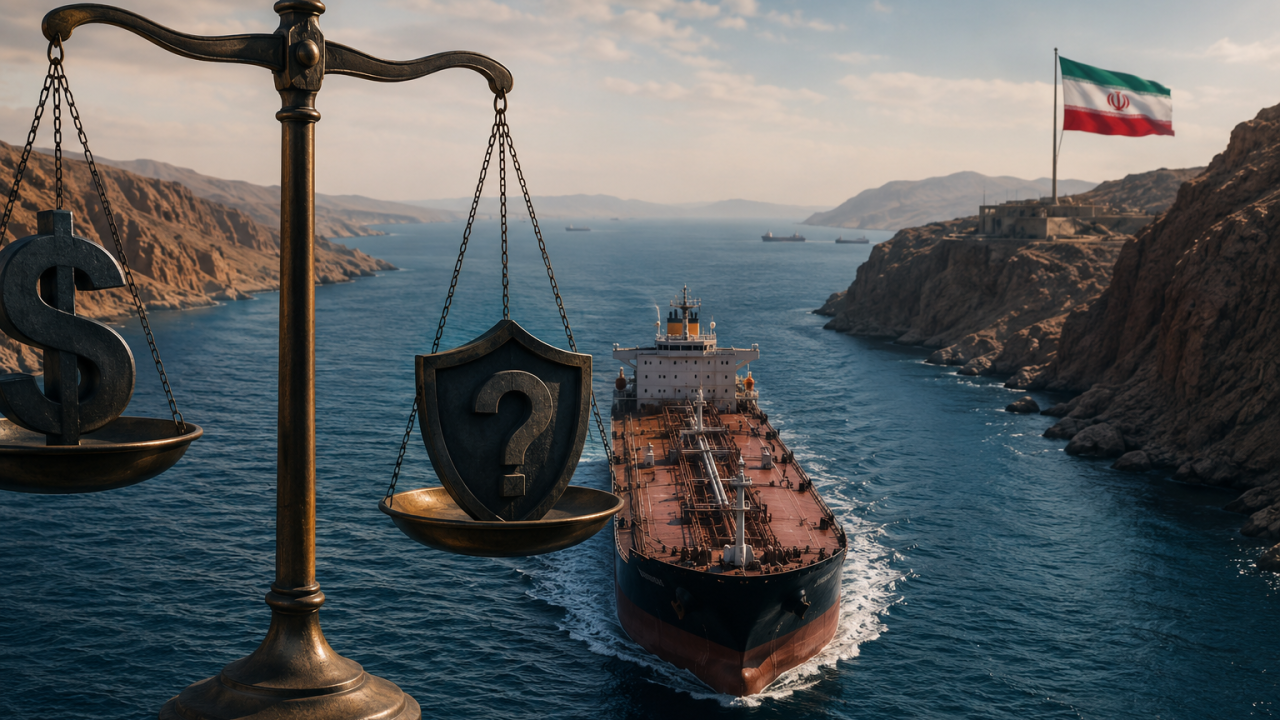

Xinde Marine News — The reopening of the Strait of Hormuz has given the shipping market a much-needed positive signal. But for shipowners, the answer to one critical question is far from simple: is transit through the Strait of Hormuz really free?
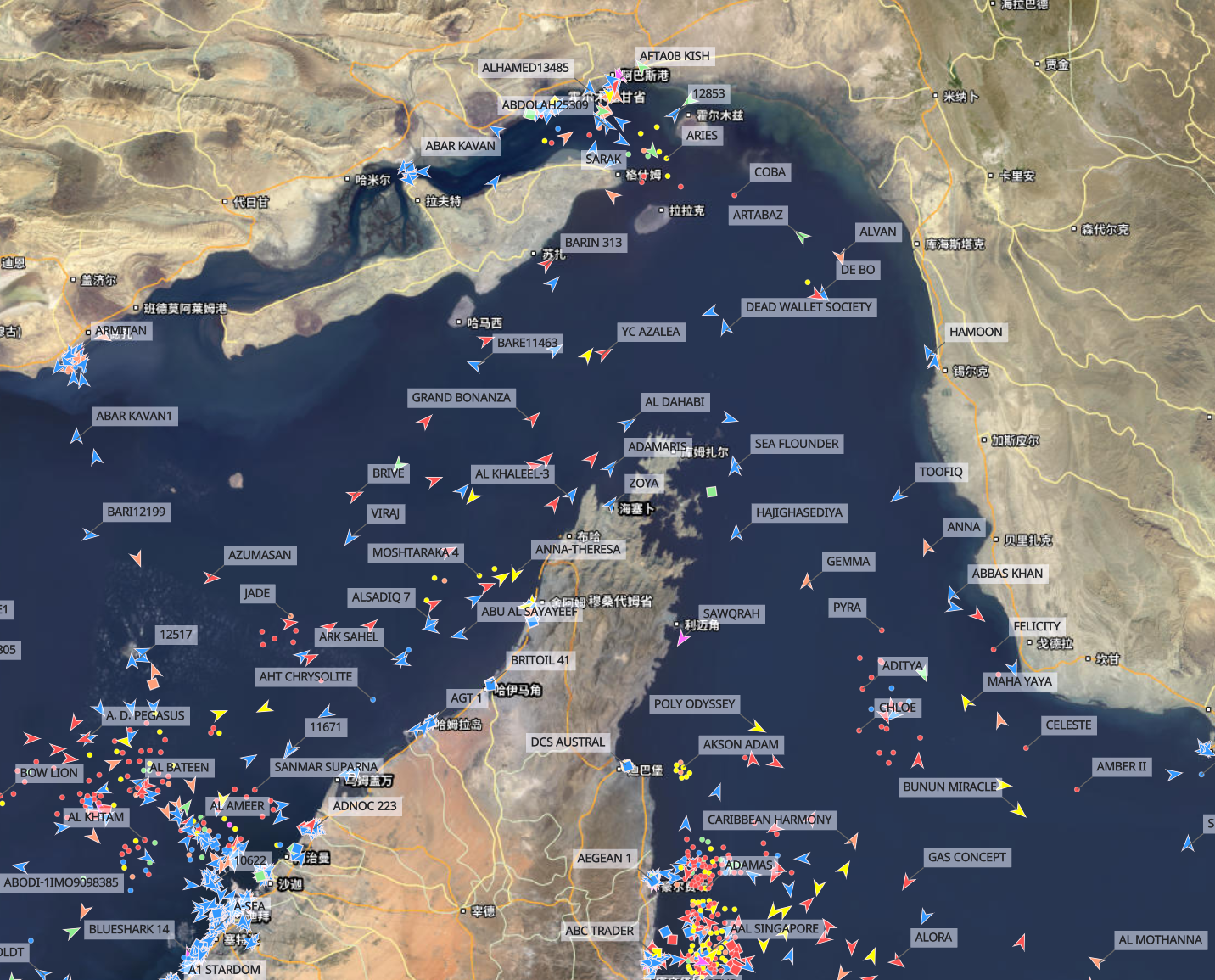
On 18 June, 25 commercial vessels crossed the Strait of Hormuz, according to data from AXSMarine and Kpler. It was the highest single-day count since mid-April and a clear rebound from the depressed levels seen in early June.
At first glance, the figure looks encouraging.
Following the US-Iran memorandum of understanding and Iran’s announcement that ships applying to transit the Strait will be exempt from relevant fees for 60 days, some owners and operators have started to test the operating environment in one of the world’s most important energy chokepoints.
But the shipping industry is now looking beyond the headline of “toll-free passage”.
Based on the latest Iranian transit rules, insurance requirements and navigation restrictions, the picture is much more complicated. For the next 60 days, ships may not be charged a direct transit fee. But a new set of costs, risks and compliance obligations is already forming around the Strait.
25 ships crossed in one day, but traffic remains far below normal
According to AXSMarine, 25 verified commercial vessel crossings were recorded through the Strait of Hormuz on 18 June. That was the highest daily level since 18 April and more than five times the average daily level recorded during the first ten days of June.
Since the start of March 2026, AXSMarine’s AIS-derived data has verified 846 commercial vessel crossings through the Strait, covering dry bulk carriers, tankers, gas carriers and container ships. That equals an average of just 7.6 crossings per day.
The gap with normal traffic levels remains significant.
AXSMarine data shows that commercial traffic through the Strait averaged around 110 crossings per day in 2025. Even with the 18 June rebound, the daily count was only around one quarter of the pre-conflict level.
This means the Strait is seeing a low-level recovery, not a full return to normal.
For shipowners, charterers, insurers and cargo interests, one day of stronger traffic can help improve sentiment. But it is not enough to prove that the waterway has become stable, predictable and commercially manageable again.
The 60-day “free” window may only be the first layer
Iran’s Supreme National Security Council has said that, under the relevant provisions of the US-Iran memorandum of understanding, vessels applying to pass through the Strait of Hormuz will not be charged relevant fees for 60 days. The costs will be covered by the Iranian government.
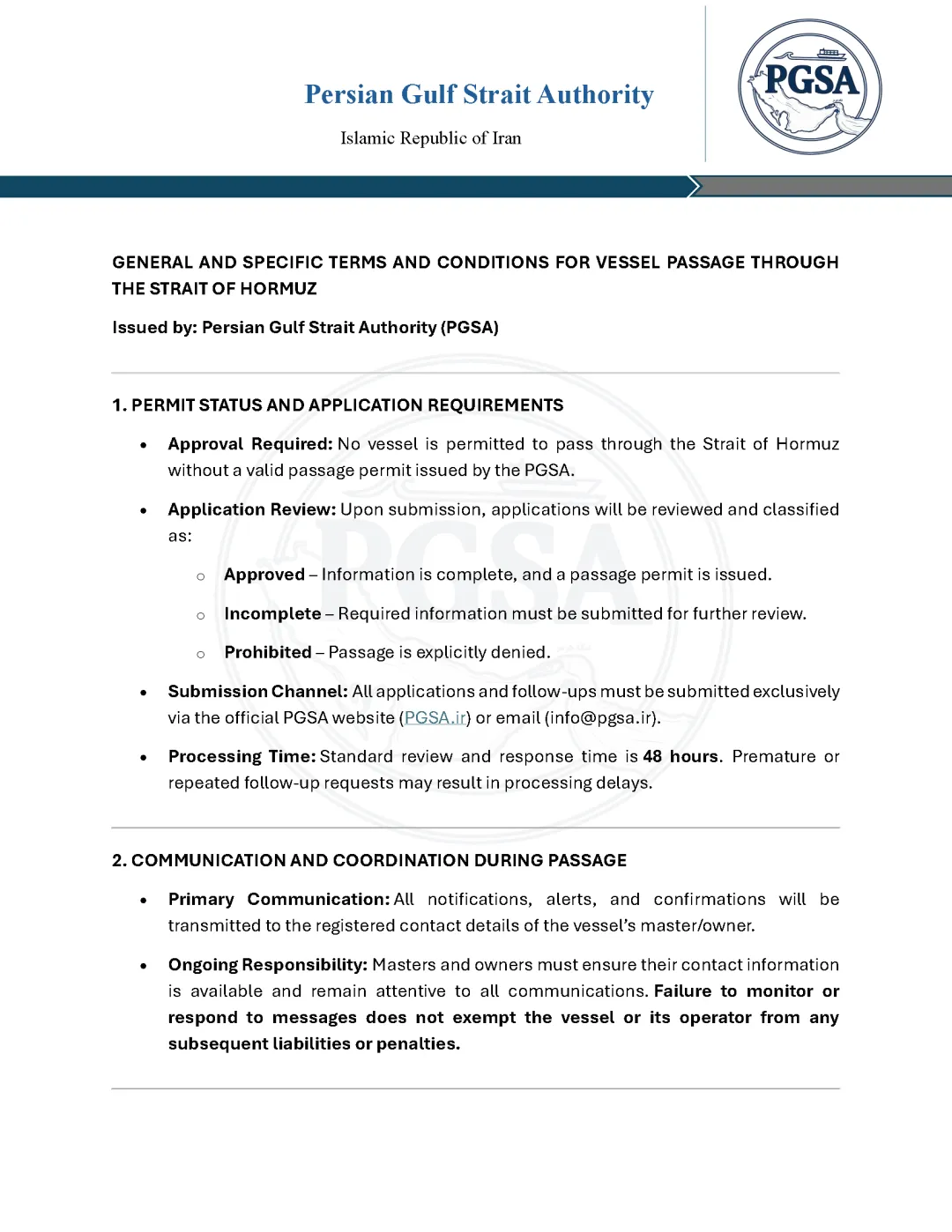
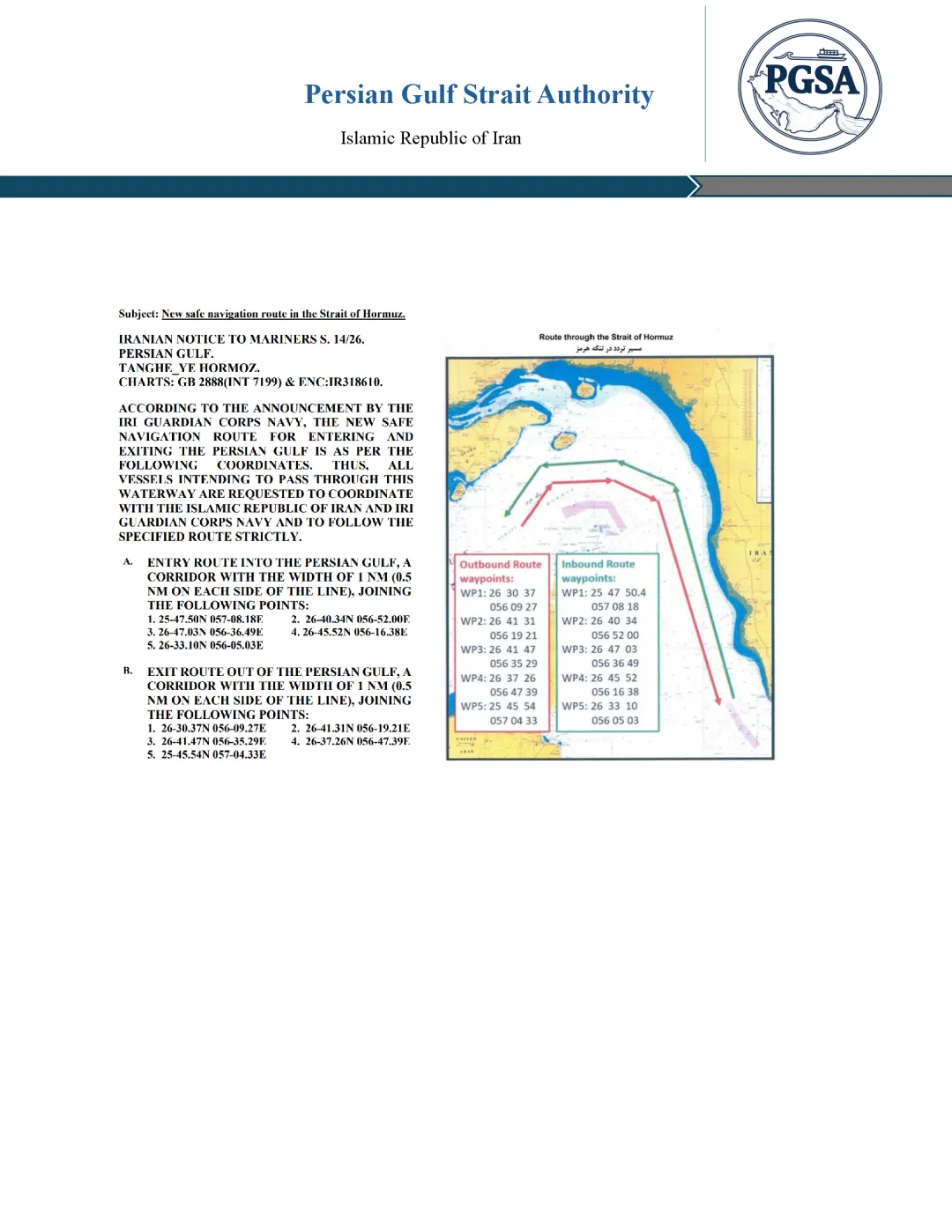
At the same time, Iran has required commercial vessels to submit transit applications to its newly created Persian Gulf Strait Authority, or PGSA. Due to remaining security risks in parts of the waterway, vessels must also use designated routes and transit within specified time windows.
On the surface, this creates a 60-day toll-free passage window.
But documents and reports related to the PGSA framework suggest that “free passage” now comes with a set of new conditions: prior application, transit permission, designated routes, fixed timing windows, mandatory insurance and the possibility of future insurance fees or other maritime service charges.
For shipowners, the most important question is not whether the first 60 days are temporarily free of direct charges.
The real question is what happens after the 60-day window closes. How will these new items be priced? Who will collect the fees? Will the system be accepted by the international shipping community? And could it alter the long-standing transit norms of the Strait of Hormuz?
Mandatory insurance could become the gateway to future charges
The most sensitive issue is Iran’s proposed mandatory insurance requirement.
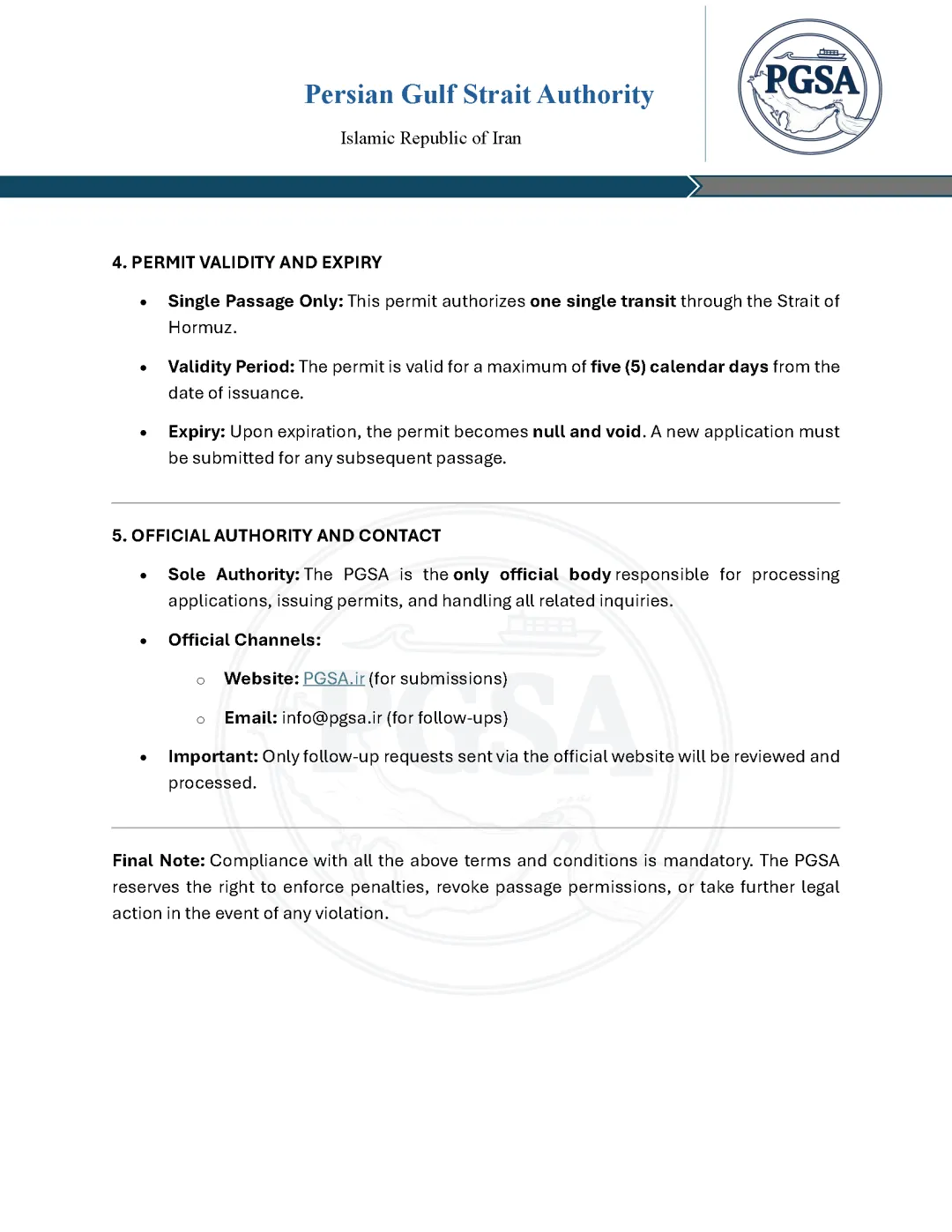
According to PGSA terms, all vessels transiting the Strait of Hormuz must obtain insurance approved by Iran. The insurance is currently provided by Iran and is free during the 60-day window.
The document states that the insurance is provided free of charge to vessel owners, with all costs covered by the Iranian government. But it also says that the PGSA reserves the right to introduce insurance fees in the future. Once such fees are introduced, owners will be required to purchase and renew the coverage accordingly.
That statement matters.
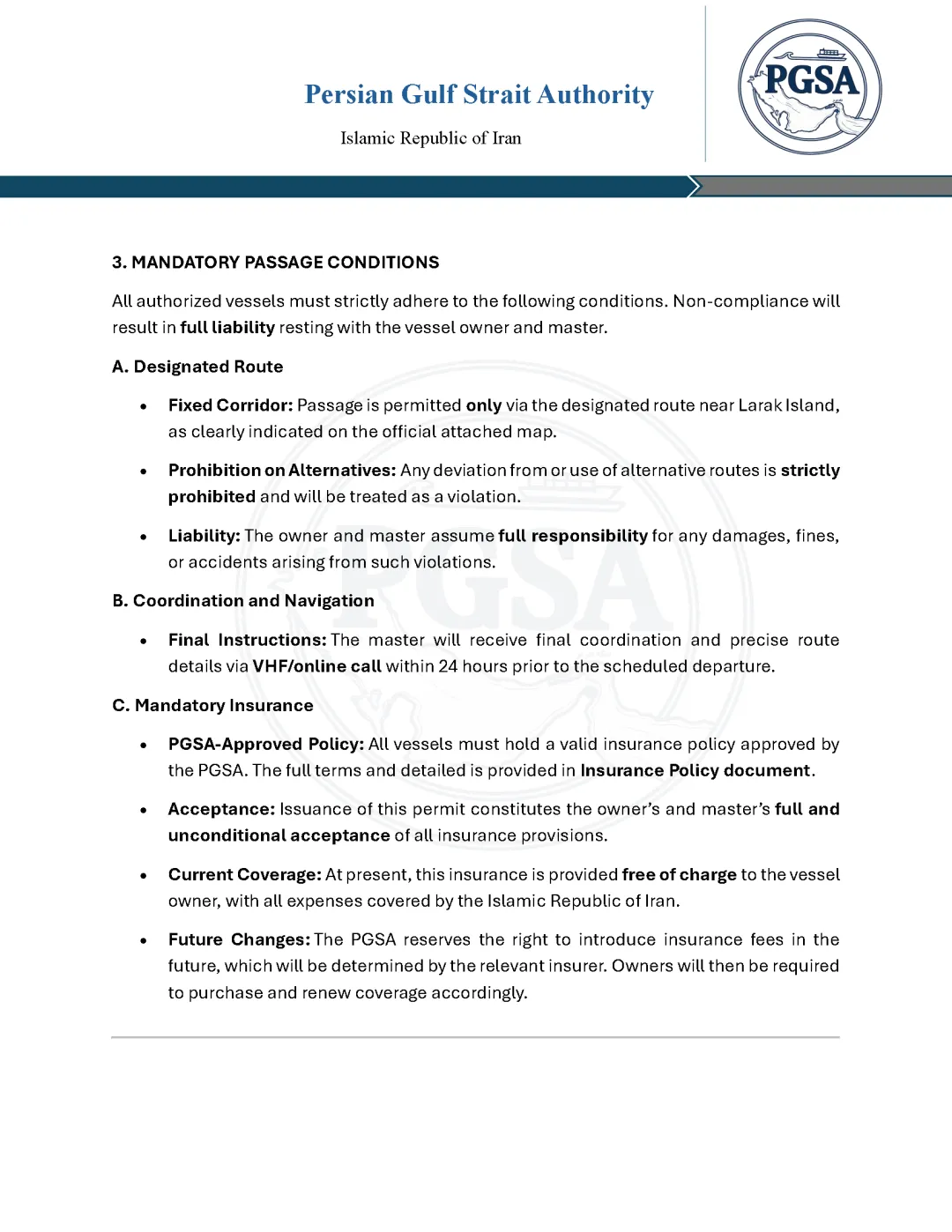
It means that no charge during the first 60 days does not necessarily mean no charge later. More precisely, Iran appears to be using the temporary window to make Iranian-approved insurance part of the transit framework, while reserving room to charge for it later.
For shipowners, this could become a complex cost and compliance issue.
Will Iranian-approved insurance overlap with existing war-risk cover, hull insurance and P&I protection?
Will the cover be recognised by flag states, charterers, cargo interests, banks and international insurers?
If Iran later introduces insurance fees, could payment create sanctions, compliance or contractual complications?
If a vessel already has war-risk cover from the London market and standard P&I protection, would it still need Iranian-approved insurance to obtain transit permission?
These questions remain unanswered.
Mandatory insurance may be presented as a safety and risk-management tool. But it could also become the entry point for a future charging system in the Strait of Hormuz.
A 48-hour application rule changes the operating logic
Beyond insurance, the PGSA also requires vessels to submit transit applications at least 48 hours before arrival.
Under the disclosed procedures, vessels planning to transit the Strait must apply through designated PGSA channels and provide information on the vessel, owner, manager, voyage plan, cargo, contact details and insurance compliance.
This could have a significant impact on vessel operations.
In the past, transiting the Strait of Hormuz was primarily a matter of navigational risk, traffic separation schemes, war-risk premiums and charterparty arrangements. Under the new framework, owners may also need to manage an additional administrative approval process.
If the system is transparent, efficient and consistent, the impact may be limited. But if approval times are uncertain, information requirements are excessive, or different flags and cargoes are treated differently, transit efficiency and commercial certainty could be affected.
For tankers, LNG carriers, LPG carriers and large container ships, timing is critical. Any delay in transit approval could quickly feed into charter hire, freight rates, demurrage exposure, inventory planning and cargo delivery schedules.
Even without a direct transit toll, administrative costs, waiting costs and contractual costs can become another bill.
The designated northern route creates another dilemma
The PGSA has also required vessels to use the designated route near Iran’s Larak Island. It has warned that any deviation from the designated route will be treated as a violation, with the authority reserving the right to impose penalties, revoke passage permission or take further legal action.
This creates a new point of tension.
Some vessels have reportedly been using a southern corridor closer to the Omani coast, with US-related security arrangements. Iran, meanwhile, is emphasising its preferred northern route through the PGSA rules.
This leaves shipowners facing a practical dilemma.
Should they follow the Iranian-designated route, or should they choose a route based on their own security assessment, insurance requirements and naval protection arrangements?
If a vessel uses the southern route, will Iran regard it as a breach of PGSA rules?
If a vessel uses the northern route, will the safety guarantees be sufficient?
If an incident occurs, how will liability be allocated?
For owners, this is no longer just a navigational decision. It is a political, security, insurance and legal decision.
Mines and AIS disruption make “free” passage more expensive
Just as the 18 June traffic rebound was being reported, mine risk again entered the market’s focus.
According to Vanguard Tech, a suspected mine was spotted around five nautical miles north of Oman’s Kumzar Island. Vessels transiting the area have been advised to navigate with extreme caution. No further public information has been released regarding the type of mine, its origin or whether mine clearance operations are underway.
Earlier, Iran had claimed that it had mined the Strait of Hormuz to force vessels to use its own traffic and charging scheme. US defence officials had also suggested that Iran may have placed 20 or more mines in the area, with clearance potentially taking a long time.
At the same time, AXSMarine warned that the 18 June rebound occurred amid a major AIS disruption event in the Persian Gulf. More than 200 commercial vessels were reportedly affected simultaneously by spoofing or abnormal AIS behaviour, the largest such event AXSMarine has observed in the area since the conflict began.
Mine risk and AIS disruption both carry costs for owners.
These costs may not appear as a direct invoice. But they can show up in higher war-risk premiums, owner risk margins, charterer compensation, crew risk communication, speed adjustments, waiting time, deviation costs and potential liability exposure.
For a laden tanker, LNG carrier or LPG carrier, “free passage” through a waterway involving elevated war-risk, mine risk and contractual uncertainty may ultimately be more expensive than a clearly priced transit fee.
Lloyd’s and Chubb launch a $400m war-risk facility
While Iran is introducing mandatory insurance arrangements, the international insurance market is also moving.
Lloyd’s of London and US insurer Chubb have announced a new $400m war-risk facility for vessels and cargoes transiting the Strait of Hormuz.
The facility will provide up to $200m of capacity for hull and P&I-related risks, and another $200m for cargo risks.
The new facility is far smaller than the previously discussed $40bn US-backed Hormuz war insurance project. That larger scheme had been seen as a potential mechanism to help restart shipping through the Strait, but it reportedly never became operational.
The launch of the Lloyd’s and Chubb facility suggests that the insurance market sees shipping activity through Hormuz beginning to resume, but only with additional specialist risk capacity.
It also adds another layer of complexity for shipowners.
Iranian-approved insurance, London market war-risk cover, P&I protection, cargo insurance, flag-state requirements, charterparty risk allocation and cargo-owner instructions will all need to be coordinated.
For major mainstream owners and energy charterers, the issue is not simply whether insurance is available.
The issue is how these different layers of cover interact, whether they are compliant, whether they cover the real risks, and who pays if something goes wrong.
Shipowners remain cautious
Kpler has noted that the increase in transits on 18 June points to improving operating conditions, but unresolved implementation details and continued dark or sanctioned crossings show that operators remain cautious. Kpler also identified five sanctioned vessels among the ships transiting the Strait.
This means the current traffic rebound may not fully represent the attitude of mainstream compliant fleets.
For major oil companies, LNG charterers, leading tanker owners, liner operators and bank-backed fleets, a return to normal deployment requires a higher threshold of security, insurance and compliance comfort. A single day with 25 crossings proves that the route is being tested. It does not prove that the market has returned to normal.
What owners need to see is repeated, safe and uncontested transits by vessels of different types, flags and cargoes over a sustained period.
Only then will charterers, insurers and owners begin to treat the Strait again as a predictable and commercially manageable route.
IMO and Gulf states worry about precedent
The PGSA rules have also triggered broader international concerns.
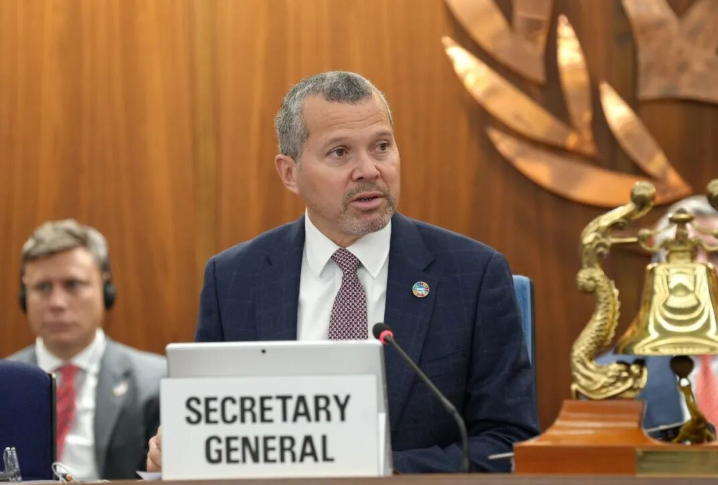
Shipping companies, Middle East Gulf states and oil majors have repeatedly warned that any form of transit fee in the Strait of Hormuz would be unacceptable. IMO secretary-general Arsenio Dominguez has also warned that allowing such charges could set a dangerous precedent for other strategic waterways.
The US continues to stress that international waterways should remain free of tolls. US vice-president JD Vance has said that Washington believes international waterways should not be subject to tolls, while also emphasising that the immediate priority is to keep the Strait open and work with Iran, Oman and Gulf coastal states on a longer-term security framework.
The problem is that Iran has already moved first by introducing PGSA rules that incorporate applications, designated routing and mandatory insurance into the operating process.
The next 60 days will therefore become a testing window for all sides.
If Iran insists on introducing insurance fees or other maritime service charges after the window closes, while the US, IMO, Gulf states and the mainstream shipping industry remain opposed, the long-term operating framework for the Strait could face renewed confrontation.
The real bill may come after 60 days
The Strait of Hormuz remains one of the most important energy chokepoints in the world. Before the conflict, a significant share of seaborne crude oil trade passed through the waterway. LNG, LPG, refined products and parts of the dry bulk and container trades are also exposed to its security environment.
The 25 crossings recorded on 18 June are a positive signal. They show that, under the US-Iran interim arrangement and Iran’s 60-day toll-free window, some owners and operators are beginning to test transit conditions again.
But toll-free passage does not mean low-cost passage.
For shipowners, the real bill may include future Iranian insurance fees, potential maritime service charges, war-risk premiums, P&I risk costs, application delays, deviation costs, waiting time, contract disputes, crew safety management and compliance expenses.
Over the next 60 days, the market should not only watch whether Iran refrains from charging direct transit fees.
It should also watch whether the new rulebook becomes permanent.
If mandatory insurance, prior application, designated routing and future charging rights become embedded in the Strait’s transit framework, the cost structure of Hormuz shipping could be rewritten.
For global shipping, the question is no longer simply whether vessels can pass.
The real question is whether they can pass safely, legally, insurably, predictably — and who will pay the bill after the first 60 days.
READ MORE
 Safety
8,500 TEU EVER LOVELY Hit Off Oman as IMO Pauses Hormuz Seafarer Evacuation Operation
 Safety
Deadly Mooring Ropes: The "Super Cycle" of South Korea's Shipbuilding Industry
 Safety
Vessel Traffic Returns! Transit Volumes in the Strait of Hormuz Rebound Significantly
 Safety
This type of ship has been ranked the worst-performing category in port State control inspections for six consecutive years
 Safety
Phased Unblocking of Hormuz: Global Shipping and Oil & Gas Markets Enter a "Temporary Restart Window"
 Safety
OFAC General License X brings tankers, insurance, class and maritime services into temporary authorization
 Safety
Dali Chief Engineer Faces Criminal Charge Over Baltimore Bridge Collapse
 Safety
For Seafarers, Lip Service Is Not Enough
 Safety
XIN HAI TONG 801 Rescues 41 People in the Mediterranean
 Safety