


CIMC Raffles Extends NOCC Car Carrier Programme to 2030
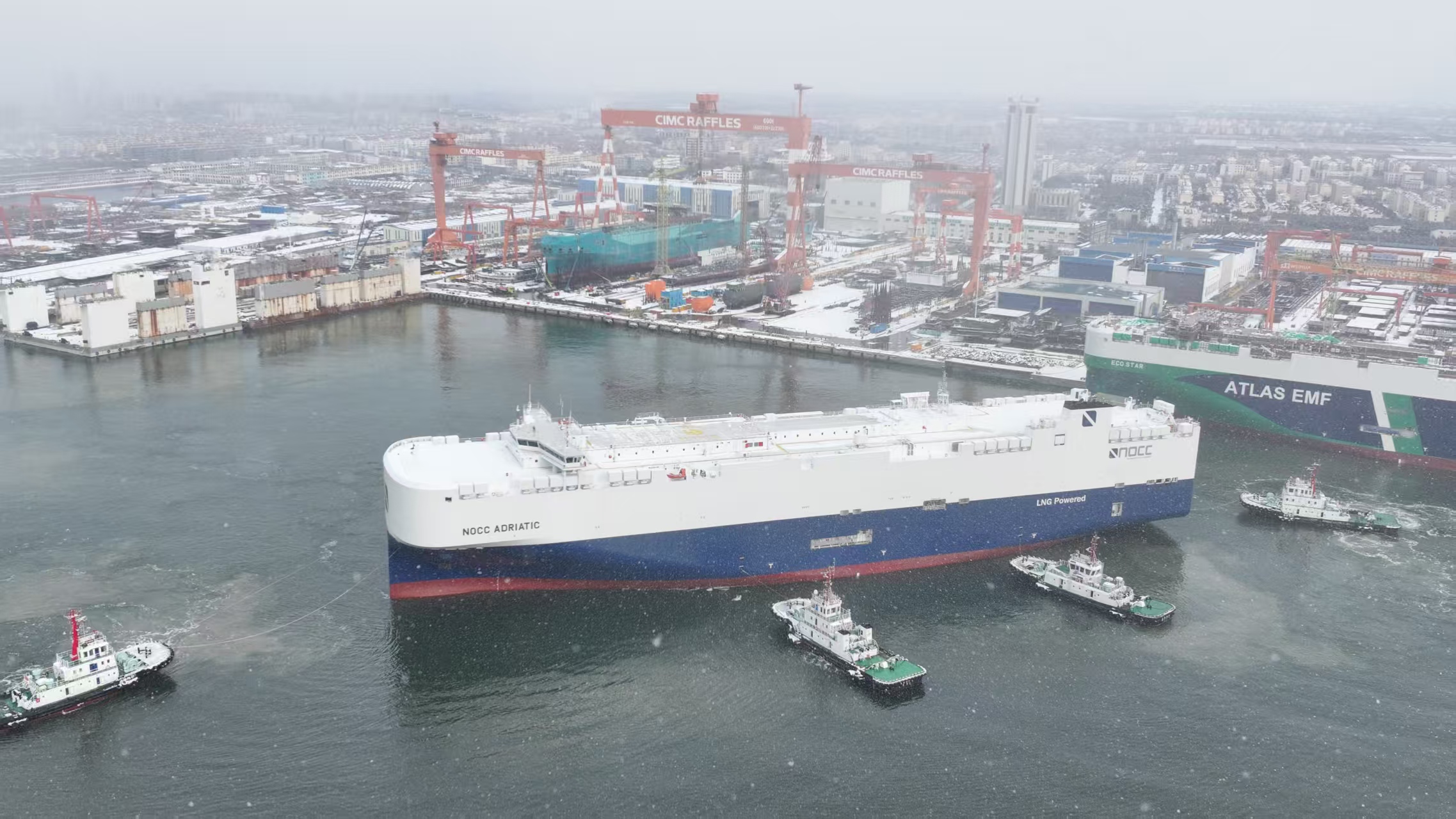

Two additional 7,100-CEU ships appear on the Norwegian owner’s fleet list, extending a repeat-order relationship with the Chinese builder. Pricing and employment arrangements remain undisclosed, while reports differ on the full size of the latest order.
CIMC Raffles’ car carrier programme with Norwegian Car Carriers (NOCC) is extending into 2030, with the owner listing two additional 7,100-CEU newbuildings on its website.
The vessels, identified as Hull 641 and Hull 642, are LNG dual-fuel pure car and truck carriers ordered from the Chinese shipbuilder, according to iMarine. Their addition brings the series identifiable from NOCC’s published fleet list to six vessels, including two already delivered.
For CIMC Raffles, the latest ships extend a customer relationship from initial deliveries into a longer construction programme. For NOCC, they represent further investment in modern tonnage supplied to car carrier operators through the charter market.
Citing Clarksons data, iMarine reported delivery dates of March and June 2030. NOCC’s website confirms the year but does not specify the months. The contract price has not been disclosed.
Repeat business follows first deliveries
The programme has moved beyond contracting into operational service.
CIMC Raffles delivered NOCC Adriatic, the second ship in the series, from its Longkou construction base in Shandong province on January 20, 2026. The yard said delivery was completed 70 days ahead of the original contractual schedule. NOCC Pacific, the first vessel, entered the owner’s fleet in 2025.
NOCC’s current fleet list sets out the following programme:
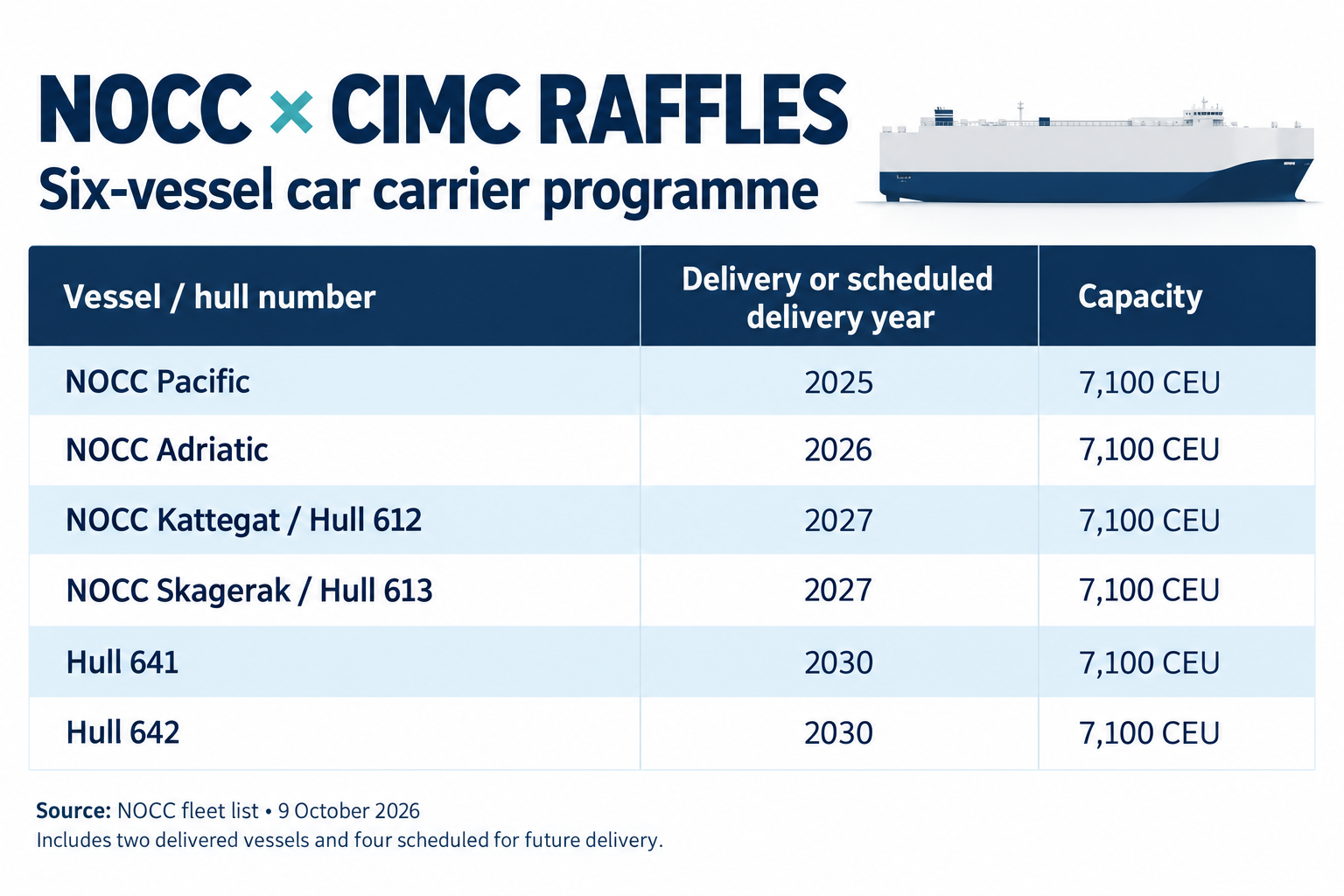
Source: NOCC fleet list. The six-ship series comprises two delivered vessels and four scheduled for future delivery.
CEU, or car equivalent unit, is the standard capacity measure for vehicle carriers. Actual intake varies with vehicle dimensions and the cargo mix.
CIMC Raffles describes the delivered ships as 7,000-CEU vessels, while NOCC lists their capacity at 7,100 CEU. The figures above follow the owner’s published specification.
NOCC Adriatic measures 199.9 metres in length and 38 metres in beam, with a design draught of 8.6 metres and a design speed of 19 knots. Its propulsion package includes two Type C LNG tanks and dual-fuel main and auxiliary engines.
Latest order size remains unresolved
Public sources differ on the scale of the latest commitment.
While iMarine reports two additional vessels, Shippax reported on October 8 that NOCC had contracted four further sister ships, with deliveries spanning 2030 and early 2031.
NOCC’s website currently identifies only the two additional hulls scheduled for 2030. Available disclosures do not establish whether the difference reflects a subsequent expansion, options or another contractual arrangement. An eight-ship cumulative programme therefore remains unconfirmed by the owner’s published fleet list.
The two identifiable additions nevertheless extend the series beyond its earlier 2027 delivery horizon. For the yard, repeat construction offers scope to carry forward design, procurement and production experience gained on the first vessels.
Charter coverage is the next commercial question
NOCC operates as a tonnage provider: it owns ships and makes them available to global and regional car carrier operators under time charters. Its investment case consequently depends on charter employment, operating performance and financing terms, alongside the underlying demand for vehicle transport.
Shippax reports that NOCC Pacific and NOCC Adriatic are chartered to Wallenius Wilhelmsen and EUKOR, respectively. Charterers, hire rates and financing arrangements for the latest newbuildings have not been publicly disclosed in the sources reviewed.
The absence of announced employment does not establish that the ships were ordered speculatively. It does, however, leave an important part of the programme’s commercial structure unclear as deliveries move four years into the future.
Comparable investment approaches $91 million per ship
A recent transaction illustrates the capital involved in this vessel class.
SFL Corporation disclosed in a US securities filing that it contracted four 7,000-CEU LNG dual-fuel car carriers between May and August 2026 for delivery in 2029. The aggregate contract price was approximately $363.1 million, equivalent to an average of $90.8 million per vessel.
That is a transaction-specific comparison, rather than an October market valuation or an indication of NOCC’s undisclosed price.
SFL said two vessels had secured long-term employment with a major Asian car manufacturer, while the other two were expected to be chartered closer to delivery.
Splash reported on August 27 that the contracted pair had five-year firm charters, with options for another five years. The firm period added approximately $150 million to SFL’s charter backlog—equivalent, on a simple two-vessel, five-year calculation, to roughly $41,000 per ship per day in contracted revenue. This is a forward charter comparison, not a spot-market assessment or a measure of net earnings.
The comparison highlights the different ways owners are committing capital: some ships secure employment before delivery, while others retain exposure to the future charter market.
CIMC Raffles has already established a delivery record with NOCC’s first two vessels. As the relationship extends towards 2030, the next milestones will be execution of the remaining series and disclosure of the employment supporting the owner’s enlarged fleet.

READ MORE
 Shipbuilding
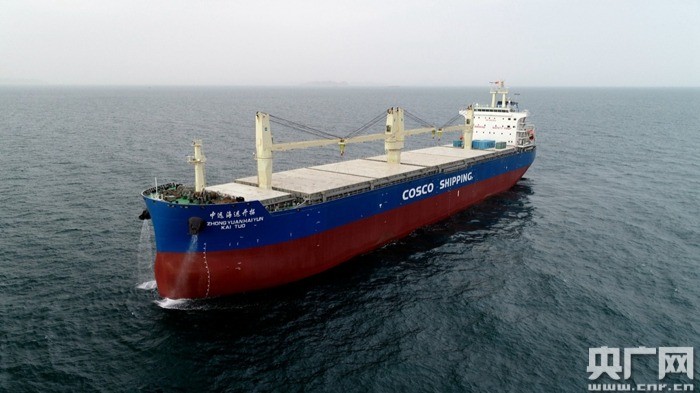
Grimaldi Advances New ConRo and Multipurpose Projects as Fleet Renewal Continues
 Shipbuilding
COSCO Shipping Specialized Carriers Shifts Eight 60,000-DWT Heavy-Lift Ships from Chengxi to Dalian
 Shipbuilding
DryDel Orders Two Kamsarmax Bulkers at Tsuneishi
 Shipbuilding
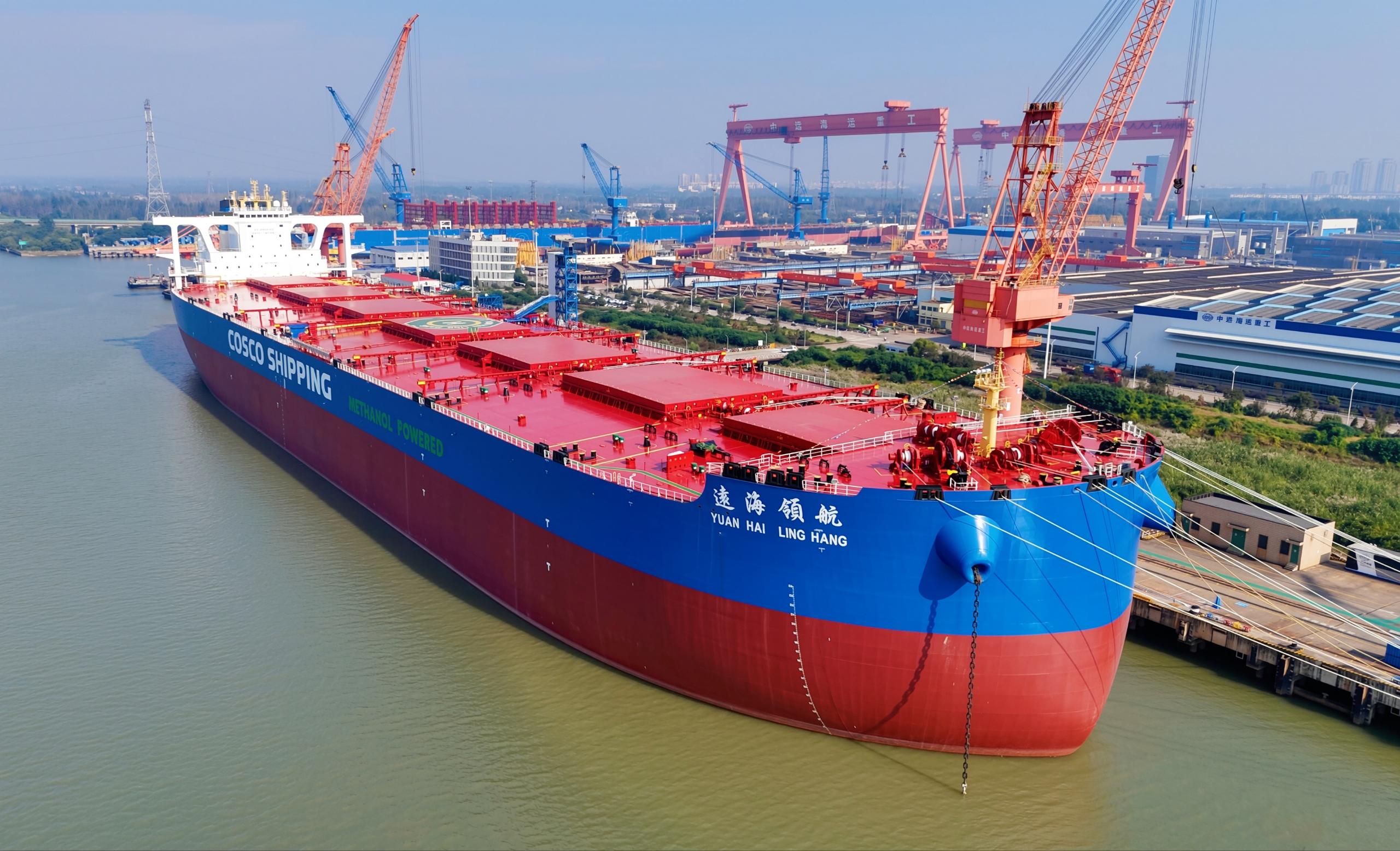
World’s First 325,000-DWT Methanol Dual-Fuel Ore Carrier Delivered
 Shipbuilding
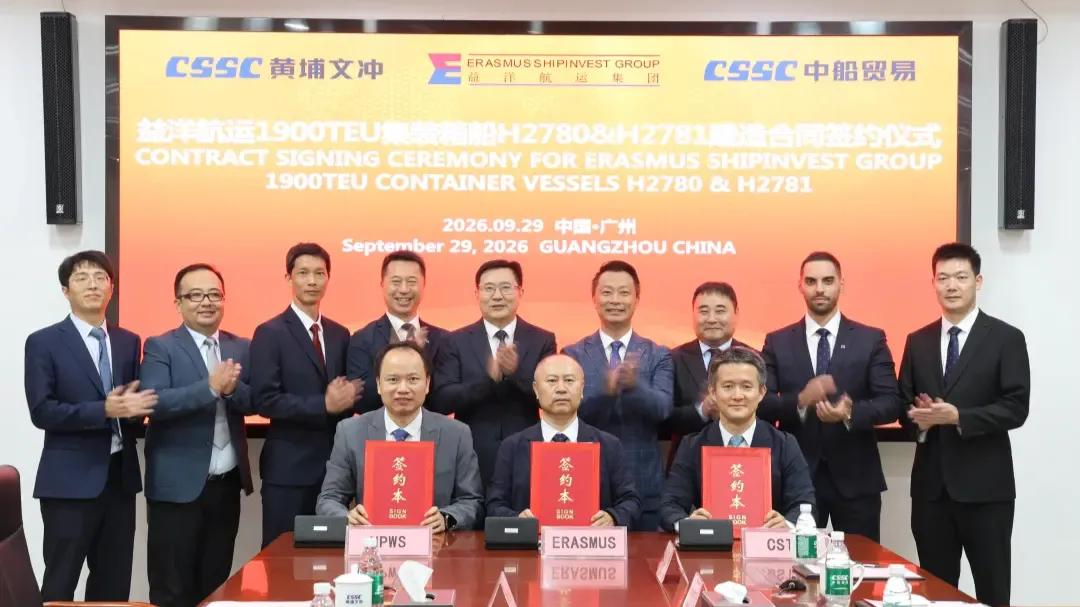
Erasmus Orders Two More Feeders in Fourth Huangpu Wenchong Deal in Six Months
 Shipbuilding
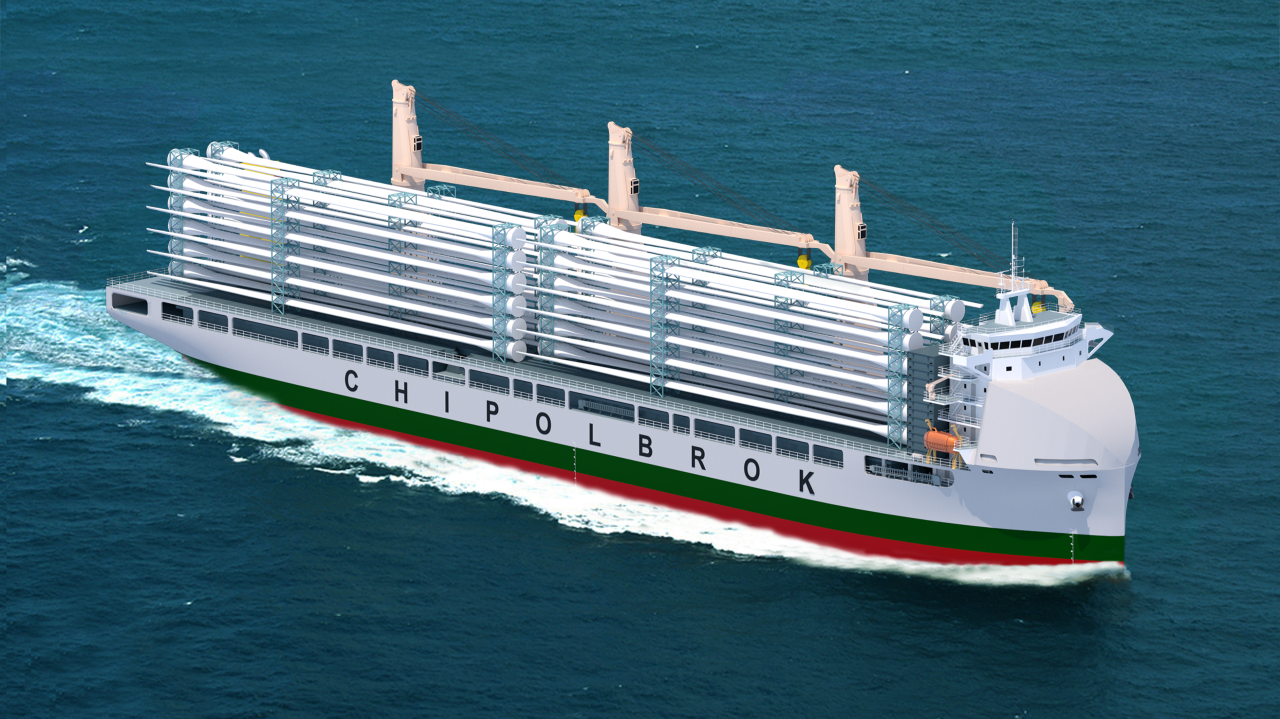
Chipolbrok Begins Construction of First 60,800 DWT Forward-Accommodation Heavy-Lift Vessel
 Shipbuilding
Jianglong Adds $40m Offshore Vessel Order to 2026 Contract Run
 Shipbuilding
Hubei Firm Proposes RMB427m LNG and Methanol Vessel Programme
 Shipbuilding
4 More,totally 16 Since 2024: Why RCL Keeps Ordering at Huangpu Wenchong
 Shipbuilding