


Shipowners Have Made a Fortune. How Will They Spend It?

Some owners are locking in newbuildings for delivery beyond 2028 under long-term charters. Others are looking at discounted second-hand LNG tonnage, repaying debt, buying back shares or simply keeping cash on the balance sheet. With vessel prices high, delivery slots distant and geopolitical premiums embedded in earnings, shipping capital is being reallocated around cash flow, downside protection and optionality.
By Chen Yang, Xinde Marine News | London
The hardest time to spend money in shipping may be precisely when the industry has the most of it.
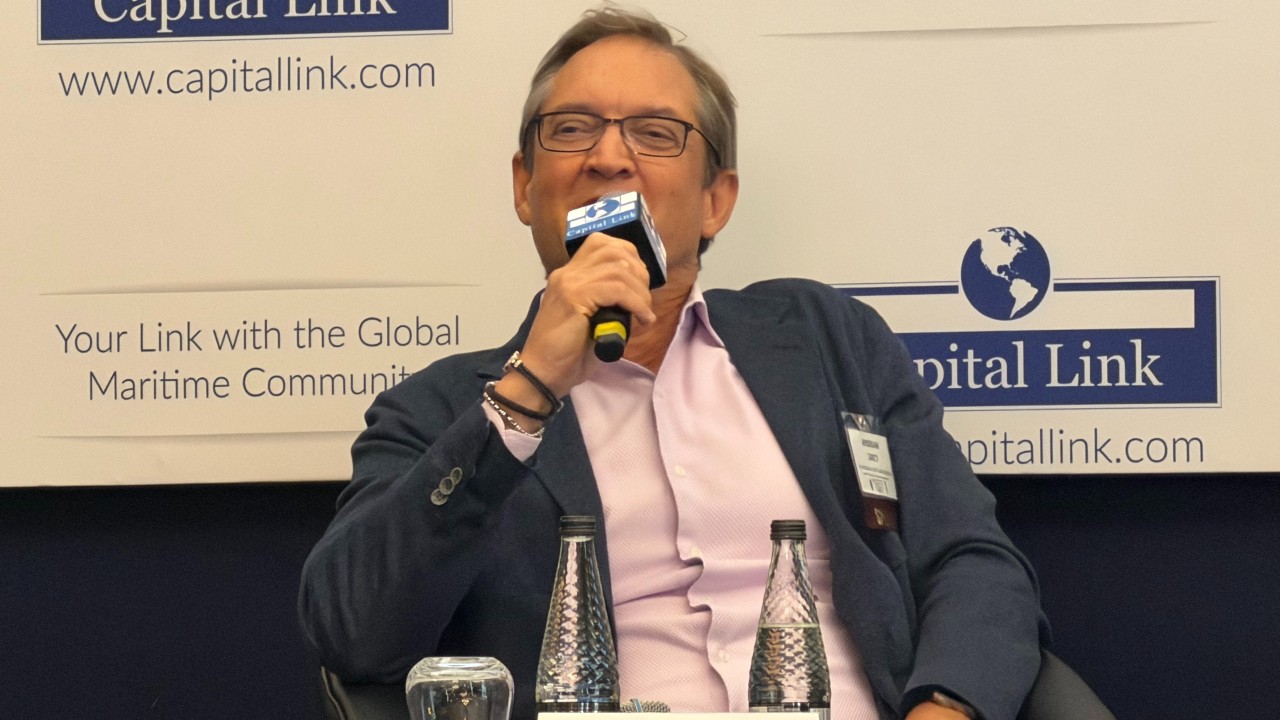
In London, Andrian Dacy, CEO and CIO of the Global Transportation Group at J.P. Morgan Asset Management, offered a deliberately contrarian suggestion. A private shipowner with an established fleet, a large cash balance and very little debt does not necessarily need to order another round of vessels. It could allocate part of that money outside shipping and continue harvesting the cash flow generated by the fleet it already owns.
Dacy noted that some owners with fleets of only around 20 ships have accumulated several hundred million dollars of surplus cash while carrying little or no debt. In that position, repaying the remaining loans, reducing fixed financial costs or even doing nothing for a period may create more value than chasing expensive assets. Cash sitting on the balance sheet is not necessarily idle. It preserves the ability to move quickly when the next correction creates a genuine buying opportunity.
Figures presented earlier that day by shipping economist Martin Stopford help explain where the money came from. On his estimates, the global merchant fleet generated approximately $3.1 trillion in cumulative gross revenue between 2021 and 2026. This was revenue rather than net profit, but the scale remains exceptional. During the same period, approximately $824 billion, equivalent to around 26% of that revenue, was committed to newbuilding orders. By July 2026, annualised new contracting had reached roughly 275 million dwt, almost matching the 2008 peak, while the global orderbook had expanded to approximately 550 million dwt.


A substantial portion of shipping’s cash has already been converted into steel. The difficulty lies in calculating an acceptable return on the next order. As the 18th Annual Capital Link Shipping & Marine Services Forum moved into its final session in London on 15 September, Reed Smith partner Panos Katsambas put the question directly to the investors on stage: “Shipping Is Cash Rich — Where Will Capital Flow Next?”
The answers quickly moved in different directions. Oldendorff is investing in newbuildings supported by long-term charters. Tufton is examining second-hand assets whose prices have come under pressure while retaining longer-term upside. Oak Hill is looking across equity, debt and mezzanine positions for different risk-return profiles. Dacy, meanwhile, argued that existing owners should also consider deleveraging, retaining liquidity and investing beyond shipping.
Behind these apparently different strategies lies the same discipline: at the top of the cycle, every additional dollar must prove that it still has a margin of safety.
More Cash, Fewer Bargains
Alexis Atteslis, Co-Head of Europe and Partner at Oak Hill Advisors, has invested through a very different shipping market. In 2011 and 2012, the aftermath of the global financial crisis left many owners overleveraged. Vessel values were falling, forced sales were common and distressed financings offered deep entry discounts. Investors who bought cheaply and kept leverage under control could capture much of their return simply through a recovery in asset values.
Today’s market has not produced the same broad supply of distressed assets. Freight markets have remained resilient amid wars, sanctions, rerouting and the reorganisation of global supply chains. Existing vessels continue to generate substantial cash, giving their owners little reason to sell at a discount. Outside capital seeking access to those earnings must first pay a high price to the incumbent owner.
Atteslis observed that shipping has repeatedly benefited from inefficiencies in the global supply chain over the past six or seven years. Pandemics, wars, blocked waterways and shifting trade patterns do not lift earnings in a linear manner. A single disruption can lengthen voyages, absorb effective capacity and push freight rates far above historical averages. This “right-tail” exposure keeps shipping equity attractive, but it also makes simple mean-reversion models less reliable. Investors cannot assume that the geopolitical premium will last forever, yet they cannot confidently declare that it will disappear next year.
Capital can therefore choose where it sits against the same vessel. Equity investors willing to absorb the full cycle can retain the upside. Debt and mezzanine capital can use collateral, payment priority and contracted cash flow to reduce dependence on geopolitical premiums. Money has not left shipping; it is becoming more selective about which layer of risk it is willing to assume.
Nicolas Tirogalas , Group CEO of Tufton Investment Management , faces a more immediate constraint. As a specialist asset manager, Tufton must demonstrate the merits of each transaction to its investors. High vessel prices raise the entry point and narrow the range of possible exit values. A decade ago, buying ships well below replacement cost, maintaining disciplined leverage and waiting for the market to recover could be enough to deliver strong returns. Many assets today already have optimistic assumptions embedded in their prices. Buying a vessel and waiting for the cycle to rise further is unlikely to produce institutional target returns consistently.

That has encouraged Tufton to search for dislocations within individual market segments. Tirogalas contrasted ordering an expensive new LNG carrier at a relatively modest contracted return with acquiring certain 11- to 12-year-old LNG carriers outside the prime segment. Weakness in the spot LNG shipping market may create a lower entry price and allow an investor to build downside protection into the transaction while retaining exposure to a recovery over the coming decade. The vessel may be older, yet the investment structure can offer more attractive optionality than a high-priced newbuilding contract.
The Same Cash Behaves Differently in Different Hands
John Wessel , Managing Director of Oldendorff Overseas Investments, offered an answer shaped by the longer time horizon of family capital. The company has recently invested in four newbuildings scheduled for delivery in 2028 and 2029, supported by charter coverage of five to seven years. Such contracts surrender part of the potential upside if the spot market rises further, but they also secure a minimum cash return beyond a distant delivery date. For capital that does not have to exit within a fixed fund life, certainty can be a return in its own right.

Institutional funds operate with a different ledger. They have defined investment periods, mandates and target returns, and every new transaction must stand on its own. Profits earned by a previous fund do not reduce the price that the next fund must pay for an expensive ship. Tirogalas must assemble entry price, charter coverage, financing and exit options into a structure that meets a specific mandate. Atteslis can move into a more protected part of the capital structure. Wessel can accept a longer payback period, while Dacy’s global platform must compare shipping with rail, aviation, infrastructure and other transportation assets.
Incumbent owners and new entrants also start from very different positions. An established owner already has vessels, customer relationships, procurement networks and shore-based management. Adding one or two contract-backed ships can be a marginal expansion of an existing platform. A new investor must pay simultaneously for the asset, the team and the commercial network, while accepting the risk that the market will have changed by delivery.
In Dacy’s view, those best placed to keep investing are often operators already inside the industry who can absorb new assets into a functioning system. Capital entering simply because current shipping cash flows look attractive faces a much higher hurdle.
The source of capital also determines which high-return opportunities can be accepted. Tirogalas described an old-vessel financing opportunity linked to a high-risk Middle Eastern trading environment. The headline return was exceptional, but Tufton declined the deal. Sanctions exposure, counterparty risk, investor mandates and reputational considerations could not be neutralised simply by charging a higher rate.
Profitability is only the beginning of the investment test. The transaction must also remain within the risk boundaries of the capital provider and withstand continuing scrutiny from banks, insurers and regulators.
Wessel introduced another force that may increasingly shape deployment: government and industrial policy. Energy security, critical supply chains and national merchant fleets have returned to the strategic agenda. Export credit, policy-backed financing and long-term cargo commitments can alter the economics of vessel investment.
Projects supported by policy capital may enjoy a lower cost of funding, while some strategic assets may be designed to guarantee transport security rather than maximise financial return. Private owners and funds may therefore find themselves competing not only with other commercial investors, but also with state-backed capital pursuing industrial objectives.
Capital Is Still Flowing into Ships — With More Conditions Attached
Ships remain the most familiar destination for maritime capital, but the questions of what to buy and how to buy it have become inseparable. Charter coverage, discounts to replacement cost, delivery timing, fuel optionality, debt amortisation and exit liquidity now work together to determine whether a vessel is worth owning.
Star Bulk provides a useful example. The company uses operating cash flow to pay dividends, while proceeds from vessel sales can be directed towards share buybacks, debt reduction or cash reserves. When the company’s shares trade below tangible net liquidation value, buying its own equity may offer a better return than acquiring another expensive ship.
Its acquisition of eight Kamsarmax newbuildings was also structured through the transfer of existing shipbuilding contracts, giving Star Bulk prices below current replacement cost and earlier delivery dates. Capital still went into ships, but only after the transaction itself created a sufficient margin.
CMB.TECH has taken another route. The group has been completing a major newbuilding programme while selling selected tankers when asset prices stand well above long-term averages. As its capital expenditure cycle winds down, management expects the company could generate approximately $700 million to $1 billion of operating cash flow after related capital expenditure in 2027.
That cash can be used to repay maturing bonds, distribute earnings to shareholders and retain flexibility for a smaller number of high-return investments. Strong freight markets can support continued ownership, while high asset prices can justify disposals. Both decisions can coexist across different assets in the same portfolio.
Philipp Wuenschmann, Head of Shipping at Berenberg, previously told Xinde Marine News that owners are placing greater emphasis on financing cost, flexibility and lighter covenant packages rather than seeking maximum leverage. Banks continue to apply conservative loan-to-value ratios of around 50% in a high-price market.
For speculative newbuildings without long-term charter support and with three or four years remaining until delivery, lenders are generally reluctant to make a final commitment too early. Liquidity is available, but the critical questions concern post-delivery cash flow, flexibility in the vessel’s fuel pathway and whether the loan can amortise sufficiently before asset values correct.
Taken together, these examples show a dynamic capital allocation mix. Newbuildings, second-hand vessels, deleveraging, dividends, buybacks and cash reserves can all exist within the same company. Selling a ship does not automatically mean management is bearish on freight, and suspending orders does not signal a lack of ambition.
Each decision reflects the same comparison: where can the next dollar earn the strongest risk-adjusted return?
Capital Is Buying Capabilities Beyond the Ship
As vessels become more expensive, operating capability carries greater weight. When the panel turned to industry consolidation, Tirogalas argued that scale can still improve vessel positioning, voyage combinations, customer coverage and unit management costs. Shipping pools already demonstrate some of those benefits. Family control, management positions and personal interests, however, continue to obstruct corporate-level mergers.
Atteslis was more cautious about operating synergies. In a strong market, savings in shore-based overheads are small relative to vessel earnings. The liquidity, investor access and financing options of a larger listed platform may be more valuable than day-to-day cost savings.
Dacy went further, noting that shipping can already control a large asset base with a relatively small shore team. Acquiring an entire corporate organisation may therefore offer less value than buying ships, hiring a specialist team or securing management capability directly. Asset and fleet consolidation can remain active even when full corporate mergers are limited.
The panel’s discussion of artificial intelligence returned to the same operational reality. Atteslis would not award a higher valuation merely because a company attaches an AI label to its business, but he would examine whether a manager is actually using appropriate data, digital and efficiency tools during due diligence.
Dacy identified specific applications. AI can increase the productivity of shore-based research, legal review and investment analysis. Commercial teams can repeatedly model future vessel concentrations using global positions, cargoes and expected deliveries, while shipboard systems can continuously optimise engine load against weather, sea state and contractual speed.
These tools do not add another vessel to the fleet, but they may increase the cash generated by every vessel already owned. In a strong market, inefficiencies in procurement, insurance, claims, drydocking and fuel management can be hidden by revenue. When freight rates weaken, every dollar of unit cost returns to the competitive equation.
Shipmanagement, data platforms, procurement networks and engineering teams are therefore becoming investable capabilities in their own right. Capital allocation is extending beyond ownership into the systems that determine an asset’s actual financial performance.
Tufton’s expansion into natural resources reflects a related form of horizontal allocation. The energy and minerals transported by ships are closely connected to commodity prices, producer profitability and seaborne demand. A team familiar with cargo flows and capital cycles may be able to identify opportunities along that chain.
The discipline remains important: physical ships and listed natural-resource equities have different liquidity, valuation and risk characteristics. Research and management expertise can be transferable; a broad macro narrative alone cannot create synergy.
China’s maritime value chain is also beginning to capture capital beyond new construction. Tufton’s 82,000-dwt Kamsarmax TR Lady, built by Yangzijiang Shipbuilding, was fitted with three transversely movable rotor sails at CSSC Chengxi Shipyard in 2023.
Lloyd’s Register modelled eight ballast and laden voyages and estimated an average net reduction of 9.1% in propulsion fuel consumption and associated emissions. The project’s eventual return must still account for installation cost, off-hire, maintenance, fuel prices, carbon costs and the division of savings under the charter, but it demonstrates another path for capital: extending the commercial life and cash-generating capacity of an existing vessel.
Wuenschmann has also argued that established Chinese yards have crossed the quality threshold required by European banks and can be assessed within the same financing framework as mature Japanese and South Korean builders.
The next stage of competition will extend to fuel-conversion flexibility, open equipment and software systems, operating data, retrofit readiness and second-hand liquidity. If Chinese yards, leasing companies and maritime service providers can connect construction, financing, management, efficiency upgrades and eventual resale, the capital they attract will extend far beyond the original newbuilding contract.
Compliance Is Becoming an Invisible Part of Vessel Value
Exceptional earnings from high-risk trades are creating a new division within the global fleet. Dacy expects investors to diverge further in their tolerance for war, sanctions and counterparty risk. Some operators may be willing to accept those exposures in exchange for extreme freight rates, while institutions constrained by mandates, regulation and reputation will struggle to participate.
A vessel may be legally tradable and still remain unacceptable to leading charterers, banks and insurers.
Clear records of ownership, cargoes, counterparties and voyages are therefore beginning to affect chartering access, financing, insurance and resale value directly. Assets with opaque histories or prolonged exposure to high-risk trades may face discounts in mainstream markets even when they are not explicitly prohibited.
The distinction Xinde Marine News has highlighted in its reporting on the Strait of Hormuz between the “physical fleet” and “effective capacity” now applies equally to capital. The number of vessels physically available is not the same as the number that compliant capital and customers can actually use.
This also changes the meaning of a high return. A double-digit or even higher headline yield may be worth considerably less if the underlying asset cannot obtain stable financing, insurance or an eventual exit.
Professional investors may pay a premium for clean vessel histories and reliable counterparties because those qualities expand the future universe of charterers, lenders, insurers and buyers. Compliance is moving from a back-office cost to a component of asset liquidity.
In a Cash-Rich Market, Waiting Is a Form of Capital Allocation
The final Capital Link panel did not identify a single vessel class destined to absorb the industry’s cash. It revealed a moving map of maritime capital.
Wessel is placing family money into post-2028 newbuildings with charter cover. Tirogalas is looking for downside protection and long-term optionality in pressured assets. Atteslis can shift between equity, debt and mezzanine positions according to where risk is most attractively priced. Dacy is reminding owners that low leverage, liquidity and investments outside shipping are also valid allocations.
Geopolitical disruption may continue to create inefficient vessel deployment and exceptional earnings. At the same time, a 550-million-dwt orderbook is accumulating future supply pressure. Ships bought today must pass through delivery, regulatory change, fuel transition and another freight cycle.
High earnings have not made the decision easier. They have simply placed a larger number of expensive options in front of owners.
Shipping companies have now earned enough money to make choices. The next phase will be shaped by those able to secure cash flow, preserve retrofit and exit options, reject transactions that sit outside their mandates and wait when asset prices offer no safety margin.
Cash can buy ships. It can also buy time. The hotter the market becomes, the easier it is to underestimate the value of the latter.


READ MORE
 Finance
“We Are Buying Ships”: NORDEN Raises 2026 Profit Guidance for the Fourth Time
 Finance
Cetus Maritime Advances Oslo IPO Plans with $133.6 Million Seacon Deal
 Finance
Overtaken by Shanghai, How Can London Keep Shipowners and Capital?
 Finance
Shanghai links safety records to RMB5m maritime loan
 Finance
HEIDMAR - Scaling for Growth: Capitalizing on Favorable Market
 Finance
Shipping’s Risk Equation Is Being Repriced as Finance, Insurance and Contracts Adapt
 Finance
Shandong Shipping and OSM Thome Form Singapore JV
 Finance
From RMB 1.87 Billion to RMB 4.55 Billion: What Changed at COSCO Shipping Energy in One Year?
 Finance
Net Profit Jumps 42% as NJTC Reshapes Its Liquid-Bulk Shipping Network
 Finance