


COSCO SHIPPING Specialized Posts $202 Million H1 Profit as Second-Quarter Earnings Double

Revenue surged 34% to approximately $2.13 billion in the first half of 2026, while net profit jumped 66% to $202 million, as vehicle carriers, multipurpose vessels and an expanding global logistics network drove a new phase of earnings growth for COSCO SHIPPING Specialized Carriers.
COSCO SHIPPING Specialized Carriers, or COSCO SHIPPING Specialized, has delivered one of its strongest interim performances in recent years, with accelerating earnings, improving margins and a rapidly expanding fleet highlighting the growing contribution of vehicle logistics, multipurpose shipping and integrated supply-chain services.
For the first half of 2026, the Shanghai-listed company reported operating revenue of RMB 14.45 billion, equivalent to approximately $2.13 billion, up 34.07% year on year. Profit before tax rose 69.22% to RMB 2.24 billion, or approximately $330 million, while net profit attributable to shareholders increased 66.24% to RMB 1.37 billion, or around $202 million. Net profit excluding extraordinary items reached RMB 1.34 billion, approximately $198 million, up 60.22%.
The most significant feature of the result was that profitability expanded considerably faster than revenue. COSCO SHIPPING Specialized’s attributable net margin rose to approximately 9.5% from about 7.7% a year earlier, while operating cash flow increased 42.78% to RMB 3.75 billion, equivalent to approximately $553 million.
Its weighted average return on equity reached 7.89%, 2.30 percentage points higher than a year earlier and a record level for the first half of a year.
The numbers suggest that the company is increasingly converting the fleet, route network and logistics capabilities built over the past several years into earnings.
Second-quarter profit more than doubled
The earnings acceleration became particularly visible in the second quarter.
Based on the company’s interim and first-quarter disclosures, COSCO SHIPPING Specialized generated approximately RMB 7.90 billion, or $1.16 billion, of revenue during the April-June period, an increase of around 42% year on year.
Attributable net profit for the quarter reached approximately RMB 965 million, equivalent to around $142 million, more than double the level recorded in the corresponding period of 2025.
Second-quarter profit was therefore more than 2.3 times the company’s first-quarter earnings and accounted for around 70% of first-half attributable profit.
The company’s estimated second-quarter attributable net margin rose to more than 12%, demonstrating that higher cargo volumes and fleet utilisation were being accompanied by stronger operating leverage.
This distinction is important.
COSCO SHIPPING Specialized is not merely becoming larger. Its expanding fleet is increasingly being deployed into cargo segments where the company possesses considerable technical, operational and network advantages.
That combination is translating into higher earnings per unit of revenue.
Vehicle shipping emerges as a major growth engine
Vehicle transportation was the standout business during the reporting period.
COSCO SHIPPING Specialized generated RMB 3.68 billion, or approximately $543 million, of revenue from its vehicle carrier business in the first half, an increase of 98.5% year on year.
The segment achieved a gross margin of 34.1%, making it one of the company’s most profitable major businesses.
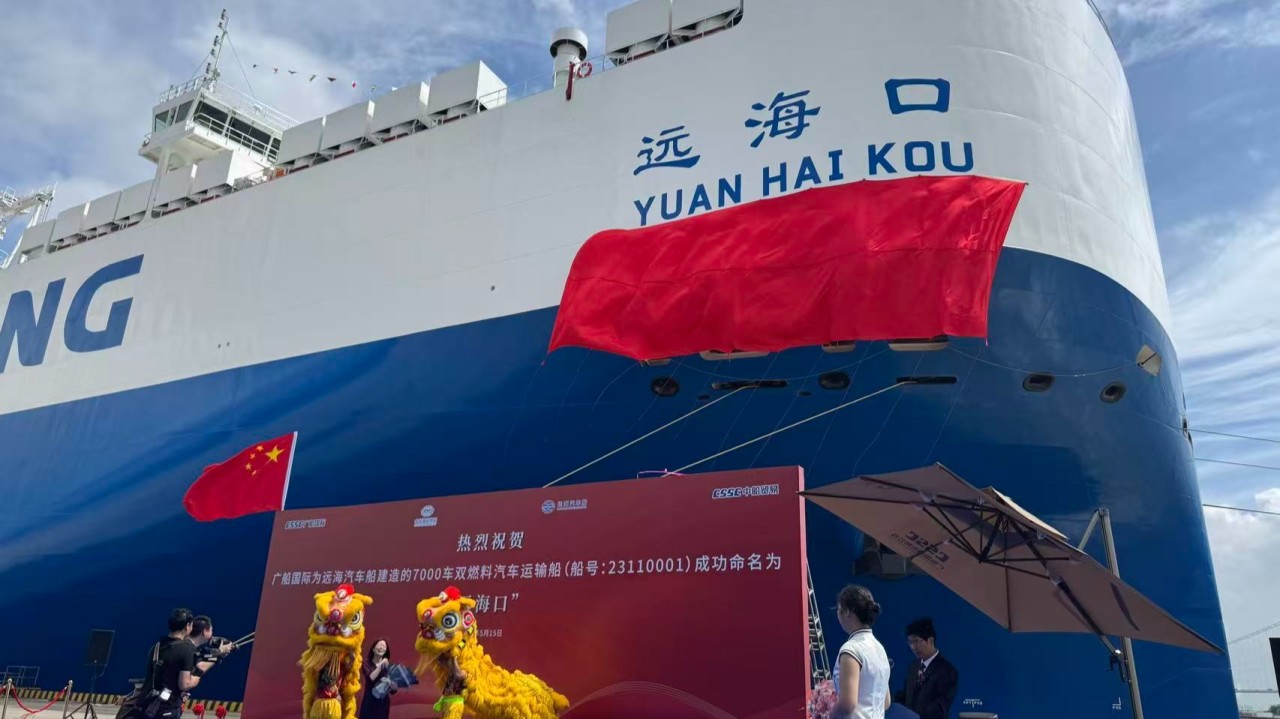
The company transported 394,600 vehicles during the period, up 63%. Of this total, 333,300 vehicles were carried by dedicated pure car and truck carriers, representing growth of 75%, while another 61,300 units were transported aboard multipurpose vessels using specialised vehicle-loading systems.
The figures demonstrate how rapidly automotive logistics has developed from a supplementary business into one of the central pillars of COSCO SHIPPING Specialized’s growth strategy.
The timing is favourable.
China’s automotive export industry has entered a structural expansion cycle driven particularly by electric vehicles, commercial vehicles and construction machinery. These cargoes require considerably more than conventional port-to-port shipping.
Exporters increasingly need stable liner schedules, inland collection, specialised terminals, storage, customs services, destination distribution and reliable overseas delivery networks.
COSCO SHIPPING Specialized has been positioning itself to capture this demand across the entire logistics chain.
The company’s ability to combine dedicated PCTCs with multipurpose vessels also gives it additional flexibility during periods of strong export demand, allowing it to supplement pure vehicle carrier capacity when required.
Multipurpose fleet becomes the largest revenue contributor
The company’s new-generation multipurpose vessel fleet has developed into another major earnings pillar.
Revenue from the segment reached RMB 4.06 billion, or approximately $599 million, in the first half, up 49.62% year on year, making it the largest individual vessel segment by revenue.
Gross margin increased by 1.39 percentage points to 14.79%.
Heavy-lift vessels generated RMB 1.85 billion, approximately $273 million, of revenue, an increase of 18.48%, with a gross margin of 24%.
Semi-submersible vessels contributed RMB 1.50 billion, or approximately $221 million, up 5.31%, while gross margin improved to 26.18%.
Importantly, all of the company’s major vessel segments were profitable during the period.
This diversified earnings structure is increasingly central to the growth story behind COSCO SHIPPING Specialized.
The company is exposed not only to vehicle exports, but also to wind turbine components, offshore equipment, engineering machinery, pulp, energy infrastructure and other project cargoes associated with Chinese manufacturing and the global energy transition.
These cargoes generally require specialised vessels, engineering expertise and sophisticated cargo-handling capabilities, creating higher barriers to entry than many conventional shipping markets.
Fleet expands to 206 vessels
Behind the earnings growth sits an increasingly large and diverse fleet.
At the end of June, COSCO SHIPPING Specialized controlled 206 vessels totalling 9.59 million dwt.
The fleet included 101 owned vessels with an aggregate capacity of 3.04 million dwt and 105 chartered vessels totalling approximately 6.55 million dwt.
The company added 11 vessels during the first half.
Its chartered fleet is particularly young, with an average age of only 1.77 years, allowing the company to scale capacity quickly without relying exclusively on heavy balance-sheet investment.
The combination of owned tonnage and flexible chartered capacity has become an important element of the company’s strategy.
It allows COSCO SHIPPING Specialized to react quickly to demand growth while maintaining greater flexibility over capital expenditure and fleet deployment.
At the same time, the growing proportion of modern tonnage provides advantages in fuel efficiency, carbon compliance and operating reliability.
The transformation becomes even clearer when viewed over a longer period.
At the end of 2022, COSCO SHIPPING Specialized controlled 107 vessels totalling approximately 3.56 million dwt.
By the end of June 2026, the fleet had expanded to 206 vessels and nearly 9.59 million dwt.
In less than four years, the number of controlled vessels has almost doubled while total carrying capacity has increased by around 170%.
China’s manufacturing exports provide a structural tailwind
One of the strongest underlying drivers of COSCO SHIPPING Specialized’s recent expansion is the increasing internationalisation of Chinese manufacturing.
During the first half of 2026, the company generated RMB 9.54 billion, equivalent to approximately $1.41 billion, from export transportation, an increase of 66.86% year on year.
This increasingly includes products such as electric vehicles, engineering machinery, wind power equipment, energy-storage systems, rail equipment and port machinery.
These cargoes share an important characteristic: they are difficult to standardise.
Many are oversized, high-value or technically complicated to transport. Their logistics chains frequently require specialised vessels, customised loading plans, cargo securing, specialised port infrastructure and overseas project coordination.
That creates a market where transportation capability cannot easily be reduced to the lowest freight rate.
COSCO SHIPPING Specialized’s portfolio of multipurpose vessels, heavy-lift ships, semi-submersible vessels, vehicle carriers, pulp carriers and asphalt carriers gives the company an unusually broad toolbox for serving these customers.
As Chinese industrial companies expand production and investment overseas, the shipping company is increasingly following them into international supply chains.
From shipping capacity to logistics corridors
COSCO SHIPPING Specialized’s strategy has also evolved substantially.
Several years ago, the central question was how quickly the company could expand specialised shipping capacity.
Today, the strategic focus is broader: building stable trade corridors, controlling logistics nodes and extending the company’s presence across the supply chain.
The company has been developing a business framework centred on new-energy industries, advanced manufacturing and strategically important bulk commodities, while expanding downstream into automotive logistics, pulp logistics and engineering-project logistics.
Its objective is increasingly to provide integrated solutions rather than simply ocean transportation.
That approach became particularly visible during its 2026 Global Partners Conference, when the company outlined five core logistics corridors covering offshore engineering, automobiles and engineering vehicles, strategic bulk imports, advanced manufacturing exports and renewable-energy projects.
The logic is straightforward.
A shipping company operating individual voyages earns freight.
A company controlling scheduled services, terminals, overseas logistics nodes, inland transport and digital information flows can participate in a much larger share of the customer’s supply chain.
COSCO SHIPPING Specialized has therefore been moving toward more scheduled services, denser overseas networks and greater control over cargo delivery.
In South America, for example, the company is strengthening coordination between logistics nodes including Vitória and Sepetiba, while in China it continues to expand regional operating capabilities and cooperation with major ports.
This network strategy is designed to make services more predictable for customers while improving cargo aggregation and vessel utilisation for the carrier.
A new generation of specialised tonnage
Newbuilding investment is supporting the next phase of expansion.
At the end of 2025, COSCO SHIPPING Specialized moved forward with four 40,000-dwt multipurpose heavy-lift vessels.
In July 2026, the company announced another investment of up to RMB 2.624 billion, equivalent to approximately $387 million, for eight 60,000-dwt multipurpose heavy-lift vessels scheduled for delivery between 2029 and 2030.
The 12 vessels represent more than straightforward fleet growth.
They are being developed for cargo markets where the underlying equipment itself is becoming larger and heavier.
Wind turbine components provide one obvious example.
As offshore wind turbines grow in size and projects move farther offshore, blades, towers and other components require vessels offering larger deck areas, greater lifting capacity and more sophisticated cargo-handling systems.
Similar trends are appearing in other industrial export sectors.
By placing orders before these cargo requirements fully mature, COSCO SHIPPING Specialized is effectively positioning its future fleet around the next generation of Chinese manufacturing exports.
Green and digital capabilities become competitive assets
Fleet modernisation is increasingly intertwined with decarbonisation.
By the end of June, COSCO SHIPPING Specialized had 23 LNG dual-fuel vehicle carriers in operation, while technologies including onboard solar systems and intelligent shore-power solutions are being introduced across parts of the fleet.
This matters because carbon efficiency is becoming a commercial as well as regulatory issue.
Customers exporting automobiles, renewable-energy equipment and industrial goods are increasingly measuring emissions across their supply chains.
Shipowners able to provide lower-carbon transport and more detailed emissions data are therefore likely to gain additional competitive advantages.
Digitalisation is developing along the same trajectory.
During the first half of 2026, COSCO SHIPPING Specialized deployed nine artificial-intelligence applications covering areas including contract review, customer service, documentation and financial processing.
The company also connected 11 previously independent information systems and obtained eight invention patents and 11 utility-model patents.
These investments may appear less visible than new ships, but their importance increases as fleet size and network complexity grow.
The challenge facing a 200-vessel global specialised carrier is not simply owning ships. It is coordinating them efficiently across cargo flows, ports, customers and international logistics networks.
Digital platforms increasingly provide the infrastructure required to achieve that scale.
Four years of compounding growth
The longer-term financial trajectory provides another perspective on the transformation.
COSCO SHIPPING Specialized generated revenue of RMB 12.21 billion, equivalent to approximately $1.80 billion, and attributable net profit of RMB 821 million, or around $121 million, in 2022.
In 2023, revenue was broadly stable at RMB 12.01 billion, approximately $1.77 billion, while attributable net profit increased 29.58% to RMB 1.06 billion, equivalent to about $156 million.
Revenue then rose sharply to RMB 16.78 billion, or approximately $2.47 billion, in 2024, while attributable net profit increased to RMB 1.53 billion, approximately $226 million.
In 2025, revenue reached RMB 23.21 billion, equivalent to approximately $3.42 billion, and attributable net profit climbed further to RMB 1.78 billion, or around $262 million.
Between 2022 and 2025, revenue therefore grew at a compound annual rate of roughly 24%, while attributable net profit expanded at close to 30% annually.
Cargo volumes followed a similar trajectory.
Annual cargo volume increased from approximately 14.42 million tonnes in 2022 to 26.20 million tonnes in 2025, an expansion of more than 80%.
By the first half of 2026 alone, attributable net profit had already reached approximately $202 million, equivalent to around 77% of the RMB 1.78 billion, or $262 million, recorded for the whole of 2025.
That comparison underlines the acceleration now taking place.
Entering the earnings-harvest phase
Shipping remains cyclical, and specialised shipping is not immune to global economic weakness, geopolitical disruption, fuel-price volatility or increasingly demanding carbon regulations.
COSCO SHIPPING Specialized is attempting to mitigate those exposures through greater geographic diversification, long-term cargo contracts, fuel-adjustment mechanisms, insurance, carbon-data management and a broader mix of vessel types and cargoes.
The deeper change, however, lies in the company’s business model.
COSCO SHIPPING Specialized is moving beyond the traditional model of deploying specialist vessels against individual cargo requirements.
It is building dedicated fleets around strategic industries, linking those fleets to scheduled trade corridors, extending control over international logistics nodes and connecting the entire system with digital infrastructure.
The result is a company that is increasingly positioned not simply as a specialist shipowner, but as a logistics platform serving the international expansion of Chinese industry.
Its 206-vessel, 9.59-million-dwt fleet provides the physical foundation.
Vehicle logistics, multipurpose shipping and project cargo provide the growth engines.
And the expanding network of corridors, ports, overseas nodes and integrated logistics services provides the mechanism through which scale can increasingly be converted into higher-value business.
After several years of fleet expansion and network investment, COSCO SHIPPING Specialized appears to be entering a new stage in which those capabilities are translating more visibly into earnings.
With first-half revenue already exceeding $2.1 billion, attributable profit surpassing $200 million, vehicle-carrier revenue nearly doubling and second-quarter earnings more than doubling year on year, the first half of 2026 offers the clearest evidence yet that COSCO SHIPPING Specialized’s years of fleet and network expansion are entering a period of accelerated earnings delivery.
Note: USD equivalents are approximate and have been converted at the central parity rate of USD 1 = RMB 6.7811 published by the China Foreign Exchange Trade System on August 28, 2026. The company reports its financial results in RMB.


READ MORE
 Finance
Shipping’s Risk Equation Is Being Repriced as Finance, Insurance and Contracts Adapt
 Finance
Shandong Shipping and OSM Thome Form Singapore JV
 Finance
From RMB 1.87 Billion to RMB 4.55 Billion: What Changed at COSCO Shipping Energy in One Year?
 Finance
HEIDMAR - Scaling for Growth: Capitalizing on Favorable Market
 Finance
Net Profit Jumps 42% as NJTC Reshapes Its Liquid-Bulk Shipping Network
 Finance
Capital Is Available, but Ship Finance Is Repricing the Risk of Buying the Wrong Vessel
 Finance
Plenty of Capital, Yet Ships Still Struggle for Financing: The Structural Mismatch Reshaping Ship Finance
 Finance
Revenue Tops $200m as Seacon Shipping’s Attributable Profit Jumps 44.7%
 Finance
Hengli Heavy Industries Posts RMB 23.5bn Revenue and RMB 3.6bn Net Profit as H1 Orders Reach 207 Ships
 Finance