


Putin Visits Zvezda as Russia Pushes Ahead with Arc7 LNG Carrier Localisation
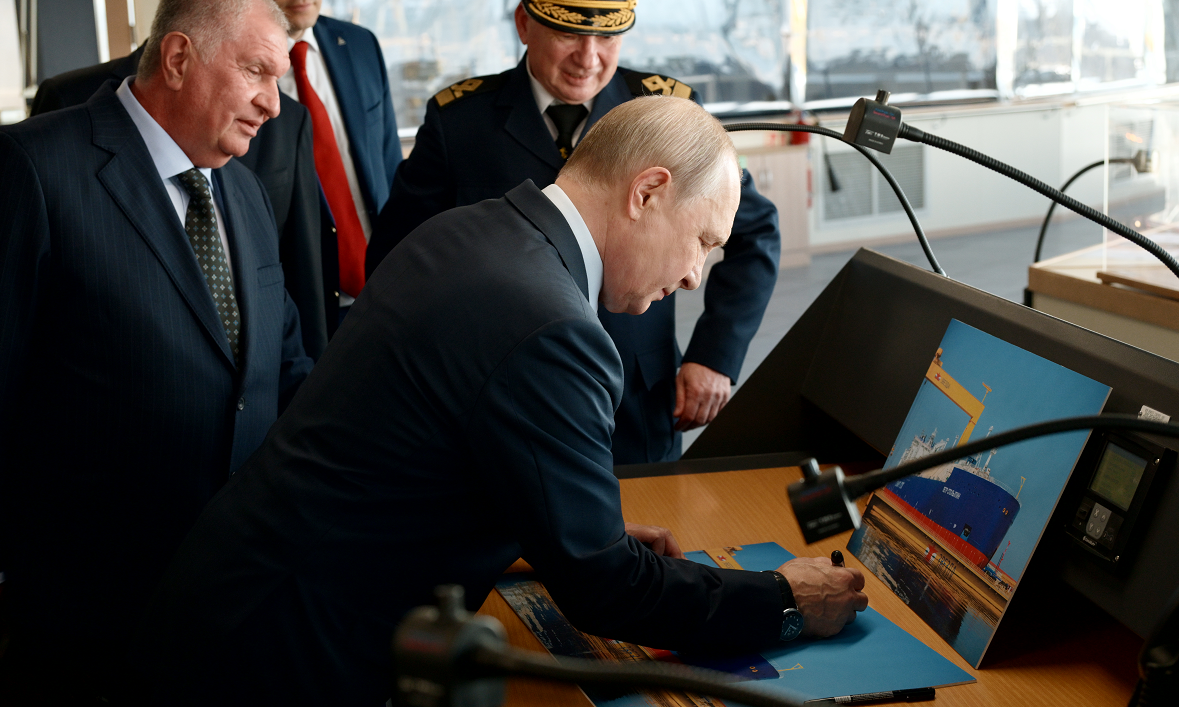

Russian President Vladimir Putin’s visit to the Pyotr Stolypin, the third of five Arc7 LNG carriers now being completed at Zvezda, highlights Moscow’s progress in restoring badly needed Arctic shipping capacity. But the vessels also reveal the limits of Russia’s shipbuilding localisation drive: the first batch remains rooted in pre-sanctions South Korean and European technology, while the next test is whether Russia can turn completion of legacy hulls into a repeatable domestic production capability.
Russian President Vladimir Putin inspected the Arc7 ice-class LNG carrier Pyotr Stolypin at the Zvezda Shipbuilding Complex in Russia’s Far East on September 2, as Moscow pushes to add more high-ice-class tonnage for the sanctioned Arctic LNG 2 project.
Zvezda said the 300-metre vessel is the third in a five-ship group currently being completed at the yard and is preparing for sea trials. Lead vessel Aleksey Kosygin was handed over in December 2025, while the second ship, Konstantin Posyet, followed in June 2026. Two more vessels remain under completion.
The Pyotr Stolypin has capacity for more than 172,000 cubic metres of LNG, a deadweight of about 81,000 tonnes and a 60 MW power plant. Zvezda says its three 15 MW steerable thrusters were manufactured at the nearby Sapphire plant and allow the vessel to navigate independently through ice more than two metres thick.
The visit was therefore about more than another ship nearing delivery.
For Russia, the five Arc7 vessels sit at the intersection of three strategic challenges: rebuilding specialised shipbuilding capability after foreign suppliers withdrew, providing enough winter-capable shipping for Arctic LNG 2, and developing a Northern Sea Route logistics system increasingly oriented toward Asian buyers.
Five ships are only part of the original plan
The current five-vessel programme should not be confused with the original scale of Arctic LNG 2’s shipping strategy.
Zvezda’s initial orderbook covered 15 Arc7 LNG carriers for the project. Rosneft announced the first five contracts in late 2019 and early 2020, followed by contracts for another 10 in September 2020. The ships were intended for long-term charter employment with Arctic LNG 2.
The wider project originally envisaged 21 new Arc7 carriers, with another six contracted in South Korea.
But the ships described as “Russian-built” were never conceived as an entirely Russian technological programme.
Samsung Heavy Industries was a key partner to Zvezda and supplied hulls, blocks, equipment and technical assistance. Research by the Oxford Institute for Energy Studies and other industry sources identifies Samsung as the Korean partner for the first five Zvezda vessels — Aleksey Kosygin, Pyotr Stolypin, Sergei Witte, Konstantin Posyet and Viktor Chernomyrdin.
Samsung delivered the hulls for the first five before sanctions disrupted further work.
The South Korean shipbuilder formally terminated contracts in June 2025 covering blocks and equipment for another 10 icebreaking LNG carriers and seven ice-class shuttle tankers. The contracts had a combined value of KRW4.85 trillion, or around $3.54 billion at the time, and the dispute with Zvezda moved into arbitration.
That distinction matters.
The five ships now moving through Zvezda are best understood as the portion of the original 15-vessel programme for which a substantial part of the Korean-built hull and supply chain had already been secured before cooperation was cut back.
Completing them is an important industrial achievement for Russia. It is not yet evidence that the full vessel can be reproduced domestically from the keel up without the foreign supply chain on which the project was originally based.
LNG containment illustrates the localisation challenge
The cargo containment system provides one of the clearest examples.
French engineering group GTT was contracted to provide tank design technology for all 15 Zvezda icebreaking LNG carriers.
GTT announced in January 2023 that it was ceasing operations in Russia following European sanctions. Its Zvezda contract was suspended from January 8, with activity on the two most advanced LNG carriers limited to work required for project safety and the integrity of its technology.
That left Zvezda facing a challenge significantly more complex than simply finishing South Korean-built hulls at a Russian yard.
Modern Arc7 LNG carriers combine ice-strengthened hull structures, cryogenic membrane containment, high-output electric propulsion, steerable thrusters and equipment designed to operate reliably under extreme Arctic conditions.
The question around Russian localisation is therefore not whether a vessel can be delivered with a Russian yard named as builder. It is which parts of that technology chain Russia can now manufacture, integrate and support without the suppliers that originally made the programme possible.
Putin’s visit to the Sapphire steerable-thruster plant was significant in that context.
Zvezda says the facility is producing the three 15 MW units installed on Pyotr Stolypin. Russia is also developing a broader industrial cluster around the yard, including domestic steel production.
Steerable thrusters are particularly important for Arc7 ships because their propulsion and manoeuvring characteristics enable operation through heavy ice, including stern-first navigation in difficult conditions.
If such systems can be produced reliably at scale and installed across later ships, they would represent a tangible step in replacing equipment that was previously heavily dependent on international technology.
Two ships are now moving into active Arctic service
The programme has meanwhile progressed beyond the symbolic delivery of a first ship.
Sovcomflot accepted Aleksey Kosygin on December 22, 2025. The carrier departed Bolshoy Kamen on its maiden voyage several days later and loaded its first Arctic LNG 2 cargo in the Gulf of Ob on January 28, 2026, before discharging into floating storage near Murmansk in early February.
The second vessel, Konstantin Posyet, was named at Zvezda on June 18. Sovcomflot said the ship, which also has capacity above 172,000 cubic metres, would operate for Arctic LNG 2 under a long-term time charter.
By late August, the vessel had moved beyond the naming stage. The Independent Barents Observer reported that Konstantin Posyet loaded its first Arctic LNG 2 cargo at Utrenneye on August 30 during its maiden Arctic deployment.
That changes the shipping picture incrementally but materially.
Russia is moving from having essentially no new domestically completed second-generation Arc7 tonnage available for Arctic LNG 2 toward a small operational fleet.
Pyotr Stolypin is the next important test. Zvezda says the vessel is preparing for sea trials, while two additional ships are still being completed.
The five-ship sequence can be summarised as follows:
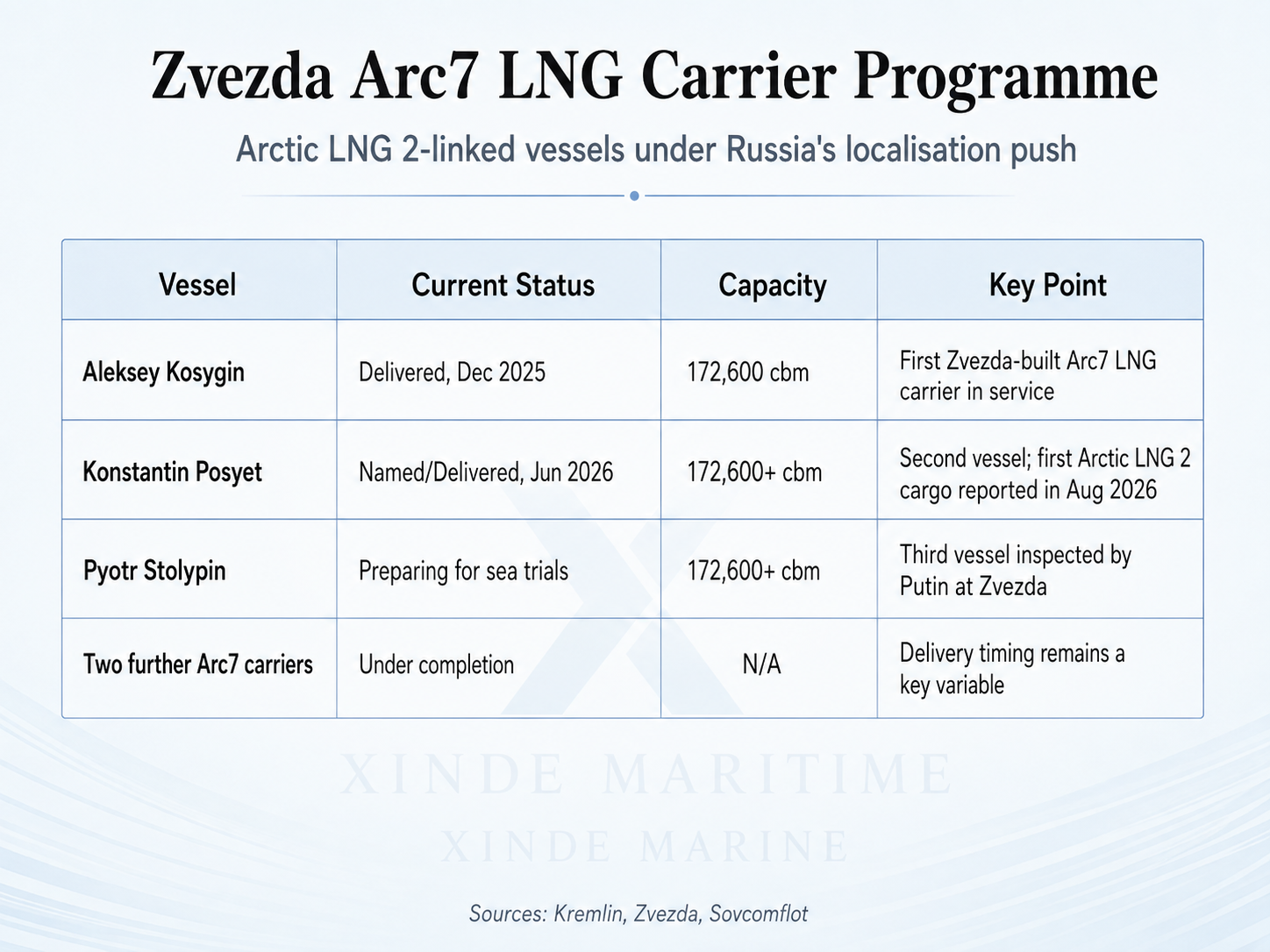
This is meaningful progress, but it remains well behind the timetable envisaged before sanctions disrupted the programme.
For Arctic LNG 2, ships are part of the production equation
The reason Arc7 delivery schedules matter so much is that Arctic LNG 2’s export capacity depends on more than its liquefaction trains.
Novatek’s original development plan called for three trains with combined production capacity of 19.8 million tonnes per year, with total capital expenditure estimated at about $21.3 billion.
The plant is located on the Gydan Peninsula in the Russian Arctic.
In severe winter conditions, conventional LNG carriers cannot provide the same direct year-round access to the project as Arc7 tonnage.
For Arctic LNG 2, liquefaction capacity determines how much LNG can theoretically be produced. Ice-class shipping capacity helps determine how much can actually be moved from the terminal when ice conditions become restrictive.
That distinction became visible after US sanctions targeted the project.
In 2024, Reuters reported that Arctic LNG 2 had suspended liquefaction operations amid sanctions and a shortage of suitable tankers.
Russia has since assembled a more complicated logistics network involving sanctioned conventional LNG carriers, floating storage and seasonal Arctic voyages. But high-ice-class tonnage remains particularly valuable because it can shuttle LNG out of the project in conditions where conventional vessels have much less operational flexibility.
The arrival of Aleksey Kosygin and Konstantin Posyet therefore does more than expand the fleet by two ships. It begins to ease a specific winter logistics constraint.
How much difference the ships ultimately make will depend on how quickly Zvezda can put the remaining vessels into commercial operation.
China is becoming increasingly important at the receiving end
The China connection is clearest in the LNG trade itself.
Since the first Arctic LNG 2 cargo arrived in China in August 2025, the country has become the principal confirmed destination for the sanctioned project’s output.
Reuters reported in June that the Beihai LNG terminal in Guangxi had received 41 Arctic LNG 2 cargoes totalling about 2.6 million tonnes since August 2025. The report said China was then the only known market taking cargoes from the project.
A second receiving point could broaden that logistics chain.
Reuters reported that PipeChina’s new Longkou LNG terminal in Shandong was being prepared as another potential destination for Russian cargoes. Longkou has annual receiving capacity of around 5 million tonnes, while Dalian has also been considered as a possible future option.
For shipping, that matters because an increase in Russian Arc7 shuttle capacity and additional Chinese receiving capacity are two sides of the same logistics equation.
Arc7 ships do not necessarily need to perform every voyage from the Arctic directly to China throughout the year. They can move cargo through the ice-constrained section of the supply chain to floating storage or transshipment points, with conventional LNG carriers handling longer open-water legs.
More Arc7 vessels therefore have the potential to increase the amount of Arctic LNG that can enter a wider Russia-to-Asia transport chain.
Aleksey Kosygin’s Zhoushan call warrants caution
A separate China-related development involves Aleksey Kosygin itself.
The vessel, IMO 9904546, has been on the US Treasury’s Specially Designated Nationals list since June 2024. Pyotr Stolypin, Sergei Witte and several additional Zvezda LNG hulls were designated at the same time. (US Treasury OFAC)
Public AIS aggregators placed Aleksey Kosygin at or near the Jinhai Heavy Industry shipyard area at Daishan, Zhoushan, in late August and early September.
VesselTracker listed the vessel at “Dai Shan (Jinhai Heavy Industry Shipyard)” in early September, while other commercial AIS services have also recorded a Jinhai Heavy Industry call.
The location is noteworthy, but the available evidence does not establish what work, if any, was carried out.
There has been no public confirmation from the Chinese facility identifying a repair, drydocking, conversion, LNG-system service or other specific commercial activity involving the vessel.
AIS data alone cannot answer that question.
The call should therefore be treated as a vessel-movement fact rather than evidence of a confirmed industrial partnership between a Chinese yard and the Arctic LNG 2 shipping programme.
That distinction is especially important given the vessel’s sanctions status.
The next test is repeatability, not another naming ceremony
Zvezda has now demonstrated that the first Arc7 hull can be completed and placed into service, and the second vessel is entering Arctic cargo operations. Pyotr Stolypin is approaching the sea-trial stage.
But the industrial test becomes harder from here.
The first five ships benefited to varying degrees from a pre-sanctions supply chain involving Samsung Heavy Industries, GTT and other foreign technology providers. The remaining 10 vessels in the original Samsung-linked programme did not reach the same stage before cooperation collapsed.
The most useful indicators over the coming months will therefore be operational rather than political: when Pyotr Stolypin actually enters service; how quickly the fourth and fifth ships follow; whether Russian-made high-power propulsion equipment proves reliable in commercial Arctic operation; and whether Arctic LNG 2’s winter loading rate rises as more Arc7 capacity becomes available.
China provides another measurable indicator. Further growth in Arctic LNG 2 deliveries to Beihai, the opening of Longkou to these cargoes, or the emergence of additional receiving terminals would show how rapidly the shipping bottleneck is being translated into larger physical trade flows.
For now, Russia has moved from completing a single highly delayed Arc7 carrier toward operating the beginnings of a small fleet. Whether it can turn those five inherited, internationally rooted shipbuilding projects into a sustainable domestic series remains the more consequential question.

READ MORE
 Shipbuilding
Breaking! Hengli Announces Deals for 52 Ultra-Large LNG Dual-Fuel Containerships
 Shipbuilding
Global Newbuilding Orderbook Matches 2008 Peak as Clarksons Flags Faster Fleet Growth
 Shipbuilding
COSCO SHIPPING Bulk Leads Order for 16 New 87,000-DWT Multipurpose Grain Carriers
 Shipbuilding
A New State-Owned Shipbuilding Group Is Born in China
 Shipbuilding
MISC Signs for Five More LNG Carriers at Hudong-Zhonghua
 Shipbuilding
Another Chinese Bridge Builder Moves Into Shipbuilding
 Shipbuilding
Amid China’s Shipbuilding Boom, a State-Owned Yard Quietly Enters Liquidation
 Shipbuilding
Yichang Changyun plans RMB120m inland bulker programme
 Shipbuilding
Steel Giant Shagang Eyes Shipbuilding as a Booming Market Draws Industrial Capital
 Shipbuilding