


AI’s Boom Is Starting to Reshape Shipping’s Asset Logic
The rapid expansion of artificial intelligence is beginning to affect shipping in ways that go far beyond digital tools, operational efficiency or smart fleet management.
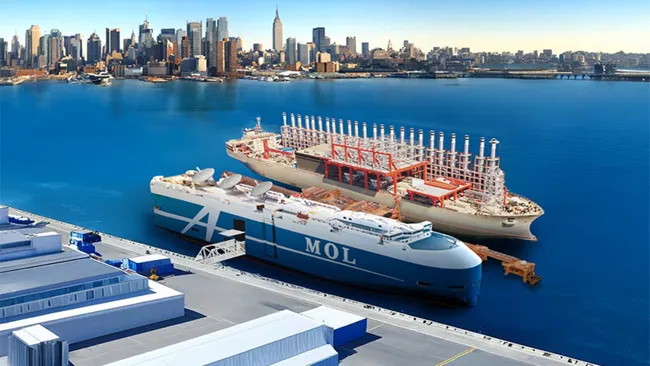

At the heart of the AI boom lies a very physical problem: computing power requires space, electricity and cooling. As large AI models and high-performance computing drive a new wave of data centre construction, the traditional land-based model is running into constraints, including limited sites, long grid-connection timelines and rising cooling requirements.
Against this backdrop, ships, shipyards, classification societies and marine engine supply chains are being pulled into a new industrial equation.
Recent developments show that AI is starting to create both new opportunities and new challenges for the maritime sector.
Old ships may gain a second life
In March, Mitsui O.S.K. Lines, Hitachi and Hitachi Systems signed a memorandum of understanding to study the conversion of second-hand vessels into floating data centres.
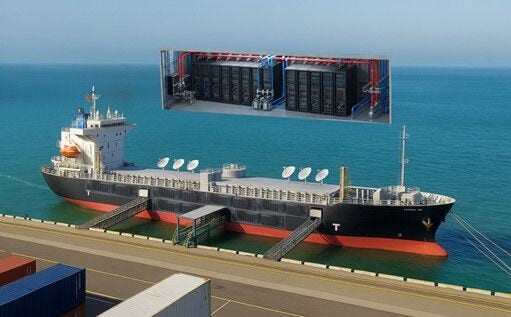
The concept is straightforward. Certain older vessels still have large usable spaces, established onboard power distribution systems, fire safety arrangements, cooling potential and robust steel structures. Through engineering conversion, these ships could be transformed from transport assets into digital infrastructure.
MOL had already explored a similar idea with Kinetics, a company under Karpowership, looking at floating data centre concepts in the 20 MW to 73 MW range, supported by floating power generation.
For shipowners, this opens a new way to think about residual value. Traditionally, older ships would either continue trading in lower-tier markets, be converted for offshore use, or head for recycling. AI-driven demand for data infrastructure could create another exit route for some ageing tonnage, especially vessels with large deck areas, strong hull conditions and adaptable internal spaces.
Shipyards are eyeing a new floating data centre product
A second development points to a different route.
In June, Capital Clean Energy Carriers, controlled by Greek shipping magnate Evangelos Marinakis, signed a joint development project with Lloyd’s Register and Samsung Heavy Industries to advance floating data centre designs.

This is significant because the project is not simply about converting old ships. It points to the possibility of designing floating data centres as a new class of maritime asset: engineered, classed, financed and built through standardised shipbuilding processes.
If this model matures, shipyards may one day receive orders from cloud computing companies, AI infrastructure investors, energy groups and digital infrastructure funds. Floating data centres could become a new niche between offshore engineering and high-end shipbuilding, alongside FPSOs, FSRUs and floating power units.
For shipyards, this could become a new source of demand. Chinese yards, with their strengths in large hull construction, modular assembly, offshore platforms and green power integration, may also have a role to play if AI infrastructure continues to move offshore.
Marinakis’ involvement is also noteworthy. Capital Group has already moved into LNG carriers, LCO₂ carriers and now floating data centres. Taken together, these investments show a long-term asset strategy focused on future infrastructure needs: energy transition, carbon capture and now AI computing capacity.
Data centres are also competing for engine supply
The third signal is more challenging for shipping.
Alphaliner recently reported that AI data centres and off-grid power projects are adding pressure to the diesel generator market. Some shipowners have reported that auxiliary diesels and generator sets have become harder to procure and more expensive, alongside the existing shortage of main engines for vessel newbuildings. Alphaliner noted that most data centres use industrial diesel generator sets in the 1 MW to 4 MW range, and cited one Amazon data centre in Virginia using 93 diesel generator sets of 2,500 kW each.
This needs to be understood precisely. Data centres are generally not competing for large low-speed two-stroke main engines used on major merchant ships. The overlap is more relevant to marine auxiliary engines, medium-speed engines, generator sets and related components.
Even so, the impact matters. Shipbuilding is already facing bottlenecks in main engines, auxiliary machinery, dual-fuel systems, shaft generators and electrical equipment. If AI-related projects absorb more engine and generator capacity, vessel delivery schedules and equipment costs could come under further pressure.
For shipowners and shipyards, the delivery risk is no longer only about berth availability. Engine slots, generator sets, fuel systems and power equipment are becoming equally important.
AI is creating a new external variable for shipping
These three cases show that AI’s impact on shipping is no longer limited to software applications. It is beginning to reshape asset use, newbuilding opportunities and equipment supply chains.
For shipowners, AI may create new residual-value opportunities for selected older vessels.
For shipyards, floating data centres could become a new product category.
For classification societies, new technical standards will be needed.
For equipment suppliers, data centre demand may create new business while tightening availability for maritime customers.
For ports and coastal cities, floating digital infrastructure may become part of future waterfront planning.
The challenge is that AI infrastructure has strong purchasing power, large project scale and urgent deployment needs. When these requirements overlap with shipping’s supply chain, traditional maritime players may face fiercer competition for critical equipment and project timelines.
Shipping needs to rethink the boundary of the ship
For generations, the ship has primarily been understood as a transport asset. Tankers move energy. Bulk carriers move minerals and grain. Container ships move global trade. LNG carriers move gas.
In the AI era, ships may begin to take on additional roles.
They may become floating data centres, mobile power platforms or offshore nodes connecting energy, computing and port infrastructure.
That shift could change how the industry thinks about maritime assets. Hull space, onboard power, cooling access, port connectivity and mobility may all become sources of commercial value.
AI is creating a new external force for shipping. It brings opportunities in asset reuse, shipyard diversification and offshore infrastructure development. It also brings challenges in equipment competition, energy demand and regulation.
Shipping has long served global trade. In the years ahead, it may also begin to serve global computing power.

READ MORE
 Technology
China and Thailand Sign MoU to Strengthen Industrial and Supply Chain Cooperation
 Technology
ISO-Compliant Fuel, Real Operational Problems: LR Warns of Emerging Marine Fuel Risks
 Technology
China’s Reusable Rocket Breakthrough Has a Surprising Link to This Shipyard: GSI
 Technology
Worried Yet? Mandatory AI Monitoring Is Coming to China’s Domestic Fleet
 Technology
Methanol Orders Stall as LNG’s Transition Window Looks Set to Run Longer
 Technology
Maritime Tech Enters the Platform Era as M&A Activity Accelerates
 Technology
SunRui to Supply Rotor Sail Systems for Two 7,100DWT Self-Unloading Bulk Carriers
 Technology
Complex cybersecurity threats demand practical solutions
 Technology
Svanehoj acquires Henri Systems Holland, enhancing its tank gauging and aftermarket capabilities
 Technology