
Tianjin Port Sets New Deep-Draft Record as 22.18-Metre-Draft Giant Bulker Berths Fully Laden
Xinde Marine News — Tianjin Port has set a new record for the deepest-draft vessel ever handled in its history.
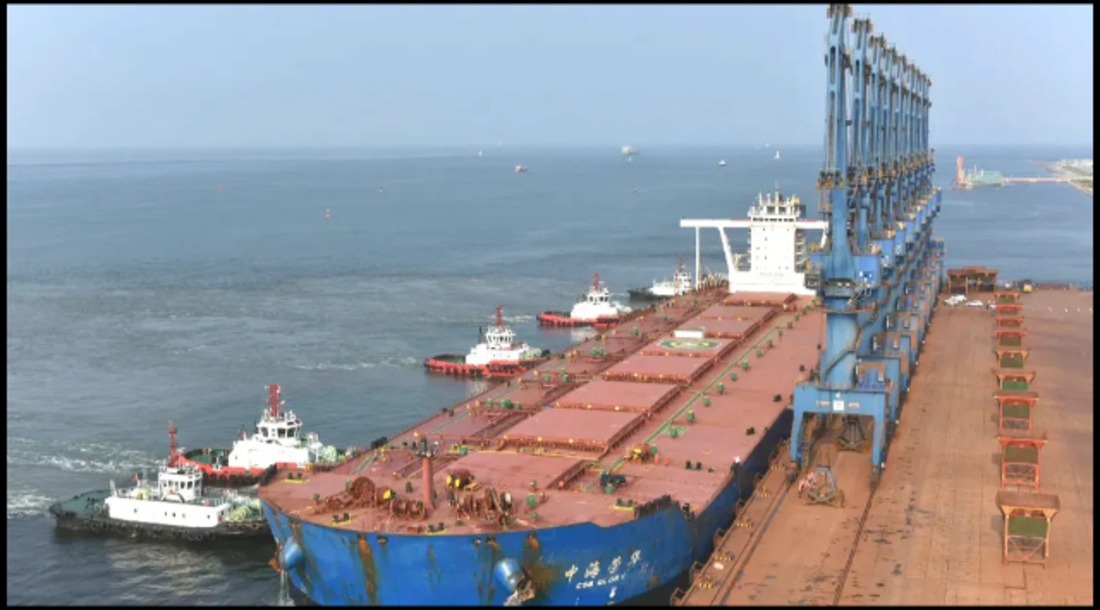
On the afternoon of July 1, the ultra-large bulk carrier CSB GLORY, also known in Chinese as “Zhonghai Ronghua”, safely berthed at Berth S27 of Yuanhang International at Tianjin Port. The vessel was carrying 311,000 tonnes of Simandou iron ore fines and arrived with a draft of 22.18 metres, setting a new berthing record for Tianjin Port.
The operation marked a major test of Tianjin Port’s integrated capabilities in deep-water navigation, tidal window calculation, pilotage, tug coordination, port clearance and terminal handling. Multiple units under Tianjin Port Group, including the dispatching command centre, pilotage centre, tug company and Yuanhang International, worked together under the guidance of Tianjin MSA to ensure the safe arrival of the fully laden giant.
A 22.18-metre draft leaves almost no room for error
CSB GLORY is a large ore carrier with a length of 330 metres and a beam of 57 metres. Its full-load displacement is about 300,000 tonnes. With a draft of 22.18 metres, the vessel required an extremely precise operating window and strict control over under-keel clearance.
To prepare for the operation, Tianjin Port Group’s dispatching command centre led the coordination work with the pilotage centre, tug company and Yuanhang International. The team developed a dedicated operating plan covering pilot boarding, channel navigation, turning control, tug deployment and final berthing.
The port repeatedly reviewed the latest hydrographic survey data for the channel and basin. It also carried out multiple tidal calculations based on tide forecasts. The team finally identified 16:28 on July 1, when the tide height reached 4.02 metres, as the critical safe window for the vessel’s passage and berthing.
Tianjin Port Group also coordinated with customs, maritime safety and border inspection authorities to optimize clearance procedures. A dynamic tide-tracking mechanism was established at half-hour intervals, while vessel speed and route were continuously adjusted during the operation. Six high-powered tugs, each with more than 5,000 hp, were deployed on standby to support the vessel’s safe entry.
Three pilots completed a nearly nine-hour operation
Given the vessel’s heavy loaded condition and unprecedented draft for Tianjin Port, the Tianjin Port Pilotage Centre arranged an enhanced pilotage team. Two senior pilots and one chief dispatcher boarded the vessel together for the operation.
At 09:00 on July 1, the three pilots departed from the eastern breakwater by launch and boarded CSB GLORY in advance. After boarding, they checked the vessel’s main engine, steering gear and other key equipment with the master, and reviewed the ship’s manoeuvring condition.
At 11:00, the order to heave anchor was given. At 12:30, the anchor was aweigh and the vessel formally started its inbound passage. At 13:50, the giant bulker entered the main channel. At 14:30, it passed the turning point. At 16:30, the vessel safely passed the shallowest section of the main channel. At 17:20, CSB GLORY was safely alongside at Berth S27 of Yuanhang International.
The whole pilotage operation lasted nearly nine hours.
Throughout the passage, every engine order and rudder movement was carefully calculated. The pilotage team kept the vessel in the centre of the channel, controlled speed with high precision, and ensured that the vessel passed the shallow section around the high-tide period. Tug positions were also adjusted dynamically to control the vessel’s transverse movement and berthing angle.
Six high-powered tugs supported the vessel’s approach
The operation took place while routine vessel movements continued across the port area. Tianjin Port’s tug company therefore had to support the record-setting bulker while maintaining normal port operations.
For the CSB GLORY operation, the tug company established a layered support formation. Main tugs were responsible for stabilizing the vessel’s movement, auxiliary tugs provided coordinated support, and standby tugs were kept ready for contingency response.
The dispatching team maintained dual-line watch throughout the operation and responded in real time to instructions from the pilotage team. This support was essential during the vessel’s passage, deceleration, turning and final berthing.
For a large vessel with a draft of 22.18 metres, the margin for manoeuvre in a one-way channel is extremely limited. The coordination between pilots, tug masters and dispatchers directly affected the safety and stability of the entire inbound operation.
Fully laden Simandou cargo highlights Tianjin Port’s dry bulk gateway role
The successful berthing of CSB GLORY is also notable because of its cargo. The vessel arrived fully laden with Simandou iron ore fines, a cargo that has attracted growing attention across the dry bulk and port sectors as the Simandou project moves into operation.
For North China, Tianjin Port is a major gateway for dry bulk cargoes and an important logistics node serving regional industrial supply chains. The arrival of a fully laden ultra-large ore carrier with a 22.18-metre draft demonstrates the port’s stronger capability in handling large dry bulk vessels, making full use of deep-water channel resources and coordinating complex berthing operations.
According to Yuanhang International, the customer had once considered changing the discharge port because of the vessel’s ultra-deep draft. The terminal quickly formed a dedicated service team, communicated closely with the customer and coordinated with all relevant parties to finalize a tidal berthing plan. This helped secure the vessel’s safe call at Tianjin Port.
After the vessel berthed, Yuanhang International used its information systems to monitor all operating lines and yard positions on a 24-hour basis. Three dedicated storage areas were arranged for the cargo. The terminal also prepared a detailed hold-by-hold discharge plan to control the vessel’s refloating process and maintain safe water depth during low-tide periods.
Dedicated personnel were assigned to weighing, tallying and separate cargo storage areas. Continuous patrols and inspections were also carried out to ensure safety, efficiency and cargo handling quality.
Tianjin Port strengthens its ultra-large bulker handling capability
The successful berthing of CSB GLORY marks a new stage in Tianjin Port’s ability to handle ultra-large dry bulk carriers.
The operation brought together hydrographic survey review, tide calculation, emergency scenario simulation, pilotage control, tug coordination, port authority support and terminal discharge planning. It created a complete operational chain for handling vessels with a draft of more than 22 metres.
The new record also underlines Tianjin Port’s deep-water advantages and its capacity to support large-volume dry bulk imports. As global iron ore trade patterns continue to evolve and larger bulk carriers play a more important role in long-haul transportation, a port’s ability to receive fully laden giant vessels will become increasingly important for regional supply chain resilience.
Tianjin Port Group said it will continue to improve its full-process coordination system for ultra-large vessels, strengthen professional service capabilities across the port chain, and further enhance Tianjin Port’s role as a regional shipping hub.