

COSCO SHIPPING Sets Up Another Supply Chain Joint Venture as Regional Platform Push Accelerates
COSCO SHIPPING has made another move in China’s port-related supply chain sector, with the establishment of a new joint venture in Ningbo.

Ningbo Yuanhai Supply Chain Co., Ltd. has recently been incorporated with registered capital of RMB200m. Public registration information shows that the company is controlled by COSCO SHIPPING Lines Co., Ltd., a core container shipping subsidiary of COSCO SHIPPING Holdings Co., Ltd., which holds a 51% stake. Ningbo Zhoushan Port Co., Ltd. holds the remaining 49%.
The company’s legal representative is Chen Chuanming. Its business scope covers supply chain management services, non-vessel operating common carrier services, international and domestic freight forwarding, sea, air and land international freight forwarding, international container shipping and general cargo shipping, container leasing, customs declaration, import and export agency services and other related activities.
This suggests that Ningbo Yuanhai is not being positioned as a conventional freight forwarding company or a simple local project vehicle. Rather, it appears to be a port-shipping supply chain platform jointly built by COSCO SHIPPING Lines and Ningbo Zhoushan Port around port operations, liner services, container resources, hinterland transport, customs clearance, warehousing and integrated logistics solutions.
From port calls to supply chain cooperation
The establishment of Ningbo Yuanhai follows a clear cooperation path.
As early as the 2025 Maritime Silk Road Port Cooperation Forum, Ningbo Zhoushan Port Co., Ltd. and COSCO SHIPPING Lines signed an agreement to jointly establish Ningbo Yuanhai Supply Chain Co., Ltd., with the stated aim of building an integrated digital platform covering global logistics supply chain, shipping and port services.
At the 10th Maritime Silk Road Port Cooperation Forum in 2026, the two sides again signed an agreement on the establishment of the supply chain joint venture. The subsequent incorporation of Ningbo Yuanhai marks the transition from strategic agreement to operational entity.
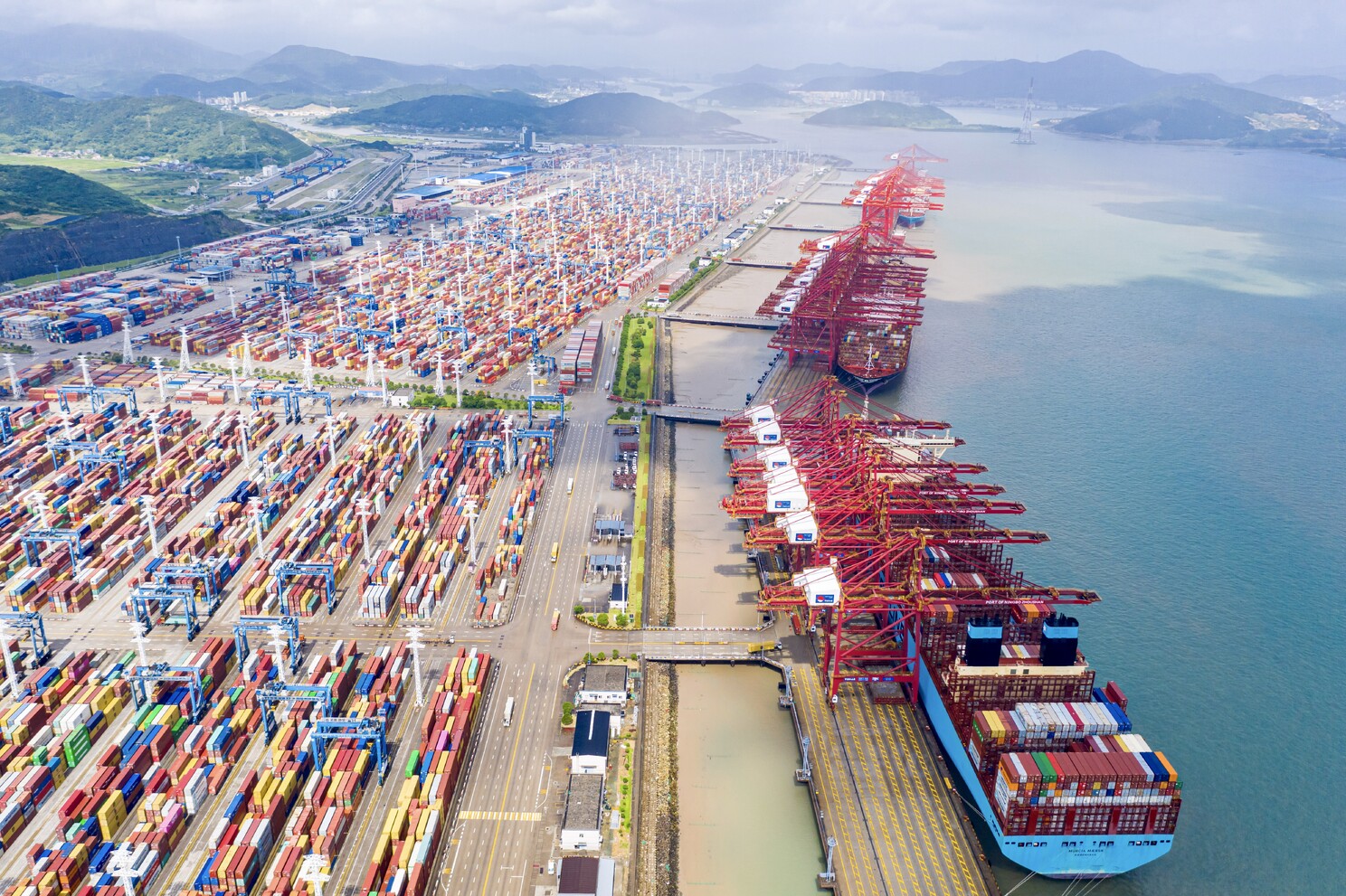
For Ningbo Zhoushan Port, the platform can help connect port handling capacity, port services and hinterland cargo organization more closely. Ningbo-Zhoushan is already the world’s largest port by cargo throughput and one of China’s most important container gateways. But future port competition will not be determined only by berths, water depth, quay cranes and throughput. Increasingly, it will also depend on whether a port can participate in customer supply chain organization and provide stronger connectivity through shipping services, container resources, road transport, rail, warehousing and customs-related services.
For COSCO SHIPPING Lines, Ningbo Yuanhai provides a platform to extend deeper into the hinterland of one of China’s most important Yangtze River Delta gateways. COSCO SHIPPING Lines controls liner routes, vessels, slots, container equipment and global customer networks. Through the joint venture with Ningbo Zhoushan Port, the company can push its service boundary further beyond ocean carriage into terminals, depots, inland transport and customer-facing supply chain solutions.
In this sense, Ningbo Yuanhai represents a further upgrade in the relationship between COSCO SHIPPING and Ningbo Zhoushan Port: from traditional port-shipping cooperation to joint supply chain organization.
A wider supply chain platform matrix is taking shape
Ningbo Yuanhai is not an isolated case.
Over the past year or so, COSCO SHIPPING has set up a number of supply chain platform companies at key logistics nodes across China. Their names, shareholding structures and regional roles vary, but the underlying direction is broadly consistent: connecting COSCO SHIPPING’s liner network and container resources with local port, land port, corridor and industrial hinterland assets.
In late April 2025, Guangxi Yuanhai Land-Sea New Corridor Supply Chain Co., Ltd. was established with registered capital of RMB300m. The company is jointly held by COSCO SHIPPING Lines and Guangxi Beibu Gulf International Port Group Co., Ltd. Its focus is the New International Land-Sea Trade Corridor, the Beibu Gulf port cluster and China-ASEAN logistics flows. Its business scope includes international freight forwarding, domestic freight forwarding, domestic container freight forwarding and NVOCC services. The strategic logic is to connect Beibu Gulf ports, ASEAN services, the land-sea corridor and inland industrial hinterlands.
Hunan Huaihua Yuanhai New Corridor Logistics Co., Ltd. was also established in 2025. Huaihua is an important inland node in the New International Land-Sea Trade Corridor and central China’s land port system. The cooperation between COSCO SHIPPING Lines and the local land port platform is less about seaport operations and more about inland cargo aggregation, rail services, multimodal transport and land port functionality.
In the second half of 2025, Shenzhen COSCO SHIPPING Smart Supply Chain Co., Ltd. was established with registered capital of RMB1bn. According to COSCO SHIPPING Holdings’ announcement, its shareholders include COSCO Container Lines (Hong Kong) Co., Ltd., COSCO SHIPPING Logistics (Guangzhou) Co., Ltd., Shenzhen City Shenzhen Port Logistics Group Co., Ltd. and CCCC Fourth Harbour Engineering Co., Ltd. The joint venture is positioned around a smart logistics platform in the Guangdong-Hong Kong-Macao Greater Bay Area, with business scope including loading, unloading and handling, general warehousing, cold chain storage, international freight forwarding, integrated supply chain services, road transportation, international and domestic ship agency and related consultancy services.
In May 2026, Chongqing COSCO SHIPPING Lines Supply Chain Co., Ltd. was established with registered capital of RMB300m. COSCO SHIPPING Lines holds 90%, while Chongqing Jiangjin Hub Port Industrial Park Operation Group Co., Ltd. holds 10%. The company is based in Jiangjin Hub Port and is clearly linked to Chongqing’s ambition to build an inland opening-up hub and strengthen the New International Land-Sea Trade Corridor. Its role is to connect inland manufacturing, rail transport, river transport and ocean shipping networks.
With the latest Ningbo platform, COSCO SHIPPING’s supply chain footprint now covers multiple strategic nodes including Beibu Gulf, Huaihua, Shenzhen, Chongqing and Ningbo. Each node serves a different regional function: Guangxi links ASEAN and the land-sea corridor; Chongqing and Huaihua support inland opening-up hubs; Shenzhen serves smart logistics and port-adjacent supply chain services in the Greater Bay Area; Ningbo strengthens port-shipping coordination at a global gateway port in the Yangtze River Delta.
If the wider COSCO SHIPPING Logistics and Supply Chain Management Co., Ltd. system is also included, more regional platforms can be seen, including Xinjiang COSCO SHIPPING Logistics and Supply Chain Co., Ltd., Guangzhou Dongjin Yuanhai Logistics Supply Chain Co., Ltd. and Shenzhen Yantian Port Yuanhai Supply Chain Co., Ltd. Together, these moves show that COSCO SHIPPING is pushing its supply chain service system further into regional nodes.
From moving containers to organizing supply chains
The immediate reason behind COSCO SHIPPING’s recent platform push lies in its changing strategic positioning.
COSCO SHIPPING Holdings has repeatedly described itself as a global digital supply chain operation and investment platform centered on container shipping. That wording is important. It shows that the group’s container shipping business is no longer confined to port-to-port ocean carriage, but is being extended toward door-to-door, end-to-end and full-chain services.
Under the traditional liner model, a shipping line mainly sells slots. Customers focus on freight rates, schedules, space availability and service reliability. In today’s supply chain environment, however, cargo owners are increasingly concerned not only about ocean freight, but also about whether cargo can move reliably, clear customs quickly, connect with rail, road, warehousing and distribution, and retain alternative options during supply chain disruption.
That requires liner companies to become more than ocean carriers. They need stronger inland organization, port coordination and digital supply chain capabilities. COSCO SHIPPING’s establishment of regional supply chain companies is a way to bring shipping networks, container equipment, terminal resources, rail capacity, warehousing, local industrial resources and customer services into one operating framework.
This also explains why many of these companies are not wholly owned by COSCO SHIPPING. Instead, they are often joint ventures with local port groups, land port operators or industrial park platforms. COSCO SHIPPING brings shipping capacity and global network resources. Local partners bring ports, logistics parks, corridors and hinterland resources. Through equity cooperation, the relationship moves from business-level coordination to long-term platform-level alignment.
Ports, land ports and corridors become new competitive units
COSCO SHIPPING’s recent investment pattern is not random. It is focused on several types of strategic nodes.
The first category is global gateway ports. Ningbo-Zhoushan is the clearest example. By forming Ningbo Yuanhai with Ningbo Zhoushan Port, COSCO SHIPPING can strengthen its supply chain coordination capability at one of China’s most important export gateways.
The second category is land-sea corridor nodes. Guangxi, Chongqing and Huaihua all fall into this group. Their value lies not only in local cargo volumes, but also in whether they can connect inland industrial belts with global shipping networks through sea-rail, river-sea, rail-sea and multimodal services.
The third category is manufacturing and foreign trade clusters. Shenzhen and the Greater Bay Area are typical examples. These regions have stronger demand for cross-border e-commerce, cold chain logistics, consolidation, customs-supervised warehousing, smart logistics parks and multimodal services. Supply chain platforms in these areas are therefore more closely linked to integrated logistics parks and digital services.
The trend is clear: competition among liner companies is expanding from route networks to hub and corridor organization. Those able to participate more deeply in port hinterlands, land port nodes and industrial clusters will be better positioned to occupy a more central role in customers’ supply chains.
A hedge against the shipping cycle
The supply chain platform push also reflects a response to shipping market cycles.
Over the past few years, container shipping has moved from a period of extraordinary earnings to a phase of rising capacity pressure. Freight market volatility remains a structural feature of the sector. Relying only on ocean freight income makes it difficult for large liner groups to maintain stable long-term growth.
For major container shipping companies, expanding end-to-end supply chain revenue, increasing integrated logistics services and improving customer stickiness are important ways to reduce exposure to freight rate volatility.
COSCO SHIPPING Holdings has previously disclosed that in 2025, its container shipping business generated RMB44.888bn in supply chain revenue excluding ocean freight, up 9.64% year on year. That shows supply chain services are no longer peripheral; they are becoming an increasingly important part of the group’s growth structure.
Regional supply chain companies are the physical carriers of that strategy. They can support booking, freight forwarding, customs declaration, warehousing, rail, trucking, depots, container management, consolidation and distribution. As the platform network grows, COSCO SHIPPING can replicate a “hub + corridor + network” model across different regions and gradually build a broader supply chain node matrix.
Ningbo Yuanhai is more than a new company
The establishment of Ningbo Yuanhai Supply Chain Co., Ltd. should therefore not be read simply as another corporate registration. It is part of COSCO SHIPPING’s broader push to build regional supply chain platforms and a sign of how port-shipping cooperation is evolving.
In Ningbo, COSCO SHIPPING is partnering with a global gateway port. In Guangxi, it is working with the Beibu Gulf port system. In Chongqing and Huaihua, it is entering inland corridor nodes. In Shenzhen, it is participating in smart logistics and port hinterland supply chain infrastructure in the Greater Bay Area.
Taken together, these moves point in one direction: COSCO SHIPPING is trying to move further from being a traditional ocean carrier toward becoming a global digital supply chain operation and investment platform.
For ports and local platforms, forming joint ventures with COSCO SHIPPING is also more than bringing in a state-owned shipping partner. It means gaining access to a global liner network, container resources, customer relationships and multimodal product capabilities. In the next stage of port and logistics competition, the key differentiator will increasingly be the ability to organize ports, rail, roads, logistics parks, customs services, warehouses, shipping routes and customers into one coherent supply chain system.
COSCO SHIPPING’s recent moves suggest it is positioning itself early for that shift.