· Existing partnership extended through 2027, continuing coral reef conservation at three sites in the Philippines and Malaysia while expanding into mangrove restoration in Sarangani Bay in the Philippines
· Measurable ecological recovery since 2021, including higher live coral cover, recovery of threatened coral species, increased fish diversity, and more frequent sightings of endangered marine life
· Community-led conservation that empowers coastal communities to restore reefs and mangroves, supporting alternative livelihoods and long-term ecosystem resilience.
The CMA CGM Group, a global player in sea, land, air and logistics solutions, and Endangered Species International (ESI), a non-profit organization, have renewed their ocean conservation partnership through November 2027, strengthening efforts to protect and restore one of the world’s most biodiverse yet threatened marine ecosystems within the Coral Triangle.
Building on a collaboration launched in July 2021, the renewed partnership continues to protect and restore 20 hectares of coral reef habitat across approximately 6,000 km2 of seabed in Malaysia and the Philippines. Conservation efforts are also expanded to include 308 hectares of mangrove ecosystems in Sarangani Bay, southern Philippines, adjacent to one of the project’s protection sites.
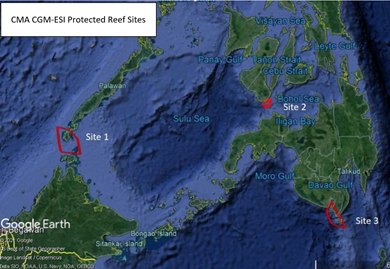
The partnership focuses on three protected areas with the Coral Triangle:
1. Balabac Island (Philippines) – Pulau Banggi (Malaysia)
2. Negros Island, central Philippines
3. Sarangani Bay, Mindanao, southern Philippines
These sites sit within the Coral Triangle that hosts the highest coral biodiversity globally, yet where more than 85% of reefs face threats from illegal fishing, pollution and coastal development.
Sarangani Bay also holds global significance for mangrove biodiversity. The area supports 24 mangrove species, representing approximately 73% of all mangrove species in the Philippines, including the critically endangered Camptostemon philippinense listed on the International Union for Conservation of Nature (IUCN) Red List of Threatened Species.
The partnership supports CMA CGM Group’s three sustainability pillars, Acting for Planet, which focuses on reducing the environmental footprint of global shipping and logistics operations; Acting for Our Partners, which aims to engage all stakeholders, including local communities, in fostering a responsible supply chain; and Acting for People, which seeks to engage employees and raise their awareness of sustainability issues. The CMA CGM-ESI partnership translates these commitments into science-driven and measurable outcomes.
Conservation Outcomes Since 2021
Monitoring data shows sustained ecological recovery across all three protected sites:
· Live coral coverage increased to 63%, up from 50% in 2023 when the partnership was first renewed, and 37% in 2021 when it began.
· Acropora coral cover, a key indicator of coral health, rose to 66% from 48% in 2023.
· 23 coral species have recovered since 2021, including Acropora tenuis in 2024. Among which, 15 species are listed on IUCN Red List of Threatened Species.
· Fish population and diversity increased to 150 species in 2025, compared with 137 species in 2021.
· More frequent sightings of endangered species such as green and hawksbill sea turtles, manta rays, blacktip reef sharks, three-spot seahorses, and camouflage groupers.
While fish diversity continues to improve, monitoring indicates that populations of larger reef fish remain limited, highlighting the need for continued protection.
Integrating Mangrove Conservation to Strengthen Reef Resilience
The expansion into mangrove conservation reflects the critical role mangroves play in strengthening coral reef resilience and climate adaptation. Mangroves filter sediment and pollutants before they reach coral reefs, improve water quality, stabilize shorelines, and reduce damage from waves and storm surges. They also serve as nursery habitats for many reef-dependent fish species and are among the most effective natural carbon sinks.
By integrating coral reef restoration with mangrove protection, the partnership adopts an ecosystem-based approach that addresses interconnected threats rather than treating habitats in isolation.
Community Engagement and Livelihood Support
Local communities play an important role in the partnership, with ESI working directly with fishing communities to stop illegal and destructive fishing practices within protected areas. Local fishermen are employed for monitoring and patrol activities. Since the partnership renewal in November 2023, four cases of minor illegal fishing have been identified and stopped.
For mangrove conservation, local communities will be involved in operating and maintaining a mangrove conservation walk, working in a mangrove nursery, and participating in restoration activities. These initiatives are expected to support sustainable livelihoods for approximately 21 families living near Sarangani Bay.
Between 2021 and 2025, the partnership delivered 202 coral and ocean conservation awareness activities, reaching over 14,000 children from coastal communities through weekly programs. The renewed phase aims to engage at least 10,000 youth annually through both ocean and mangrove conservation camps to foster long-term local stewardship.
Bo WEGENER, CEO of CMA CGM Asia Pacific, said, “As a company whose operations rely on the oceans, we see marine biodiversity protection not just as a duty, but as our mission to preserve the very seas that sustain us. Our partnership with ESI puts that commitment into real action. It is heartening to see the improvements in biodiversity across the three protected sites. By expanding the scope to include mangrove conservation, we can look forward to strengthening restoration efforts over the next two years”
Pierre FIDENCI, ESI President said, “Protecting marine biodiversity is a global and local imperative. With the support of CMA CGM, we are actively restoring the coral reefs and mangroves that serve as the nursery of our oceans. Our expanded conservation work in mangrove restoration is particularly vital, as these coastal forests are key to the protection and survival of our coral reefs.”
The opinions expressed herein are the author's and not necessarily those of The Xinde Marine News.
Please Contact Us at:
media@xindemarine.com


 CMA CGM and Endangered Species International Expan
  OceanScore Reaches USD 5 Million ARR as Demand for
  COSCO Shipping’s Major Europe Move: Extending Its
  EVERGREEN CONFIRMS FLEETWIDE ROLLOUT OF INMARSAT NE
  PIL marks New Year's Eve by sponsoring Humanity Mat
  Corvus Energy Secures Record Order for Seven Fully