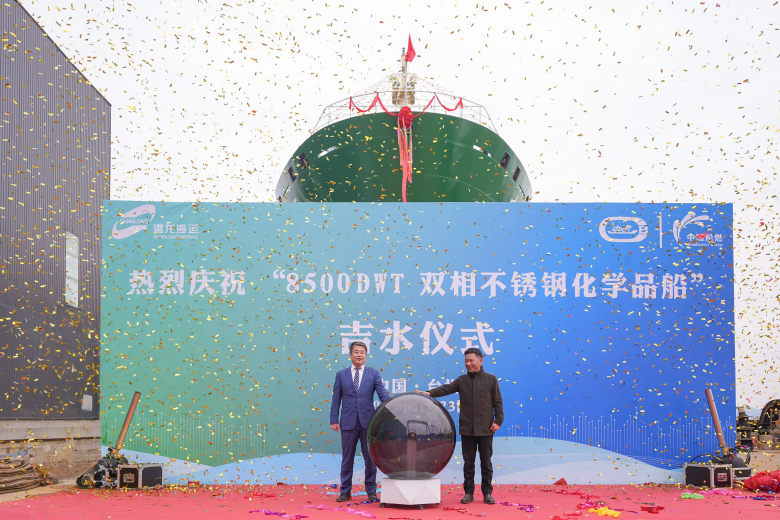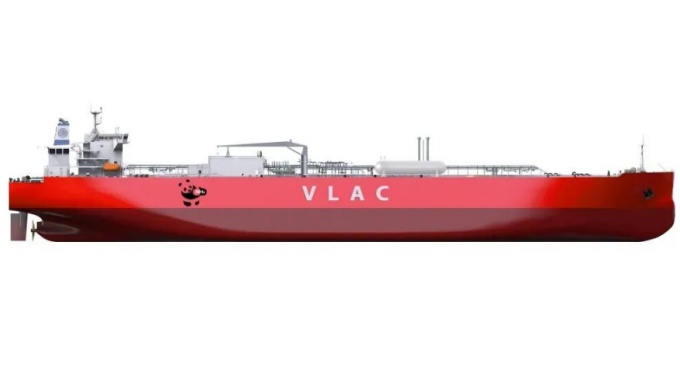
Shanghai — In a major development for the gas shipping sector, Jiangnan Shipyard officially announced on January 26 that it has signed a construction contract for two 90,000 cubic meter (cbm) Ultra-Large Ammonia Carriers (VLACs) with Southwest Maritime (TSM), in partnership with China Shipbuilding Trading Co. (CSTC).
Jiangnan Shipyard emphasized that this collaboration represents a deep continuation of a strategic partnership spanning over a decade. It is also a proactive response to global "Dual Carbon" goals, highlighting the strengthening comprehensive competitiveness of Chinese shipbuilders in the field of green energy transport equipment.
As previously reported by Xinde Marine News in "Breaking! Tianjin Southwest Enters VLAC Sector," market rumors regarding an agreement between TSM and Jiangnan Shipyard had been circulating since last December. This official announcement moves the order from "market speculation" to a "confirmed contract" with a trackable schedule.
Technical Highlights: Efficiency and Sustainability
From a technical perspective, Jiangnan Shipyard disclosed that these VLACs will adopt a new generation of low-resistance hull lines. Designed to meet the dimensional constraints of the old Panama Canal locks, the vessels feature optimized bow and stern profiles and waterline distribution. This design achieves a superior balance between "maximizing cargo capacity" and "minimizing navigation resistance," thereby enhancing overall operational efficiency.
Regarding propulsion, the vessel's core design features an LPG dual-fuel system. According to Jiangnan Shipyard, compared to traditional fuel oil propulsion, this system can significantly reduce CO₂ emissions by approximately 20% and SOx emissions by roughly 99%, fully meeting EEDI Phase III requirements.
This technical pathway aligns closely with current upgrade trends for large gas carriers—prioritizing regulatory compliance, efficiency gains, and fuel flexibility—and lays a solid engineering foundation for the large-scale application of VLACs in the future ammonia energy transport chain.
TSM Enters the Mainstream VLAC Arena
For Southwest Maritime, securing these two 90,000 cbm VLACs signifies more than just a fleet expansion; it marks their definitive entry into the mainstream liquid ammonia transport sector.
The industry consensus is that while 90,000 cbm class VLACs share a common technical architecture with mature VLGCs, their core objective is specialized design and operation for "full-load liquid ammonia" cargoes. Consequently, the finalization of VLAC orders often indicates that shipowners have made clear medium-to-long-term judgments regarding future liquid ammonia trade and the transport demands of the ammonia energy industrial chain.
Simultaneously, the "new design under old Panama constraints" signals a move toward productization. By systematically optimizing hull lines and cargo capacity under strict route and port accessibility constraints, the design achieves better ton-mile efficiency and operational economics. This represents not only a performance upgrade at the single-vessel level but also implies that the shipyard’s R&D in the VLAC niche has moved from concept validation to engineering, serial production, and replicable delivery.
Southwest Maritime: A "Heavy Asset Player" in Gas Shipping
Jiangnan Shipyard describes Southwest Maritime as a significant participant in the global gas shipping sector. Its fleet covers a diverse range of vessel types, including small and medium-sized LPG/ethylene carriers, VLGCs, Ultra-Large Ethane Carriers (VLECs), and asphalt carriers.
According to Clarksons Research records (as of January 28, 2026), TSM’s current operating fleet stands at 32 vessels. The fleet structure is anchored by LPG carriers, supplemented by large-capacity ethane/LPG vessels, multi-gas capable (LNG/Eth/LPG) ships, and asphalt tankers. This structure of "Gas Focus + Diverse Vessel Synergy" provides greater portfolio resilience against market cycle fluctuations.
Regarding its orderbook, Clarksons records show TSM has 12 vessels on order (excluding the newly announced VLACs). These include:
1. Three 174,000 cbm LNG carriers under construction at Hudong-Zhonghua, with delivery windows between 2027 and 2028.
2. Multiple 25,000 cbm and 41,000 cbm LPG carriers at Huangpu Wenchong.
3. 5,000 cbm small gas carriers at Jiangmen Hangtong.
1. Three 174,000 cbm LNG carriers under construction at Hudong-Zhonghua, with delivery windows between 2027 and 2028.
2. Multiple 25,000 cbm and 41,000 cbm LPG carriers at Huangpu Wenchong.
3. 5,000 cbm small gas carriers at Jiangmen Hangtong.
Notably, order information for some newbuilds includes "Ammonia" annotations under "Alternative Fuel Type/Capability," reflecting a proactive layout for new fuel transport chains and future cargo structure shifts. With the addition of these two 90,000 cbm VLACs, TSM’s "Operating + On-Order" capacity map will tilt further toward large-scale, green, and new fuel carrier segments.
Jiangnan Shipyard: Deepening the Gas Carrier Lineup into Ammonia Transport
From the shipyard’s perspective, the value of winning another VLAC order extends beyond the contract value; it represents a vertical expansion of their gas carrier product pedigree.
Jiangnan Shipyard possesses long-standing technical and delivery expertise in high-end gas carriers like VLGCs and VLECs. As key equipment for future ammonia energy transport, VLACs require both the continuation of existing VLGC platform capabilities and specialized design and verification regarding cargo containment systems, safety redundancy, and operational boundaries specific to liquid ammonia.
The announced combination of "Next-Gen Low Resistance Lines + Old Panama Fit + Dual Fuel + EEDI III Compliance" indicates that Jiangnan Shipyard is cutting into and consolidating the VLAC niche with a clearer productization path. In fact, as reported by Xinde Marine News in "Strong Start! Jiangnan Wins Two 90k VLAC Orders from EPS," the shipyard had already secured orders for two similar vessels from Eastern Pacific Shipping (EPS) earlier this year, along with two large LNG carriers
Jiangnan emphasized that it will continue to work with Southwest Maritime to create an industry cooperation benchmark amidst the shipping energy transition. This phrasing often implies room for further synergy in vessel iteration, follow-on orders, and system solutions surrounding new fuel transport (e.g., fuel and cargo safety management, energy efficiency optimization, and digital operations).
From "Carrying LPG" to "Carrying Liquid Ammonia": Chinese Owners Closing the Loop on New Fuel Transport
Over the past decade, the keywords for the Chinese gas shipping market focused on "VLGC localization," "fleet scaling," and "operational capability enhancement."
However, against the backdrop of "Dual Carbon" goals and the rapid advancement of new fuel industrial chains, a new main line is being added to the industry narrative—the acceleration of deep-sea transport chains for "new fuels/feedstocks" such as ammonia, methanol, and ethane.
However, against the backdrop of "Dual Carbon" goals and the rapid advancement of new fuel industrial chains, a new main line is being added to the industry narrative—the acceleration of deep-sea transport chains for "new fuels/feedstocks" such as ammonia, methanol, and ethane.
As a potential hydrogen carrier and future fuel, the development of liquid ammonia trade and cross-regional transport capacity relies heavily on the supply and mature operation of mainstream vessel types like the VLAC. Southwest Maritime’s move into VLACs, superimposed on its existing accumulation in VLGC/VLEC operations and continuous newbuilding investment, provides a realistic foundation for extending from traditional LPG transport to ammonia energy transport.
Meanwhile, Jiangnan Shipyard’s R&D and order progress in this field are expected to further elevate the presence of Chinese high-end gas carrier equipment in the global green energy transport race. It is foreseeable that as the ammonia energy chain moves from demonstration to scale, medium-to-long-term demand in the VLAC market will become a new structural variable in the gas shipping sector; this official announcement marks a milestone where this trend is being realized simultaneously on both the supply side and the owner side.
The opinions expressed herein are the author's and not necessarily those of The Xinde Marine News.
Please Contact Us at:
media@xindemarine.com