India’s "national team" container carrier moves forward again: SCI and CONCOR to become anchor shareholders, with multiple port companies to take stakes in BCSL
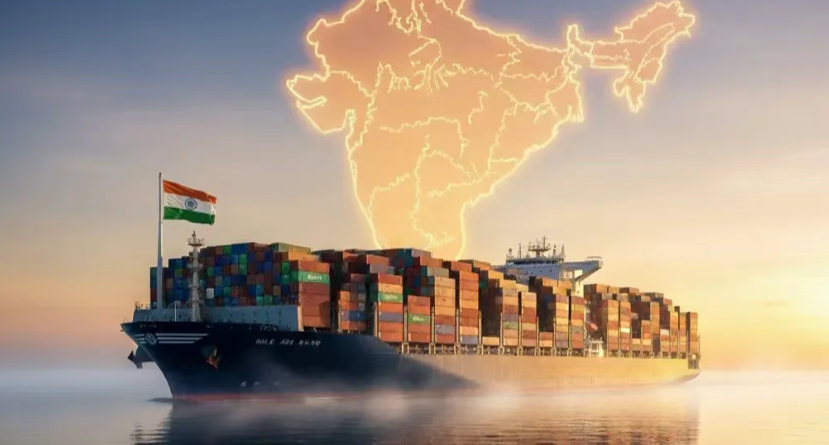
As previously reported by Sinde Maritime Network in "A national-level container shipping company established! Targeting a 100-ship fleet," in October 2025, Indian Prime Minister Narendra Modi officially announced at the Global Maritime CEOs Forum the establishment of India’s first national-level container shipping company—Bharat Container Shipping Line (BCSL). According to Indian media, this marks an important step for India in building a "national fleet" and strengthening autonomy in seaborne trade. The announcement has also been seen as a key milestone for India's push toward becoming a maritime power under its "Maritime Vision 2047."
According to the latest disclosures from local Indian media, India’s plan to set up a national-level container shipping company is moving from "announced" to "equity implementation." Reports say BCSL’s equity partners are expected to be finalized by the end of this year. Local media claim the Indian government plans to confirm equity partners and sign a Memorandum of Understanding (MoU) in the third week of December, after which it will begin drafting a detailed business plan for the container shipping company. For the market, this timeline suggests that BCSL has entered a critical phase of institutional and capital assembly: shifting from macro narrative and policy signaling to an executable, implementable equity structure and operating setup.

Two state-owned enterprises to take control: SCI and CONCOR to become "anchor shareholders"
On the shareholding structure, reports indicate that the state-owned Shipping Corporation of India Ltd (SCI) and the container/multimodal logistics company Container Corporation of India Ltd (CONCOR) will serve as BCSL's anchor equity holders, jointly holding a majority stake.
Notably, both SCI and CONCOR are "Navratna" state-owned enterprises designated by the Indian government, enjoying greater financial and operational autonomy and being granted institutional space to compete globally in a more market-oriented manner.
Having two "Navratna" enterprises assume the controlling core helps create an institutional fulcrum between national strategic objectives and commercial operations. It also signals the Indian government’s intention to build container shipping capability through a model of "state capital-led, but not fully administrative."
Multiple port companies to take stakes: strengthening the financial base with port "cash reserves"
In addition to SCI and CONCOR, the remaining equity is expected to be held by multiple government-controlled port entities, including the Chennai Port Authority, Kamarajar Port Ltd, and the V.O. Chidambaranar Port Authority in Tuticorin.
The report says one important consideration for bringing in port companies as shareholders is to use their relatively ample surplus cash reserves to provide a more solid financial foundation for the new shipping company.
The report also notes that under the current institutional arrangements, these port entities do not pay dividends to the Indian government, and therefore the availability of their cash flows and reserves is believed to support BCSL's capital strength.
In short, BCSL's "financial chassis" is being built through a combination of "state-owned control + port shareholding," aimed at enhancing risk resistance and the ability to sustain investment.
A clearer division of labor for "ships + boxes + inland logistics": SCI to charter tonnage, CONCOR to provide containers and the inland network
On the operational division of labor, the disclosed plan emphasizes that BCSL will launch by coordinating three elements: vessel capacity, container assets, and an inland logistics network.
SCI currently owns a limited number of container ships (about three, according to the report). Under the proposed plan, SCI would introduce capacity to BCSL through chartering from the market, with BCSL responsible for actual operations. This arrangement reduces the pressure of heavy asset investment in BCSL's early stage, while embedding capacity sourcing and chartering management capabilities within the national platform—enabling a faster start-up and greater flexibility.
Meanwhile, CONCOR would provide container assets for BCSL and, leveraging its multimodal transport and inland logistics infrastructure, support cargo aggregation and the efficiency of inland collection and distribution.
CONCOR positions itself as India’s leading logistics and multimodal operator. Its value lies not only in the containers themselves, but also in its inland network capability and multimodal organization capacity. If this division of labor is implemented as planned, BCSL's start-up logic would not be merely "charter ships and launch services," but an attempt to build a closed-loop cargo organization system linking "ports—inland—routes," laying the foundation for subsequent route expansion and network-based operations.
Signals of CONCOR accelerating its "going global": Middle East cooperation has started, with the Far East next
The report also notes that CONCOR has shown a stronger intent to internationalize.
This year, CONCOR signed an MoU with Dubai-headquartered logistics and shipping services company the Rais Hassan Saadi (RHS) Group, planning to provide related services in the Middle East. Its Chairman and Managing Director, Sanjay Swarup, also recently told analysts that the group's next step is to expand into the Far East market, adding that profit margins in its international business segment exceed 30%.
This information suggests CONCOR is not merely a “domestic logistics support partner,” but is proactively strengthening cross-border logistics and international service capability. If BCSL’s future network expands into Asia and beyond as planned, there is a realistic possibility of synergy between CONCOR’s overseas positioning and BCSL’s route development.
BCSL moves from "vision narrative"into a phase of "institutional and capital validation"
From the "announcement" to the emergence of shareholding and division-of-labor proposals, BCSL is moving from a vision narrative into a period of institutional and capital validation.
The market will likely focus next on three variables. First, whether the governance structure of anchor shareholders plus port shareholding can form a clear decision-making mechanism and capital discipline, avoiding administrative objectives overwhelming commercial discipline. Second, how the initial reliance on chartering to secure capacity will affect the cost curve, charter tenors, and earnings elasticity—determining commercial sustainability. Third, whether the boundary between resource coordination and market competition for port shareholders is clear: whether positive synergies can be formed in terminal services, port-call organization, and collection/distribution efficiency, while avoiding structural distortions.
Overall, BCSL is moving from "slogans and planning" to "capital and resource assembly." If equity partners are finalized and an MoU is signed by year-end as scheduled, followed by the drafting and execution of the business plan, the "countdown to substantive operations" for India's national-team container carrier may begin. Its spillover impact on regional liner competition, the organization of India's import-export cargo flows, and global liner companies’ positioning in India will also gradually shift from the policy layer into market-level variables that can be observed.
by Xinde Marine News
The opinions expressed herein are the author's and not necessarily those of The Xinde Marine News.
Please Contact Us at:
media@xindemarine.com