Restrictions on firefighting foams containing PFOS and PFAS, combined with discontinued supply, make contingency planning critical for ships still using fluorinated firefighting foam ahead of their next annual survey, writes Rasmus Schmidt, Marine Fire Service, VIKING Life-Saving Equipment.
New global International Maritime Organization rules that restrict PFOS content in firefighting foams have alerted commercial ship owners to a pressing regulatory requirement, but discontinued production of older foams calls for immediate action rather than awareness.
In June 2025, the International Maritime Organization’s MSC.1 Circ. 1694 formalised restriction of PFOS content in shipboard firefighting foams from 1 January, 2026. New ships can no longer use foams with PFOS content of above 10mg/kg in fixed or portable firefighting systems, with restriction applying to existing ships from their first subsequent annual, periodic or renewal.
But maritime regulation has not been the driver for restricting the use of ‘forever chemicals’. In fact, a years-long process led up to the 23 October, 2025 European Commission restrictions on land-based use of all per- and polyfluoroalkyl substances (PFAS) - of which PFOS is one. From that date firefighting foams were limited to a total PFAS concentration of 1 mg/L, with a five year phase-out for portable extinguishers and 10 years on fixed foam systems.
While the Commission included a 10-year grace period for maritime and offshore, land-based use accounts for around 80 percent of the firefighting foam market. Consequently, since 2024, mainstream production has focused on Fluorine Free Foam.
Even should they wish to do so, shipowners seeking to replace condemned foams or top up with fluorinated foams today will find the store cupboard is empty. And without compliant firefighting foams onboard, ships cannot sail.
Action required
For entirely practical reasons, therefore, owners should have plans in hand to replace any prohibited foams before the end of 2026, by the latest. Subsequently, a vessel is obliged to have documentation to prove the type of foam carried onboard is compliant with MSC.1-Circ.1964
But replacing a firefighting foam with a fluorine-free alternative is not a ‘drop-in’ process. It requires planning, technical expertise and the support of documentation all along the line and is best accomplished as part of a scheduled drydocking to avoid disruption to operating or charter obligations,
Tanks and shipboard systems, for example, need deep cleaning to ensure they are free of older foams. Fluorine-free foams (especially AR types) can be more viscous than their predecessors, meaning that firefighting systems may need recalibration - or even re-engineering with more powerful pumps. Additional approvals from class may also be necessary.
Where procurement of new foams is concerned, owners carry the obligation of holding a statement from the OEM that specifies its type, production period and batch number. The owner also needs to be able to demonstrate that foams which have been removed because they are no longer compliant are disposed of safely by an authorised facility.
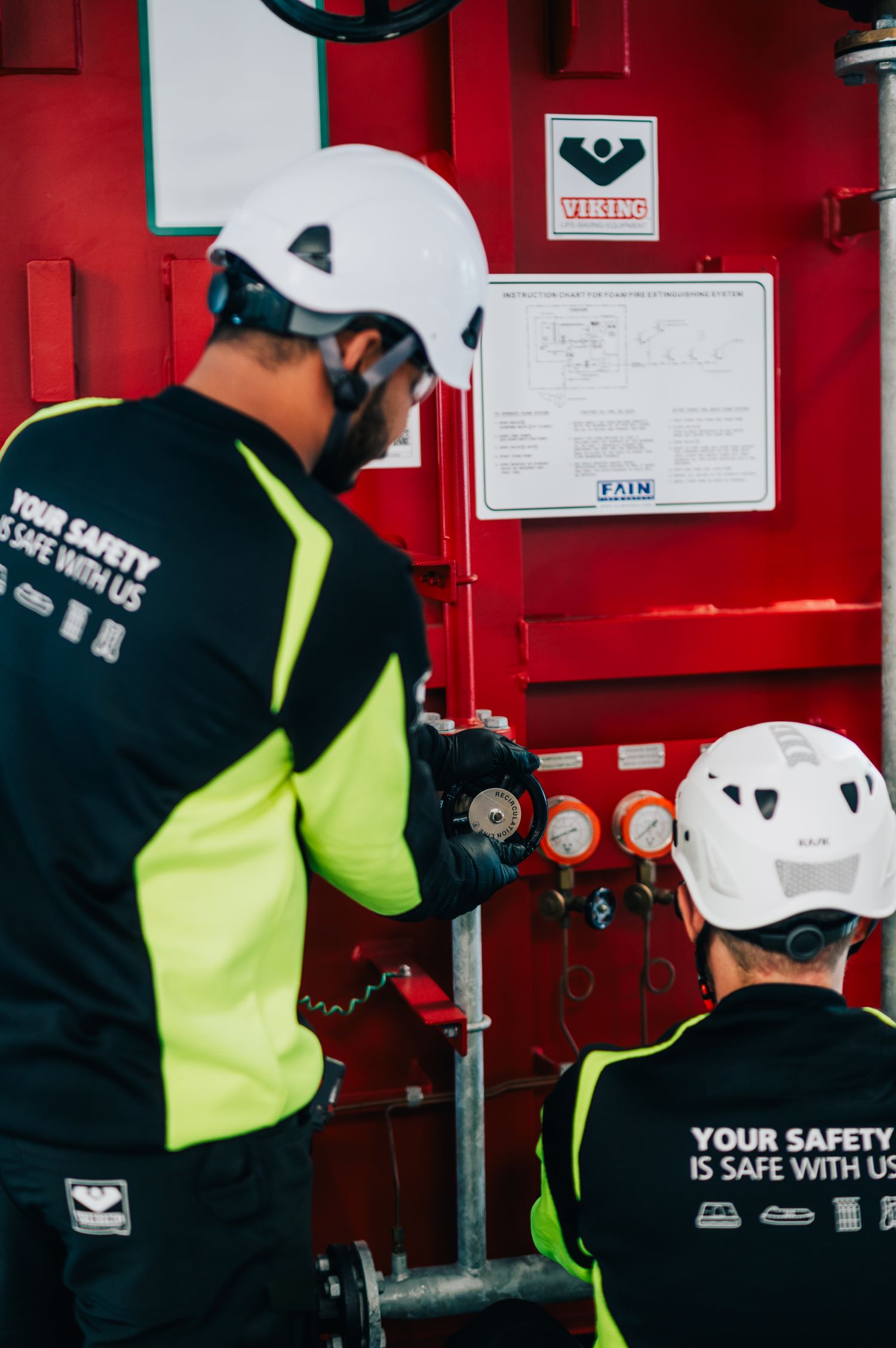
As a dedicated provider of marine fire service (MFS) expertise, VIKING Life-Saving Equipment stepped up its foam testing activities in early 2025 in anticipation of the coming IMO restriction. It has since completed around 600 compliance tests for ship owners covering PFOS.
With requirements in force, VIKING has shifted its focus as a service partner to implementing change. It has agreements with Dr. Sthamer and Fomtec - both with extensive experience as suppliers of synthetic fluorine free foam concentrate for marine applications.
Change management
VIKING has already overseen foam replacement projects in Asia, Europe and the Middle East across the offshore vessel, oil tanker and chemical tanker segments, and works with authorised partners to manage the chain of disposal for owners.
The accumulated experience has reinforced VIKING’s conviction as to the benefits of project management for ensuring drydocking scheduling and service provision coincides with on time foam delivery from a reputable source. A ship waiting for the right foam is losing earnings; technical shortcomings – for example on tank cleaning - may mean non-compliance; and ‘compliant’ foams from unproven sources can store up issues for later.
Feedback from VIKING customers in the first part of 2026 shows class inspectors paying particular attention to verifying that OEM declarations match foam application. Meanwhile, other challenges are fast emerging. In one recent case, an owner asked VIKING to check foams delivered to a newbuild for compliance purposes, only to find that while the foam had been compliant its supplier had since discontinued production.
ENDS
The opinions expressed herein are the author's and not necessarily those of The Xinde Marine News.
Please Contact Us at:
media@xindemarine.com