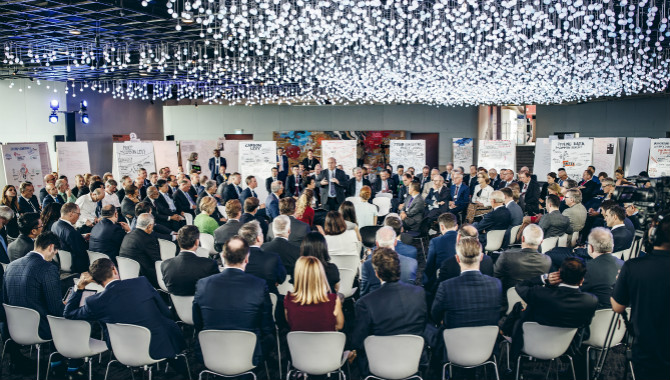
A new report summarizes the discussions that took place when more than 220 decision-makers convened for the Global Maritime Forum’s second Annual Summit in Singapore. Together, they identified collaboration as a key driver for positive change.
Copenhagen, 19 December 2019; It will require collaboration and bold leadership to meet new societal demands, improve the sector’s safety record, address climate change, reap the rewards of digitalization, and other shared responsibilities. That was the clear message when 220 decision-makers from across the maritime spectrum – and beyond – came together for the Global Maritime Forum’s Annual Summit in late October. Together, they identified collaboration as a key driver for positive change.
“As a platform for facilitating and driving multi-stakeholder collaboration, the Global Maritime Forum stands ready to work with those who are prepared to unleash the potential of global seaborne trade, and turn ideas generated at the Annual Summit – and the palpable optimism we experienced – into tangible solutions,” says Johannah Christensen, Managing Director, Head of Projects & Programmes at the Global Maritime Forum.
Shipping’s decarbonization is seen as a shared obligation
Intense discussions on shipping’s decarbonization showed that achieving the ‘at least 50% by 2050’ reduction target set by the IMO is seen as a shared obligation. Reaching the target will require an unprecedented level of collaboration across the entire global maritime value chain, as well as with the energy sector, with governments, and a range of other stakeholders.
“Participants discussed pressing questions around zero emission fuels and technology, how to de-risk first movers, and how to ensure commercial viability of zero emission vessels. As one working group’s proposal of introducing a global carbon levy of $75 per ton of CO2 from 2030 shows, there were no elephants in the room,” says Johannah Christensen.
Providing a safe work environment is a moral imperative
Improving maritime safety was another important topic at the Annual Summit. Providing a safe work environment is both a moral imperative and a key factor in attracting the talented seafarers of the future. Johannah Christensen comments:
“The discussions at the Summit focused on how the shared desire to improve safety can be translated into actions that will have a real impact. Among the recommendations in the report are visible leadership, an improved understanding of seafarer well-being and its relationship to safety, and improving data collection and sharing to deepen knowledge and drive change.”
The maritime sector can offer a compelling career path to the young generation
Attracting the right talent is a necessity for the industry’s long-term success.
“The maritime sector can offer a compelling career path to the young generation, especially as the industry is looking to improve safety, well-being and its environmental performance. Participants in our Annual Summit believe that the sector can be more visible and adapt the work environment and culture to better suit the aspirations of young people,” says Johannah Christensen.
In addition, participants stressed that it is important to ensure that the skills of the maritime work force are continuously updated to match technological developments, not least the rise of digital technologies.
Potential for improving efficiency through digitalization
Digital technologies and how they can drive improvements in efficiency across the maritime logistics chain was the fourth issue in focus at the Annual Summit. Johannah Christensen comments:
“While participants agreed that there is a large potential for improving efficiency and reducing waste through digitalization and data sharing, it was also clear that there are significant barriers that must be overcome if these benefits are to be reaped.”
Among the barriers identified are a lack of trust, a lack of standards to underpin data collaboration, as well as an often uneven incentive structure, where the stakeholders who benefit the most from the sharing of data, are different from the stakeholders who bear most of the costs.
The Global Maritime Forum’s third Annual Summit will take place in London on 13-14 October 2020.
The opinions expressed herein are the author's and not necessarily those of The Xinde Marine News.
Please Contact Us at:
admin@xindemarine.com